Not long ago, Toronto had an image problem. It wasn't because of anything negative -- on the contrary, Canada's biggest city was seen as just too "nice," and in the eyes of its top marketing brass, that's the kiss of death when it comes to competing for visitors and major events in a crowded marketplace.
"Our slogan used to be 'Toronto the Good,' and we spent a lot of time promoting our city as 'friendly and familiar,'" says Andrew Weir, executive vice president and chief marketing officer for Tourism Toronto. "That's all lovely and nice, but 'lovely and nice' are the absolute enemies of a desire to visit. We have to be something more than that."
Weir spoke during a recent meeting in New York City of destination marketing organizations and economic-development officials hosted by City Nation Place, which organizes events around the theme of "place branding," a term that has taken on greater importance amid the cacophony of the digital age. The importance of this concept to meeting planners is an evolving story.
Once it was assumed that a meeting venue was chosen based on prosaic factors such as hotel availability, venue space, airlift and overall cost. But with increasingly limited time and seemingly limitless events, today's participants might be more selective in deciding which meetings to attend. The perceived allure of a destination could play a significant role in boosting registrations; a blah image, on the other hand, could be a turn-off.
Social media has accelerated that trend, and it can complicate matters, as destination marketers have less control over their brands. Social media platforms such as Facebook, Twitter and Instagram can amplify negative news and tank a destination's image in a nanosecond. At the same time, social channels are perhaps the most effective outlets for DMOs to promote and spread their message to a wider and more targeted audience.
Does a destination's brand really matter to a meeting planner? Research says yes.
"When it comes to making a final decision, oftentimes the brand of a city -- essentially the perception that visitors have of the destination -- plays an important role," reads a report from consulting firm Marketing Challenges International, Social Media Marketing for Global Destinations in the Meetings and Conventions Industry.
In the case of Toronto, the city did, in fact, recast its message to convey more of an edgier, urban vibe with the tag line, "Canada's Downtown." An accompanying marketing and social media campaign highlighted the city's cultural offerings and diverse population with noteworthy nuggets like the fact that the city produces all official communications in 30 different languages, out of the more than 130 foreign tongues that are spoken by residents.
That message was picked up in numerous stories in print and digital media; today, Weir claims, it's unlikely anyone would dismiss Toronto as simply a blander version of New York.
The Art And Science Of Branding
Among the questions planners consider in selecting a site, according to the Marketing Challenges report, are: Does the destination offer rich culture and history? Is it known for any business industries or universities? Is it known for its cuisine, music, art or nature? Will visitors feel welcomed by the locals?
That last point is no minor matter for some destinations. Consider Amsterdam, where tourism is booming but locals have been increasingly outspoken about the effect of visitors on their quality of life. At press time, the city was planning to increase taxes on tourists by as much as 10 euros per night "to limit stag weekends...and reclaim the city for residents," according to an article in The Guardian. The response of the city's visitors bureau was notable in its simplicity: It banished the word tourists from its vocabulary. "We don't allow it," says Frans Van der Avert, CEO of Amsterdam Marketing. "We call them visitors instead."
Meeting-goers, of course, aren't technically tourists -- they'd be more in the camp of what Van der Avert describes as "quality visitors," which he defines as "a visitor who is not a nuisance for another visitor. They don't use the city as a backdrop for parties." Indeed, Amsterdam ranked seventh among the top 15 cities for international association meetings in 2016, per the annual tally by the International Congress and Convention Association, drawing 144 such events. It also is the third highest-ranked business city in Europe and renowned as a startup incubator.
"For business meetings, we want to have a very strong pro-business image,"
Van der Avert says, a point that is underscored in various media blitzes. Among other things, Amsterdam is revving up what he describes as a "huge Brexit campaign" -- in effect, capitalizing on the uncertainty over the impact of the British vote to leave the European Union. Many international corporations already are choosing to decamp from London, and Holland wants to get some of that action, he says. "We're telling them, don't go to Paris or Frankfurt, go to Amsterdam."
How Cities Tell Their Stories
Oscar Wilde famously said, "The only thing worse than being talked about is not being talked about." That resonates with many DMOs that know being ignored or misunderstood can be worse than enduring a spate of negative news, which can be overcome. Paris, for example, drew a record number of association meetings last year, winning the No. 1 spot on the top 15 list, despite the terror attacks of two years ago.
Following are others examples of destination-branding successes, along with strategies for promoting interest in a locale and drawing delegates, as discussed during City Nation Place.
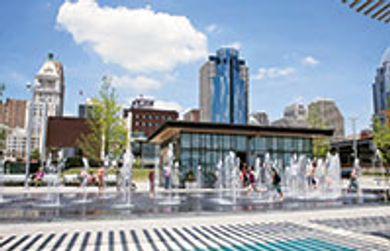 Cincinnati has wooed journalists to
give the city some positive publicity.
Cincinnati has wooed journalists to
give the city some positive publicity.• Define your identity. Cincinnati's dilemma could be summed up by just one fact: The city is in Ohio, but its airport is in Kentucky. "We sit on the cusp of three states; it's a 15-county region, and each one has a specific story," says Julie Calvert, executive director of Source Cincinnati, the marketing arm for the area. And while Cincy is home to some major corporate headquarters, like Procter & Gamble, "we weren't getting the traction we needed," Calvert says. "People weren't thinking a lot about Cincinnati."
To remedy that, Source Cincinnati organized a series of media visits and paired the visiting journalists with local influencers, depending on their specialty, under its "connectors" outreach program. It paid off in the form of 170 national placements in publications including the New York Times and National Geographic, resulting in 3 billion impressions -- worth almost $9 million in advertising value.
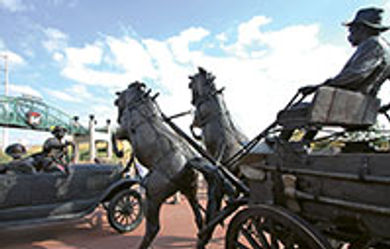 Visitors to Tulsa, Okla., get their kicks
on the heavily promoted Route 66.
Visitors to Tulsa, Okla., get their kicks
on the heavily promoted Route 66.Sometimes the aim is simply getting on the map, literally. "A lot of people don't even know where Oklahoma is," jokes Ray Hoyt, president of the Tulsa Convention and Visitors Bureau & Tulsa Sports Commission. But maybe they've heard of Route 66, which is now promoted as a campy visitor attraction that runs right through the center of town, and one that is evidently perfectly suited to Instagram, with its retro signage and roadside eateries. Tulsa has been working to distinguish itself from old cowboy clichés by focusing on its well-preserved examples of art deco architecture from its heyday as Oil Capital of the U.S., its sports teams like the Tulsa Oilers and its generally more liberal, cosmopolitan vibe.
• Play up the turnaround story. Promoting a city that's been through bankruptcy can be an uphill slog. "As everyone knows, we've had a lot of bad headlines in Detroit for a long time," says Olga Stella, who runs Detroit Creative Corridor, a group that promotes the city's burgeoning design scene. "When all of your earned media is negative, you've got to get creative."
As Detroit regains its stride as Motor City thanks to a rebound in automobile manufacturing, it hasn't been a huge leap to become a draw for innovators in design and technology, Stella says. A breakthrough came not long ago, when Detroit won the coveted designation as a "city of design" from UNESCO, the only U.S. city with that title. "It cemented Detroit's brand as a place for creative industries," notes Stella, and it's attracting like-minded conferences and events, such as AIA's annual design awards held at the Detroit Design Festival.
• Let brand ambassadors deliver the message. New York City has Taylor Swift; Los Angeles has the proverbial celluloid cast of thousands -- including the hit film La La Land, which has been used in numerous tie-ins by LA Tourism, the city's DMO. That particular deal took almost as long to bear fruit as the movie itself.
"We previewed an early script to see how we could leverage it," says Ernest Wooden Jr., chief executive of LA Tourism. Eventually, he sealed a deal with the Lionsgate studio to promote the film as an official tourism partner. "That's something that you can't put a marketing dollar price on," Wooden says, with some understatement, as the movie went on to win numerous Oscars. It also reaped the desired results for the DMO, says Wooden: In a survey taken shortly after the release, some 86 percent of people who'd seen the film said they felt more positive about the city, and 87 percent were more likely to go there as a result.
• Be quirky and hard to define. Yes, such qualities can be turned into a selling point, too. Just ask Jeff Miller, president and CEO of Travel Portland in Oregon, who represents a city that, among other things, is known as "where young people go to retire." From this hipster image, though, have sprung some novel promotional ideas, including a $4 million "Portland Is Happening Now" campaign several years ago that included a giant 25-foot-high cuckoo clock featuring hourly messages from city influencers like Tazo Teas founder Steven Smith.
"When you don't have an iconic landmark like the Space Needle or Fisherman's Wharf, you need to talk about the experience," Miller says. "We are selling the lifestyle of Portland." And that, perhaps more than any other quality, is what generates the buzz and grabs results in today's digital marketplace.