Video EXTRAs
Dicussing the New Face of Incentives
• Melissa Van Dyke, president of the Incentive Research Foundation, talks about how modern motivation is influenced by younger generations.
• Jeff Broudy, executive vice president of United Incentives, dishes on which countries will be the next big users of incentive programs.
As recently as this past December, few motivation professionals were confident that the battered incentive travel industry was on the rebound. Six months later, there's a palpable difference. New research and other indicators reveal an improved business outlook for U.S. firms, a need to recognize and reward a recession-weary work force, a marked increase in requests for proposal, program bookings for as far out as 2014 and a renewed interest in sending groups to far-flung destinations.
"Things are looking up, and people are feeling optimistic," says Mary MacGregor, vice president, account development, for Chicago-based BCD Meetings & Incentives and current president of Site, the association for incentive and travel professionals. "While no one is doing the 'happy dance' yet -- the past two years are still fresh -- there are a lot of reasons to feel good."
As the cloud that's been shadowing the marketplace lifts, now is a good time to take a fresh look at key influencers shaping motivation programs today.
Business on the rebound The improving economy bodes well for the resurgence of incentives, as U.S. companies look to their sales teams -- the traditional group for which programs are designed to motivate -- to boost revenues. At the same time, a growing number of firms are feeling a need to recognize the rest of their long-suffering employees.
Jim Ruszala, director of marketing for Fenton, Mo.-based Maritz Travel, points to a MetLife 2011 survey of employee benefits trends, which revealed one in three people are disenchanted or dissatisfied with their current position and plan to change jobs in 12 months. He says firms are taking note and looking to "re-engage the disengaged."
MacGregor agrees. "Talent management is a critical issue, especially keeping and engaging top performers," she says. "Firms may have felt they didn't need to invest in people as they had before the recession, particularly through sales channels, but that isn't true any more."
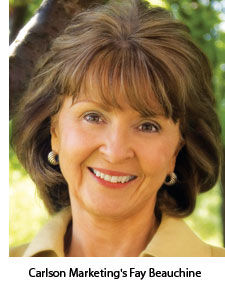 These market realities are translating to a significant bump for incentive firms and suppliers. "There is a euphoric feeling and enthusiasm; RFPs are triple what they were a year ago," says Fay Beauchine, CITE, president of engagement and events at Minneapolis-based incentive firm Carlson Marketing. For McGregor's part, "We have seen more 2012 and 2013 business booked earlier than we have in other years."
Jeff Broudy, executive vice president of Philadelphia-based United Incentives, says his firm is experiencing a solid rebound in 2011, both in the number of qualifiers for existing programs and new business.
"The general lift in the economy's confidence level has ended the hiatus some businesses took the past few years," says Broudy, who also is chair of the Incentive Research Foundation's board. "I believe that many companies saw the impact of halting their incentives and now want to get back on board, particularly in the dealer-distributor channel."
Today's programs While few programs today
feature the bells, whistles and budgets that characterized pre-2008
trips, the cuts that took place over the past few years -- to budgets,
group sizes, length of programs -- are holding steady, with little
change expected in the immediate future.
A February Site
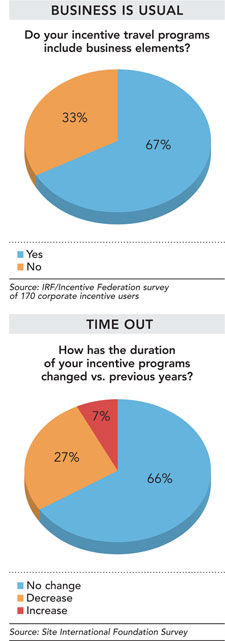
International Foundation survey revealed that 66 percent of respondents
anticipated no change to the duration of their incentive programs this
year vs. previous years. And 43 percent of respondents to the IRF's
latest Trend Survey expected program budgets to slightly increase in
2011 (industry estimates say 5 percent or less). "That really means the
budgets are flat, when you consider hotel and airfare increases," says
Maritz's Jim Ruszala.
Other notable trends:
• Going abroad. One key difference for programs in 2011 and beyond is a renewed interest in rewarding top performers with international trips.
Joe
Lustenberger, director of marketing, North American, for Euromic, a
consortium of 80 international destination management firms, is seeing
more requests for proposal, especially from clients Euromic has not
worked with during the downturn. Of particular interest, he says, are
destinations with new nonstop connections from U.S. gateways, including
Ireland, Hungary and Turkey.
BCD Meetings & Incentives also
is seeing a resurgence in international programs, with bookings in
European destinations such as London; Ireland; Prague, Czech Republic;
and Istanbul, Turkey, as well as South and Central America. "The world
has opened up a little more in past few months," says Mary MacGregor.
 Continuing trends
Among the incentive modifications that came about as a result of the
AIG effect and the recession is the addition of new program components:
corporate social responsibility and business sessions. And both of these
elements appear to be more than passing fads.
Continuing trends
Among the incentive modifications that came about as a result of the
AIG effect and the recession is the addition of new program components:
corporate social responsibility and business sessions. And both of these
elements appear to be more than passing fads.
• More meetings. According
to preliminary results of a joint IRF/Incentive Federation study,
two-thirds of respondents (170 corporate incentive users) include some
business or meeting element in their programs. These inclusions go well
beyond a meet-and-greet session with the top brass; now, companies are
incorporating sessions to introduce new products or to get feedback on
products and initiatives, as well as to solicit ideas from top
performers.
• Doing good deeds. Charitable components,
which can range from making gift boxes for overseas troops to renovating
dilapidated playgrounds for local children, are included in at least 25
percent of programs today, according to industry estimates. And their
use is expected to grow, says IRF president Melissa Van Dyke, who points
to the Global Workforce Study by Towers Watson that found corporate
social responsibility is the third most important driver of employee
engagement overall.
"People have passion for CSR and know they
are making a difference," says Ruszala. "Giving back is part of the DNA
for Generations Y and Z in particular." (Click here to view a free
M&C webcast on "CSR for Meeting Professionals.")
• Proving ROI.
Sources note a renewed focus on ROI or ROE (return on event). "It's a
silver lining that came out of the recession," says Carlson's Fay
Beauchine. As the majority of incentive programs are geared toward
increasing sales, ROI traditionally has been calculated based on whether
participants achieved their sales goals.
• Measuring loyalty.
Today, firms are using new measurements to determine "softer" ROI
factors, like employees' or distributors' loyalty to the company.
"They're being asked how they felt about the company before and after
the program, and how likely it is they will remain with the firm," says
Beauchine.
Social media Now that the
industry has stabilized, some forward-thinking pros are looking into the
next phase of incentive program design. In its white paper on incentive
trends for 2011, the IRF singled out several factors that will affect
the future of the industry. Among them are the use of social media and
the influence of games on learning and engagement.
• Facebook and beyond.
The types and uses of social media included in incentives are diverse.
"It can be trip photos downloaded to Facebook, creating apps for
smartphones that show maps of the hotel, or sending winners mobile
messages during the program to direct them to a 'surprise' gathering or
place where gifts are hidden," says Beauchine.
• How social?
Social media already is part of many programs, although estimates on
its use vary widely. Carlson Marketing puts the figure at 80 percent;
Maritz estimates 10 to 20 percent of its programs include some form of
it (with the numbers "growing fast"); and at Phoenix-based ADI Meetings
& Events, president Ann d'Eon says half of the programs her firm
organizes incorporate social media.
• Broadening the scope.
Jim Ruszala of Maritz sees clients using social media mostly in the
contest (qualifying) portion of programs. "It's the evolution of
communications," he says. "In the old days, we sent participants direct
mail and faxes. Then the web gave us a new dimension, and companies
created websites that were central clearinghouses for information about
the contest and the trip." Now, he says, the latest phase in contests
involves electronic program kickoffs, countdowns and leaderboards, so
participants can track their progress toward reaching their goal in real
time. Firms are creating apps for contests, too.
• Key caveats.
Though social media can be a great enhancement to programs, there are
potential pitfalls. "We still need to figure out how to use some
applications without liability" (e.g., posting photos of the program on
Facebook), cautions Ann d'Eon. She and other pros recommend that clients
consult their legal departments before posting pictures, videos or
comments online.
Introducing "gamification"
What's next? Innovative incentive planners are examining how the
popularity of electronic games like the Angry Birds app or Facebook's
Farmville can engage participants and influence programs.
• Growing interest.
Both Carlson Marketing and Maritz have few clients who already engage
in "gamification" -- incorporating gamelike elements into their programs
-- but interest is strong and growing. Michelle Pokorny, solution vice
president, employee engagement and recognition, at Maritz, says games
are becoming so popular because they tap into key human drives: the need
to acquire, defend, bond and create.
• Games participants play.
Maritz has several clients who use gamification to drive education and
engagement. Among the most popular methods are online scavenger hunts,
in which employees or sales-channel partners learn about new products at
different stages and earn virtual trophies and badges as they reach
different levels in the game.
American Family Insurance, based in
Milwaukee, developed its own version of Farmville last year to educate
consumers about its products. According to Karen Yee, field promotion
specialist at the company, the company is considering launching a
version of the game for its agents to help better increase their product
knowledge.