 Shrinking budgets are a fact of life for meeting professionals. In fact, they expect their meeting budgets to shrink by an average of 10 percent for 2010 vs. 2008, according to a May 2009 survey of 516 planners conducted by Ypartnership for the Professional Convention Management Association, the PCMA Education Foundation and American Express.
To help you trim your own event costs, M&C asked peers to share their penny-pinching ways. Following is a roundup of some tried-and-true trimming tactics for different meeting elements.
STAFFING
1. Hire local. Janice Petrelli, owner of the Jacksonville, Fla.-based event planning company Perfect Planning, makes it a point to cultivate freelance contacts around the country, and when possible uses workers who live within driving distance of the event. "This saves on airfare as well as hotel rooms," she notes.
2. Negotiate staff rates. "In our hotel agreements, we negotiate for staff rooms to be 25 percent off our group rate," says Jennifer Collins, CMP, president and owner of The Event Planning Group, based in Washington, D.C. "Given that staff remain in their rooms the least, we believe this is a reasonable request." For meals, Collins makes sure staff are included in food and beverage guarantees.
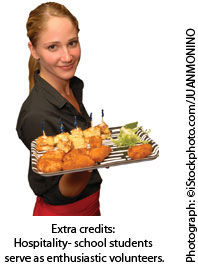 3. Enlist students. Terry O'Brien, a Chicago-based regional vice president for site-selection and meeting procurement firm Hospitality Performance Network, recommends hiring college students who require low (or no) wages and can count the experience working on your event as an internship. And at hospitality schools, students seeking careers in meeting planning or the hotel business usually are eager to help out on a volunteer basis or for a very modest fee. For more details, see "Calling All Volunteers."
4. Hire temps. Marianna Zaparyniuk, global special-events support manager for Dallas-based cosmetics company Mary Kay, says temporary workers can pack and distribute registration packets at events or check name badges or tickets at the doors. One temp agency with nationwide reach is Elite Staffing (800-423-5595; elitestaffinginc.com).
5. Work with DMOs. A number of destination marketing organizations (destinationmarketing.org) offer free staff assistance as a value-added measure. For example, the Northern Kentucky Convention & Visitors Bureau in Covington, Ky., provides free staffers based on a group's total room night usage.
GROUND TRANSPORTATION
 6. Get your money's worth. According to Shannon Hamm, director of sales for New Orleans-based Hotard Coaches, "Since most companies require a minimum amount of money to charter a bus -- usually equal to the cost of a five-hour charter -- I recommend that planners get the maximum use out of their motor coaches for that period by staggering the beginning and ending times of meetings and seminars at the event, which allows for fewer buses to be used for continuous shuttles, as opposed to transferring all the attendees at the same time."
7. Time the travel. "You should be able to cut costs on airport transfers by knowing exactly when your attendees are arriving," says Elise Kert, owner of Del Mar, Calif.-based meeting and event planning firm Corporate Meeting Concepts. This is because grouping arrivals together allows planners to use less equipment and staff. Kert notes that most attendees will not mind waiting at the airport an extra five or 10 minutes for transportation.
8. Track the changes. John Stachnik, DMCP, general manager of On The Scene, a Chicago destination management company, recommends that planners using a DMC for ground transportation keep close watch for any passenger flight itinerary changes, and contact the DMC immediately if such occur. "If you cancel a car early enough," says Stachnik, "you might avoid cancellation penalties."
9. Ask for flat fees. "I try to negotiate a flat fee per person, regardless of whether attendees will be in a motor coach, limo or minibus," says Kate McCaw, director of meetings and incentives for Summerville, S.C.-based Patriot Meetings and Management. "It's very difficult to project ground fees until everyone's air is booked, and it's a nightmare trying to budget without that information."
10. Go with an owner. McCaw adds, "It's smart to look for a ground transportation company that owns its vehicles, rather than leases them." Those that lease tend to mark up rates.
11. Let the bidding begin. "If a larger need for ground transportation exists, send an RFP through the local CVB," advises Dian Ginsberg, CMM, CMP, manager of events for the Tampa, Fla.-based Association to Advance Collegiate Schools of Business International. "I like to indicate key factors in the decision-making process, such as pricing, availability, condition of vehicles, etc." But most importantly, Ginsberg makes it clear that companies are bidding against each other, which encourages the suppliers to submit their best possible pricing.
A/V AND EQUIPMENT
12. Schedule smart. Ann Chitwood, co-owner of Brooklyn, N.Y.-based event planning firm LilyGild, reduces costs by working with clients on the most efficient scheduling of presenters. "Many times," she says, "those in charge of the agenda have not put much thought into the different needs of speakers. In some cases, just by shuffling room assignments, we have been able to eliminate days of A/V setups."
13. Stay in front. Bill Wulff, CMP, president of Fort Lee, N.J.-based Above the Rim Events, believes planners should not be married to a rear-screen projection setup. Says Wulff, "Front-screen projection with digital light processing systems allows for an amazing image with reduced staging costs." With a suspended front screen, there's no need to rent pipe and drape for the wings, as the screen can go right up against the ballroom or facility wall.
14. Go solo on screens. "For a large meeting where I normally would use two screens and projectors, I'm using one of each," says Annette Zarriello, CMP, CMM, meeting planner for the Durham, N.C., branch of Blue Cross Blue Shield. This saves money -- and helps keeps the speaker more focused on the audience.
15. Compare estimates. Midori Connolly, owner of the San Diego A/V production and staging company Pulse Staging and Events, says to ask potential meeting venues for estimated A/V rigging and power charges. "We have helped clients save thousands of dollars by comparing rates from venues," she says.
16. Use lights strategically. Jimmy Callahan, president and CEO of Boston-based production company JCALPRO, says, "Static lights, such as Lekos, can be used with a rotator and colored gels to give a similar look to a moving light -- but for less money."
17. Go for gobos. Callahan also recommends using textured or custom gobos (patterned light filters) to dress up the space without having to purchase banners or spend more on eye-catching décor elements.
FOOD AND BEVERAGE
18. Lower the bar tab. Cutting
down attendees' alcohol intake will lower costs dramatically, without
affecting the quality of the meeting. Replace a full liquor selection
with beer and wine, or provide a couple of drink tickets per person,
followed by a cash bar.
 19. Shrink portions. Michelle
Malloy, CMP, CAE, director of meetings for the Washington, D.C.-based
National Association of Regulatory Utility Commissioners, recommends
asking the hotel to provide smaller coffee cups. "The small ones work
out to be 20 cups per gallon," she says. "The next option up is coffee
mugs, or 16 per gallon. We ask them never to use the cardboard cups,
which can offer as few as 12 cups per gallon."
19. Shrink portions. Michelle
Malloy, CMP, CAE, director of meetings for the Washington, D.C.-based
National Association of Regulatory Utility Commissioners, recommends
asking the hotel to provide smaller coffee cups. "The small ones work
out to be 20 cups per gallon," she says. "The next option up is coffee
mugs, or 16 per gallon. We ask them never to use the cardboard cups,
which can offer as few as 12 cups per gallon."
20. Serve beverages in bulk. During
refreshment breaks, try using pitchers of fruit punch, iced tea or
lemonade, instead of individual bottles or cans. That way, attendees
imbibe only what they want, and planners aren't stuck paying for each
can that's opened.
21. Ban water bottles. Filtered tap water at water stations is eco-friendly and saves money.
22. Skip breakfast. Begin the morning sessions a bit later so attendees are responsible for their own morning meals.
23. Go cold. If
you offer breakfast, eliminate cooked fare in favor of cereals, breads,
yogurt parfaits, etc. This saves up to $7 per person, says Charles
Massey, CMP, CEO of West Hollywood, Calif.-based Synaxis Meetings &
Events.
24. Go liquid. Morning and afternoon breaks can be limited to drinks only.
25. Save dessert for later. Ask
your hotel or caterer to serve the dessert originally planned for lunch
during the afternoon break, suggests Kathy Norris, CMP, CMM, meeting
planner for Blue Cross Blue Shield of North Carolina.
26. Query the chef. "Throw
away the banquet menus and work directly with the chef whenever
possible," says Jane Matteson Mundell, CMP, senior meetings manager for
the Lincolnshire, Ill.-based Association of Legal Administrators. "I
have found that by being very up-front with my budget numbers, I can
get wonderful recommendations from the person who really knows what is
available and affordable."
27. Dine in. Hotels want to
keep groups under their roof as much as possible and are willing to
negotiate. If you bring a group to the hotel restaurant, ask for
special pricing.
28. Ask for more incentive to stay put. Perhaps
the property will include a free cocktail party, coffee break, etc., if
you agree to keep all or most meal functions for the event on-site.
29. Order hotel food to go. As
Kate McCaw of Patriot Meetings and Management found, many properties
will try to keep your business even when you hold a meal function
off-site. She arranged for a resort to cover the cost of an off-site
venue rental and split the transportation expenses for an event the
property catered.
SPEAKERS/ENTERTAINMENT
30. Enlist home-grown stars. Use
local talent to cut down on speaker, entertainment and travel costs. A
local university is a good source. Mary Lou Beagan, program coordinator
for the University of Rochester (N.Y.) Medical Center's Internal
Medicine Residency, often taps the resources of her university, which
include two music schools and a regional theater. A local DMO
(destinationmarketing.org) can help find free talent.
31. Scour the D-list. Alison
L. Huber, communication specialist and event planner for the Madison,
Wis.-based Wisconsin Association of School Boards, suggests hiring
speakers who have not quite made it to celebrity status. They are
cheaper but no less inspirational.
32. Recruit from within. Tap
the CEO or other top executives from your organization as speakers.
They are not only free "talent," but their very presence often can
provide assurance and motivation to the audience in rough times.
33. Milk professional contacts. If
you're a member of an association, look for speakers within your
membership, says Michelle Malloy, and get a "professional courtesy
discount."
34. Get greater value. Brian D. Palmer,
president of the Libertyville, Ill.-based National Speakers Bureau,
suggests trying to get more than just a speech from a speaker. "Ask him
to do a breakout session as well, or to include some of his own
learning materials."
35. Add a virtual element. Deborah
Smith, president of the Deborah Smith Group, a bureau based in
Brookline, Mass., suggests asking talent to educate attendees via
social media channels, as a supplement to the presentation. "Some
speakers are willing to add a pre- or post-conference webinar on a
topic like social networking, as it requires more in-depth
explanation," she says.
TEAM BUILDING
36. Help the community. Charitable
team-building events tend to cost less and create stronger bonds
between co-workers. For example, cleaning up a public beach or park can
cost less than $100. A local DMC can help.
 37. Stay on-site. A
simple way to save some cash is to keep activities on the premises,
provided your organization has the space. "We have a lovely lawn
outside our headquarters building," says planner Kathy Norris of Blue
Cross Blue Shield of North Carolina. "Departments have used it for
various sports, followed by a picnic lunch."
37. Stay on-site. A
simple way to save some cash is to keep activities on the premises,
provided your organization has the space. "We have a lovely lawn
outside our headquarters building," says planner Kathy Norris of Blue
Cross Blue Shield of North Carolina. "Departments have used it for
various sports, followed by a picnic lunch."
38. Split the day. Planners
can save by sharing the expense of a venue rental, says Joan Rothbard,
event planner at Recreation Picnic Service based in Livingston, N.J. "A
pharmaceutical planner can partner with another in a related field,"
she posits. "One group can use the venue in the morning and the other
in the afternoon."
39. Streamline the program. Sharon E.
Sullivan, president of Sullivan Custom Planning, with three offices in
Rhode Island, says elaborate theme parties with expensive bands and
open bars can be replaced by shorter, low-cost affairs, like large
scavenger hunts or team cooking events held on-site.
40. Recycle equipment. Some
team-building events require extra cost for equipment. For example,
Rothbard explains, when putting together her company's cardboard boat
regatta activity, in which participants build and race cardboard boats,
materials must be purchased for every event. But for activities like
speed stacking, which requires plastic cups, a timer and a bit of
teamwork, all you pay for is the labor. And reusing supplies cuts down
on waste -- an added bonus for planners looking to go green.
TRADE SHOWS
41. Drive to save on shipping. If
the show is within reasonable driving distance, Synaxis' Charles Massey
recommends renting a small truck, like a U-Haul, for transporting
stands, exhibit materials, brochures, giveaways, etc.
42. Use budget-friendly badges. Recycle
plastic name-badge holders and lanyards after each event (have
volunteers collect them or set up a well-marked drop-off bin). Better
yet, eliminate the cost of holders completely by using name badges that
don't require them, such as TempBadge from PC/Nametag (pcnametag.com).
43. Decorate strategically. Instead
of decorating the entire ballroom, only drape the front of the room,
and make it outstanding. "If you have a focal point, that's what guests
will see when they walk in, and that's what they will remember," says
Charles Massey.
44. Rent to own. Custom booths can be
costly; try renting displays instead. Some exhibit houses offer rewards
programs that allow customers to apply part of the money they've spent
on rental toward the purchase of the display at a later date.
45. Buy bags in bulk. When
purchasing booth bags, consider how many shows you'll use them at
annually and how many attendees each show attracts, rather than
ordering them separately for each show. You'll get the best price when
you buy in larger quantities, as well as reinforce your company image
and brand by using the same design on all your trade show bags.
DÉCOR
46. Use colored linens. Ask
your caterer or venue to use house table linens, rather than ordering
custom linens from rental firms. Michael Cervelli, president of special
events for Carlstadt, N.J.-based Total Entertainment, says most
suppliers do stock colored linens, in addition to ivory and white, and
typically will provide them for no additional cost.
47. Use the right lights. If
you don't have the budget for fine linens, crystal stemware, fancy
centerpieces, etc., give tables a "pop" by using a technique called
pin-spotting -- tiny overhead lights aimed directly on the table that
provide all the elements of an elegant 3-D effect, Cervelli says. The
cost usually runs about $15 per table.
 48. Make dessert a focal point. Save
thousands of dollars by substituting pricey floral arrangements with
tiered dessert trays laden with nonperishable sweets to be eaten at
meal's end, suggests Barbara Trejo, manager, conference planning, for
St. Louis-based Ascension Health.
48. Make dessert a focal point. Save
thousands of dollars by substituting pricey floral arrangements with
tiered dessert trays laden with nonperishable sweets to be eaten at
meal's end, suggests Barbara Trejo, manager, conference planning, for
St. Louis-based Ascension Health.
49. Furnish frugally. Instead
of renting furniture for a pre- or postfunction lounge, ask if the
property has couches and comfy chairs that can be moved to your meeting
area to make cozy conversation nooks.
50. Skip the print. "Most
guests leave their event program at the table," notes Michael Cervelli.
To cut costs, he recommends creating a digital journal of sponsors that
can be projected on screens throughout the event. Afterward, add the
link to your organization's website, so sponsors get even more
exposure.