Who's Consolidating?
Trade show organizers in a wide range of industries are experimenting with mergers or colocated events as a way to increase value to their members. A few recent examples:
The Wisconsin Jewelers Association canceled its Midwest Jewelry Expo to join forces with a new launch, The Instore Show, which debuted in Chicago in April.
The American Association of Physics Teachers and the American Association for the Advancement of Science produced a joint Winter Meeting in Chicago in February.
The Institute of Food Technologists and the Food Processing Suppliers Association will colocate their annual expositions -- which typically attract 18,000 and 10,000 people, respectively -- next year in Chicago.
The LA International Textile Show will colocate with the Material World & Technology Solutions at the California Market Center this fall, to "eliminate market confusion and bring together an unprecedented international product and service resource that promises to become the must-attend event for the sewn products industry," according to Tim Von Gal, president of Material World & Technology Solutions.
Hanley Wood Exhibition's The TFM Show for facility management professionals colocated with Construct2009 for the first time in Indianapolis in June.
In the U.K., the Bible Society's National Christian Resources Exhibition absorbed the Christian Booksellers Convention in May.
 In fall 2007, after two years of research and deliberation, the Dental Trade Alliance unveiled an unusual manifesto that called for a voluntary overhaul of dental exhibitions. An association of manufacturers and distributors of dental equipment and supplies based in Alexandria, Va., the DTA felt its members were being drained by an industry that produced 167 meetings with trade shows annually in the United States alone, or one show for every 1,200 practicing dentists.
"The Dental Trade Alliance has concluded that the current model for dental meetings and exhibitions in the United States is no longer efficient or effective," the position paper began. Trade shows were too expensive and too long, and attendance was slipping, the paper argued. Too many meetings were poorly organized and held in uninspiring locations, and organizers were not reaching out adequately to young professionals. The paper contended that only dental shows that attracted more than 5,000 dentists provided maximum return on investment for exhibitors and attendees. "Therefore, the trade strongly endorses a nationwide consolidation of dental meetings, so that each meeting meets the 5,000-dentist target." At the time, only about 10 dental events in the U.S. were that large.
Not wanting the paper to be empty rhetoric, the DTA delivered concrete proposals and initiatives for the industry to consider. The alliance detailed a list of attributes that contribute to worthy exhibitions, urging organizers to adjust their meetings accordingly (see "Anatomy of an Ideal Dental Meeting"). The DTA also promised to start rating industry trade shows, based on a combination of exhibitor surveys and empirical metrics such as attendance, drayage costs and amount of time dedicated exclusively to the exhibition without competition from educational programming -- a process begun this past January.
Recognizing that associations often use exhibitions to generate nondues revenue, the alliance also pledged financial assistance to groups that choose "to encourage the merger of smaller dental meetings into larger, regional meetings that better fit what today's dentist and dental company demands."
The DTA is unique in taking this aggressive stance for self-regulation, but it's hardly alone in thinking that must-attend megashows are the way of the future. Trade show organizers across all industries are coming to similar conclusions: To stay competitive in crowded marketplaces, they need to merge exhibitions or partner with organizations to produce joint meetings.
"I do think that in this economy, travel budgets have been tightened, limiting the number of conventions individuals can attend," says Jackie Williams, executive director of the Society for Nutrition Education, based in Indianapolis. The SNE collaborated with the Institute of Food Technologists in Chicago in 2007 to produce a single exhibition while each organization held its own meeting in the city.
A few notable examples of show consolidation include:
• The Professional Convention Management Association, which is poised to colocate annual conferences with the Association of Corporate Travel Executives as part of a strategic alliance announced in June (see Newsline);
• InfoComm and the National Systems Contractor Association, which merged their exhibitions last year to "save industry professionals time and money by offering everything they need under one big roof";
• The Newspaper Association of America, which this year replaced two of its conferences with a single event, mediaXchange; and
• Messe Frankfurt GmbH, which will colocate its new Texprocess exhibition with the well-established Techtextil beginning in 2011 to create "a textile powerhouse" where "manufacturers have the chance to make contact with twice the number of potential customers while visitors benefit from a much bigger and optimized range of products and services."
The concept of partnering to increase value isn't new, but John Graham, president and CEO of the Washington, D.C.-based ASAE & The Center for Association Leadership, says show consolidation has picked up recently, along with outright mergers of associations. "Companies that belong to multiple associations are taking a hard look at dues expenditures," he notes. "When you have multiple players in the same space in a vertical industry, companies are saying, ‘We really can't afford the luxury of two associations.' "
That attitude is true of meeting attendance, too, Graham says, which along with everything else is forcing associations to reevaluate what they offer their members and how they run their organizations and their meetings. Graham doesn't agree that only the largest events will be viable going forward, but he does allow that if two trade shows serve largely "the same customer base with the same companies exhibiting at both shows, then yeah, I think the industries are better served with fewer shows."
Anatomy of the Ideal Dental Meeting
While calling for a consolidation of dental conferences, the Dental Trade Alliance outlined the components of what it considered a model event.
 Size
Size Industry meetings should attract a minimum of 5,000 dentists and support staff. Larger shows will offer more to attendees and give exhibitors the critical mass they need to deliver ROI.
 Schedule
 No show should be longer than four days, with exhibits open for no more than three days. Exhibits should run Thursday to Saturday, with no half days, and education should be offered after the last day of the exhibition.
 Location and facilities
Meetings should be held only in major cities that have hotels near the convention center or in "highly desirable resorts with reasonable proximity to major airports and highways."

Traffic and purchasing incentivesOrganizers should encourage traffic and transactions on the show floor, by setting low registration fees, for example, giving rebates to those who buy at the show and holding contests on the show floor.
 Education
Continuing education sessions must not compete with activities on the trade show floor but should be held nearby. Free sessions should be held on the floor itself, and presentations should be interactive.
 Entertainment
"Memorable after-hours entertainment is key to attracting attendees, especially younger dentists." And making the show experience engaging for the younger generation is key to sustainability.
 Metrics
Show organizers should be able to provide detailed, reliable statistics such as the number of attendees by demographic, lead generation at the show and how much time attendees spend on the show floor.
Illustrations (except dollar sign): istockphoto.com Dental groups respond
The DTA's paper,
which was released more than a year and a half ago, has yet to affect
much change in the industry. "Most dental show organizers agree there
are too many shows," says Fred Freedman, director of marketing for the
DTA, who wrote an early draft of the paper. "But none of them wants
their show to be the one to go."
Freedman also contends it's
still early to see results: "A lot of shows are wired in two to three
years out." But no mergers along the lines of the paper's
recommendations have been announced.
There have been a few
"cheap wins," Freedman notes. The Chicago Dental Society, which was
reshuffling its 2010 Midwinter Meeting anyway, discovered that the
meeting's new dates satisfied the DTA recommendation that trade shows
run three days, beginning on a Thursday -- and the CDS publicized that
fact. The American Dental Association, complying with another DTA
suggestion, will book only top-tier cities for its exhibitions,
eliminating from its rotation the likes of Kansas City and
Philadelphia. "We are aware of the challenges that a large meeting
faces in smaller cities," says Marisa W. Goldberg, manager of
exhibition and sponsorship sales for the ADA.
Goldberg chooses
her words carefully when discussing the DTA paper, generally agreeing
with its guidelines -- the ADA's annual conference already implements
most of them -- but she adds that some smaller events are
indispensable. "We appreciate the need for dentists to have continuing
education opportunities close to home and, in some cases, that means a
smaller show," she says.
Shannon McCarthy, director of sales for
the Massachusetts Dental Society (MDS), says the alliance's call for
mergers makes sense: "We realize exhibitors are being spread too thin."
At the same time, she notes, "It's tough for the DTA to make that
statement. They're trying to support their members, but it's not quite
that easy." Associations all need to prove their value to members, and
organizing trade shows, even small ones, is a way that groups do that,
McCarthy notes.
The main meeting of the MDS, known as the Yankee
Dental Congress, is a model of the type of consolidation the DTA
endorses. A joint meeting for dental societies from all New England
states, the YDC attracted 26,000 attendees in January and is one of the
largest dental meetings in the country. Additionally, McCarthy says the
MDS is negotiating with two other organizations to fold their shows
into the YDC. "With the economy where it is, it's in everyone's best
interest to work together," she says.
On the DTA scorecards,
Fred Freedman says that, so far, trade shows have received higher marks
than he anticipated from exhibitor surveys, which he attributes to low
expectations exhibitors have going into dental shows in the current
economy. But the results could help explain why so many dental shows
have managed to survive, despite widespread agreement that the dental
meetings industry is oversaturated: Exhibitors still manage to have a
positive experience at trade shows, even if they wish they didn't
attend so many.
As for financial assistance for consolidating
meetings, Freedman says the DTA still is willing to provide education
grants or other kinds of sponsorships to groups that consolidate
meetings, but so far there haven't been any takers. Freedman points out
that the DTA is bound by antitrust laws, which limit what the alliance
is able to initiate.
Society Teamwork
 One of the shining examples
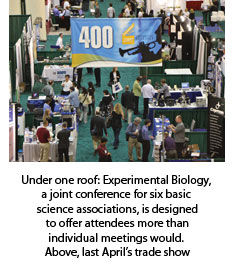
 of meetings collaboration is Experimental Biology, a long-running joint conference for basic science associations that attracted 10,000 people in April in New Orleans. The convention is organized out of the Office of Scientific Meetings and Conferences, which is a department within the Federation of American Societies for Experimental Biology. FASEB has been producing joint meetings for associations since 1912; its major annual conference was reborn as Experimental Biology by six FASEB member societies in the early 1990s.
Experimental Biology has a guiding governance document and a board of directors. Each society appoints a representative to the show's management committee, but the OSMC has its own staff that handles meeting logistics.
Individual societies pay for their own scientific sessions and presenters, while the meeting organizers have a budget for basic costs such as meeting space. Revenue is shared according to a formula based on attendance (the American Association of Anatomists gets credit for all anatomist attendees, for example) and the number of abstracts each society's members submit. Attendees pay a single registration fee.
Dr. Martin Frank, executive director of the American Physiological Society, says the multidisciplinary nature of the meeting "enhances opportunity for discovery," and the aggregation of sessions allows for the creation of robust education tracks in areas such as professional development and the teaching of science. Intersociety politics don't get in the way; Frank says scientific associations choose to organize their meetings in generally the same manner, anyway.
Other mergers
Consolidation can take many
different forms and serve a variety of purposes. Typically, trade shows
that are under some kind of duress -- reduced budgets, slipping
attendance or dwindling sponsorships -- will partner with larger shows
to remain viable. "Almost every time this occurs, it's driven by
economic factors," says ASAE's Graham. Groups can merge or colocate
exhibits, either by holding full, concurrent conferences or by
presenting a pavilion within a larger show. Motivations to collaborate
include increasing brand exposure, saving money, reducing competition
for attendees and supporters, eliminating repetition from the show
calendar and creating one-stop marketplaces for industries.
Other
times, organizers will streamline two or more of their own events into
one. Microsoft, for example, recently announced it was consolidating
its Office Developer Conference with its SharePoint conference in
October. "By adding the ODC track to the 2009 SharePoint conference, we
can provide better exposure to those seeking to develop solutions
across the platform," Microsoft announced on its website.
For
the Milwaukee-based Association of Equipment Manufacturers, however,
joining forces with existing shows is an integral part of its global
growth strategy. "The AEM trade show model is to reduce the number of
shows and increase value to the industry," says Megan Tanel, vice
president of exhibitions and events. When entering new markets, "we
work on consolidating events out there," she says. AEM searches for
local partners with existing meetings, or organizations with local
contacts who want to launch a joint show, instead of going to market
with competing exhibitions. Tanel says AEM always has worked hard to
develop relationships with kindred organizations around the world, but
now people are more willing to negotiate.
 AEM's experience in
China is a case in point. The association wanted to enter the Chinese
market and sought collaboration from Chinese organizations that already
had exhibitions in place, but never could work out a partnership
agreement. Instead, AEM launched CONEXPO Asia in 2006. But the thought
of merging persisted, and this year, AEM announced it would cease
CONEXPO Asia and instead dedicate resources to support two existing
shows, Bauma China and BICES (Beijing International Construction
Machinery Exhibition and Seminar). Launching a successful show helped
AEM build credibility in the marketplace, Tanel says. "We got what we
needed. Now we have a voice for the manufacturers in the industry, and
we extended our branding."
AEM's experience in
China is a case in point. The association wanted to enter the Chinese
market and sought collaboration from Chinese organizations that already
had exhibitions in place, but never could work out a partnership
agreement. Instead, AEM launched CONEXPO Asia in 2006. But the thought
of merging persisted, and this year, AEM announced it would cease
CONEXPO Asia and instead dedicate resources to support two existing
shows, Bauma China and BICES (Beijing International Construction
Machinery Exhibition and Seminar). Launching a successful show helped
AEM build credibility in the marketplace, Tanel says. "We got what we
needed. Now we have a voice for the manufacturers in the industry, and
we extended our branding."
The details
When considering a merger, groups will have to address a number of issues first.
Income and expenses.
It's vital to determine how groups will share revenue and cover
expenses for a joint meeting, says ASAE's Graham. A 50-50 split won't
make sense in all, or even most, situations, because exhibitions being
merged are rarely identical in size, and often one group stands to
benefit more from a joint show than the other. Are the financial
obligations and rewards proportionate to the risks involved for each
group? And even if associations agree on how to share planned expenses,
who will cover unanticipated expenses?
Marketing.
Responsibilities for the promotion of the show -- from a financial as
well as a creative and a logistical standpoint -- are important to
delegate up front, Graham says.
Timing. If the shows
being consolidated do not ordinarily occur at the same time, the
ability to compromise on new dates could be a deal breaker, says the
Society for Nutrition Education's Jackie Williams. For example, members
of the SNE tend to be professors, who prefer to meet in the summer, she
notes. If SNE ever held a joint show -- a possibility being explored --
Williams says the new event would have to take place in the summer to
make sense for her members.
Program division. Williams
adds that another sticking point is how to divvy up the joint meeting
program. Will groups each be responsible for their own education
sessions? If so, will both groups' sessions run concurrently, or will
each group get its own day or portion of a day for sessions?
Exit strategy.
One of the great things about mergers is they don't have to be
permanent, notes Frank Hackett, executive director of the National Auto
Auction Association based in Frederick, Md., which will combine its
Spring Business & Quad Zone Meeting with the Conference of
Automotive Remarketing beginning next March. "You can always go back,"
he says. But to avoid headaches, groups should anticipate the
possibility of a breakup when they are joining forces. Under what
circumstances can one party pull out of the joint show? Who retains the
rights to the show's brand, format and programming elements? If a group
decides to back out of a merger, will its organizers be allowed to
launch a competitive event immediately?
Pride. There
are a lot of individual egos as well as institutional pride at stake
when consolidating meetings, and the clash of personalities can make
mergers difficult to pull off. "The most important thing is mutual
trust by the people at the top," Hackett says. "If leadership trusts
each other, it makes it a lot easier."