Getting Tough on CME
A report released in April from the Institute of Medicine is calling for more detailed disclosure of relationships between doctors and pharmaceutical and medical device companies. The report, by the institute's Committee on Conflict of Interest in Medical Research, Education and Practice, recommends that a method of disclosure be standardized for the entire industry and that Congress should require health-care companies to report, on a national public website, any payments or gifts they have given to health-care providers.
As for continuing medical education, the report finds that "the current system for financing CME relies too heavily on industry support and needs to be overhauled," and warns if more regulation is not enforced, state policy makers will act. For more information on the report, visit
iom.edu/conflictofinterest.
 Planners struggling to adapt to new levels of scrutiny and shifting regulations can take heart knowing that a niche group of peers has been coping with such challenges all along and has valuable lessons to share. M&C asked two meeting professionals with extensive experience in the medical/pharmaceutical realm for some advice on what meeting planners for any type of organization can do to cope and excel in these tumultuous times.
Forge bonds with procurement and legal
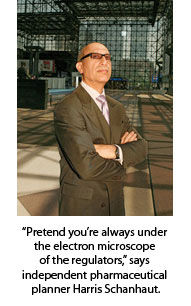
Accountability is key when all eyes are on you, says Harris Schanhaut, CME (www.effectiveevents.web.officelive.com), a New York City-based independent pharmaceutical planner with more than 25 years of experience. "Pretend you're always under the electron microscope of the regulators," he advises. "If you don't have a close relationship with your procurement and legal departments, now is the time to start one. They have a much better pipeline when it comes to tracking and keeping up with regulations."
And if your gut says something might be off, don't take a step without first checking with either department.
Be prepared to plan on the fly
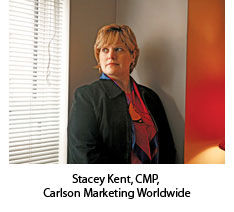
With lead times shrinking, planners are finding themselves doing more at the last minute, something medical meeting organizers are well versed in. Stacey Kent, CMP, director of congresses and conventions for New York City-based Carlson Marketing Worldwide, has worked in medical education for nine of her 24 years as a planner. "It's a very moment-by-moment audience," she says of the attendees in that specialized niche. "There are a lot more variables. You're planning by the seat of your pants."
Having three weeks to plan a meeting isn't considered uncommon in the pharmaceutical industry, Kent says, and the most important weapon you can have is an on-their-toes staff.
"As long as you have a solid group of smart, rational planners, it can be done," she notes. "It's hard to do it with people who are scattered or working for other departments at the same time. If you're lucky enough to work with dedicated people and a solid software database, you'll hit it out of the park."
Kent also advises meeting planners to stay focused and try to keep their emotions at bay in times of stress. "Don't get flustered," she says. "Go with the flow and don't analyze everything. Just make it happen."
Establish watertight rules; keep airtight records
Under rules such as the PhRMA (for Pharmaceutical Research and Manufacturers of America) and AdvaMed (for Advanced Medical Technology Association) codes that medical meeting planners must follow, dinners and entertainment at continuing medical education conferences are strictly regulated and often forbidden, depending on the precise circumstances.
Schanhaut believes it is a good idea for any firm to institute its own similar code of restrictions to ward off any unwelcome scrutiny. "When companies adopt such guidelines early, it will serve to their benefit," he notes. "Back when I was working for American Express, the rules were you couldn't give a customer a gift worth more than $100 more than once a year. Most companies don't specify that. American Express took the bigger stance."
Meetings departments also should keep up-to-date databases, and planners should, in effect, act as their own auditors, says Schanhaut. "Keep as many detailed records as possible," he emphasizes, "especially financials, from every source." And, he adds, don't expect a reward for your efforts. "Let's face it, you don't hear about ethical companies getting gold stars -- you only hear about unethical companies getting into a lot of trouble."
States Step In
 As scrutiny of the relationship
 between health-care providers and pharmaceutical and medical device companies grows ever more intense, a growing number of states are instituting new laws to regulate the industry.
In July, a Massachusetts rule will go into effect that eliminates any gift or payment from a drug or device company to a health-care provider. Earlier, worry had set in that the rule also would ban presentations by drug company doctors and scientists, essentially scrapping a large source of sponsorship for meetings. But in March, a plea from Patrick Moscaritolo, president and CEO of the Greater Boston Convention & Visitors Bureau, was heeded, and regulations were revised to allow sponsorships at medical meetings. The CVB recently updated its website (
bostonusa.com), complete with a planner FAQ.
 Communicate gently and frequently
While in the process of planning meetings under PhRMA guidelines, Kent says the most important tool to prevent mishaps is communication. "There's a lot of double-checking and triple-checking" of the rules, she affirms, quipping that in the rarefied medical realm, "you can't even give someone a complimentary pencil anymore."
Kent says planners should be flexible and diplomatic when working with clients -- and raise any issues of concern as they arise. "Much of this scrutiny might be frustrating and unwarranted, but people have to take it in stride. Communication is paramount."
Spell out the reasons for meeting
Draw up a business objective before you even begin the planning stage.
"Just as a manufacturer sets up a new product line to produce and draws a detailed cost-benefit analysis, the same process should be set up for a meeting," says Schanhaut. Among the factors to consider: "Planners must keep the organization's mission statement in mind, along with the human investment required."
When practical, go virtual
When planners put together meetings for physicians, they have to keep in mind how difficult it often is to pull attendees away from their busy medical practices and needy patients.
Lately, webcasts have been a good choice for some of Stacey Kent's clients. "We're leaning more toward implementing webcasts for doctors to learn about new drugs," she notes, adding that virtual meetings increasingly are being substituted for taking doctors out to dinners at swanky steak houses.
Kent says virtual continuing medical education is much more convenient, allowing doctors to sit at their desks and learn about a new drug or medical device right at their own computers.
"I think for financial and accounting meetings, this could be a new option," Kent notes, adding that webcasts are especially effective for educational practices that need to be shown and demonstrated.