(Pictured) Attendees gathered for a presentation at the Hub Stage at the Direct Marketing Association's rebranded annual show, now called &THEN, held in October in Boston.
When London-based consultancy Brand Finance unveiled its annual ranking of the world's most powerful brands this past February, a surprise winner emerged. Lego, the Danish toy maker of colorful plastic blocks, was crowned best brand in the world, knocking the reigning champion, Italian automaker Ferrari, off its pedestal.
How this 83-year-old, family-owned company outmaneuvered high-profile global firms like Nike, Red Bull and Rolex is a testament to its strong brand identity and ability to evolve in a dynamic and competitive marketplace. According to trade organization Brand Identity, Lego hit all the right branding buttons in key factors such as consumer familiarity, loyalty, promotion, staff satisfaction and reputation.
Meetings and events, too, can live or die by the effectiveness of their branding. Planners can take a few lessons from the effective strategies of experts, as well as brand-savvy peers.
The power of branding
When thousands of people gather in a space, the atmosphere has to be just right. Visuals, lighting, sounds and colors all should create an excitement that makes attendees feel they made the right choice to spend the time, money and effort to be there. But branding efforts should begin in the initial planning stages of the event.
Even then, an eye-popping logo, a cool name and a killer website are not the sum total of what it takes to create a brand for any professional event, says Matthew Shaw, co-founder of London-based branding and web-design agency Shaw + Skerm. The agency is the branding brains behind many of London's most high-profile professional campaigns and events, including Go/Fence, from British Fencing, which wants to shift people's perceptions of the sport as elitist, and Cloudforce, San Francisco-based Salesforce.com's largest U.K. show, held annually at ExCeL London.
"Professional event branding is all about a joined-up approach, with every element of the event design complementing all others for maximum effect," says Shaw. Done well, he adds, it should be utterly seamless from entrance to exit. "The most important thing to remember is that branding isn't about creating a host of identical displays and stamping the same conveyor-belt design onto every banner and stall. It's about developing a strong, cohesive idea that echoes across the event."
That includes the design of the trade-show floor itself, where every surface, corner and nook is an opportunity for attendees and exhibitors to connect and communicate. That concept drove the new layout for the Austin-based Texas Restaurant Association's rebranding of its annual two-day food-service trade show, which rotates between Dallas and Houston and attracts more than 700 exhibitors. In 2013, fresh from celebrating the event's 75th anniversary, the association's board of directors decided it was time to rebrand their venerable Southwest Foodservice Expo to keep up with a restaurant industry that had been gradually transforming from regional Tex-Mex player into a more sophisticated dining scene.
The strategy: a new name -- the Texas Restaurant Association Marketplace -- and a completely redesigned show layout.
"It looked like a typical farmers' market, but with a very cool, bar-like atmosphere," says Wendy Woodland, vice president of marketing and communications for TRA. The show featured four distinct exhibitor areas: food trucks, a craft beverage garden, new restaurant technologies and Texas farm-to-fork specialty foods.
"The feedback we got from our attendees was they felt the show had so much new energy," says Woodland. "We definitely reached new exhibitors and got our audience talking. It's a very exciting time for us."
# Hashing Out the Hashtag #
Hashtags are not just Twitter's domain anymore. With its ability to generate discussion among individuals and entire groups who bond over a topic or event, this onetime curiosity of a symbol practically has morphed into social media wallpaper. And that makes it a simple yet powerful tool in any branding strategy, says K.C. Hopson, CMP, founder, president and chief executive officer of Baltimore-based
EventRebels, an event software company founded in 2000. "You need to think about what the event's hashtag will be while you are branding the event, and not treat it as an afterthought," he advises.
Hopson offers the following tips on making the hashtag the cornerstone of an event's social media branding effort.
• Choose your hashtag carefully. It should be an easy one to remember, easy to type and less than 10 characters.
• Search Twitter to make sure your hashtag isn't already in use.
• Avoid hyphens or special characters, and anything that can be misconstrued, such as a profane text-messaging acronym.
• Keep it relevant to the event, and remember that hashtags are not case sensitive, so you can play around with capitalization effects for branding purposes.
• For annual events, consider adding the year to differentiate between them. However, because the hashtag needs to be typed quickly, use only the last two digits of the year (for example, #ABC15 not #ABC2015).
• Advertise your hashtag on signage and templates, and begin posting the official hashtag before the event, so attendees can get involved in creating an early online buzz.
• If your industry has a popular hashtag (such as #eventprofs for meeting professionals), include it in your Tweets. There's no rule that says you can't use more than one hashtag, and this way you will reach a greater audience -- and perhaps attract future attendees.
Building on brand strength
Smart brands focus on remaining relevant, which is why they continually check their brand pulse in the marketplace. Case in point: the Chevy Chase, Md.-based Ritz-Carlton Hotel Co., which earlier this year said it would unveil a new logo and corporate voice across all touch points, tweaking its image for the first time in this iconic luxury hotelier's 32-year history.
The philosophy behind the move is that Ritz-Carlton no longer is just a hotel company. Today, the brand extends to residences, retail, golf clubs, a leadership center and a philanthropic foundation called Community Footprints. "As a brand that aims to lead the way for luxury, we didn't wait for emphatic data to tell us there was a problem to fix," said Ed French, chief sales and marketing officer, in announcing the effort. "We took a leadership point of view and conducted global studies, not on where luxury has been, but where it is going."
For any event's brand strategy to succeed, it needs to keep reinventing its approach, says Chris Cavanaugh, executive vice president and chief marketing officer for FreemanXP, an 87-year-old brand-experience agency based in Washington, D.C. "The most successful brand experiences today disrupt the traditional model and tap into the deep-rooted need for audiences to connect on multiple levels via virtual and instant communities," he says.
One group that radically changed its traditional show model is the Direct Marketing Association, which will celebrate its 100th anniversary in 2017. The organization unveiled a completely new show in October in Boston, under a new name, "&THEN, a DMA Event."
"We literally blew up the old event," says Lindsay Hutter, senior vice president of communications for DMA. The rebranding began with a survey of members to identify their needs as marketers, and also targeted those who had stopped coming to the annual show and those who had never attended. "The initial insight was that the new event needed to be for and about the marketing industry, and not for and about DMA," says Hutter. "And it needed to speak to the new generation of marketers we call GenD, who are data-driven and focused on creating demand with a capital D."
To design &THEN, DMA invited a diverse group of marketers to help curate the show. Armed with the association's research, they huddled this past April at DMA's New York City headquarters and developed the layout and content for the refreshed event. For starters, they did away with all the ho-hum speeches from the association's leaders, as well as all awards and recognition ceremonies. Next, they went the nontraditional route and hired CNN contributor and syndicated talk show host Mel Robbins to emcee each day's keynote sessions, which included nonmarketing executives like Blake Mycoskie, founder of Toms, a Maine shoe company that has donated 35 million pairs of shoes to needy children around the world over the past 10 years.
The overhaul extended to the exhibit floor: A central area called The Hub provided an event-long networking forum for attendees to connect, while the Hot Zone featured a Shark Tank-style competition for young advertising- and marketing-tech firms, during which half a dozen judges from Facebook and other leading companies doled out cash prizes of up to $25,000.
DMA's new strategy also included leveraging the brand power of its speakers, from the likes of Adobe, Oracle and the Harvard Business School, across multiple social media platforms. "Big brand names attract attention and give a conference credibility," notes Hutter. "Our show is a whole new experience that weaves creativity and co-creation on-site, using new and unique educational and inspirational methods."
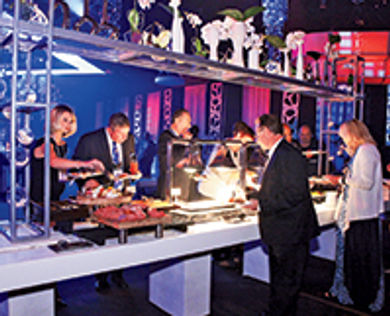 CIC's lounge-style buffet
at this year's IMEX America
CIC's lounge-style buffet
at this year's IMEX AmericaThe Washington, D.C.-based Convention Industry Council also is keeping its events -- and thus its brand -- fresh. For the 20th anniversary of its Hall of Leaders and Pacesetters Awards Celebration held in October in Las Vegas, during IMEX America, it ditched its traditional formal black-tie gala dinner for a lounge-style nightclub vibe, with high-end appetizers and entertainment. Laura Schwartz, a former White House director of events and author of Eat, Drink and Succeed, was brought in as host.
"We wanted to change up the celebration because it's important for us to remain relevant and original," says Kasey Connors, director of programs and services for CIC. "The new program was shorter on the speeches and proved a greater opportunity for us to network and celebrate with each other. It was the best of both worlds -- the quality ceremony the industry has come to expect in a new, unique setting."
Insights from a Branding Expert
Before Lisa Borromeo Checchio joined the Parsippany, N.J.-based Wyndham Hotel Group as vice president of brand marketing this past August, she was director of brand management and advertising for JetBlue Airways Corp. Not only did she oversee the launch of the carrier's award-winning "Air on the Side of Humanity" campaign, she was the creative brain behind the launch of Mint, the airline's premium cabin service, which debuted in 2014.
 Wyndham's Lisa Borromeo Checchio
 To promote Mint, Borromeo Checchio created the Mint Room at The Grove, an outdoor mall in Los Angeles. With JetBlue crew members as staff, consumers got to test out the airline's new lie-flat seats; sample Long Island duck, poached pears and English pea soup from its inflight small-plates menu; and sip cocktails from a centerpiece bar that doubled as a mobile-charging station, while taking a #JBSeatSelfie for a chance to win a roundtrip Mint ticket. Some 30,000 consumers experienced the Mint Room during its four-day pop-up, giving the new product a huge marketing push.
Borromeo Checchio recently shared some insights on branding with M&C.
What is the first thing to think about when establishing a brand identity?
Your customers. They are why brands exist. Without the customer, nothing else matters, because what is a brand without a customer to share its story, buy its product or believe in its cause?
What is emotional branding?
It's the transcendence of marketing from imposing a product or service on a customer to proactively inviting the brand into their lives. You achieve it by putting the customers' needs first, which creates a two-way relationship between them and the brand. People are defined by the brands they choose, and they want to feel a sense of pride through those associations. Emotional branding evokes a sensory reaction that drives commitment and brand loyalty.
How can planners ensure their live event's brand matches its online brand?
Live events are special in that they bring people together face-to-face, forcing dialog and human interaction. They're experiential, idea-generating and tap into all senses, which means they are the makings for emotional connections. These elements cannot be lost once taken online. You have to have a cohesive digital experience, from desktop to mobile and tablet, to social media and apps, not only in the look and feel, but understanding the customer's needs at the moment of interaction. This is where an event's brand personality can really shine, and where you can customize the experience for the user.
How does a brand stay relevant, without losing its core audience, and attract new customers?
A brand has to be more than just a logo to stay relevant. Is a new logo going to be the reason a customer buys a product? For some, maybe. But image is more than a logo. It is adapting to the world around your customers by understanding what is now important to them, and recognizing new ways, through technology or social sharing, in which to engage them.
While brands should always be looking for ways to attract new customers, that cannot come at the expense of their core customer. Millennials, for example, have been said to "collect experiences." To stay relevant with them, you need to give them something special. And if you do, they'll be happy to share that experience with the world.