They work six- to eight-hour shifts as greeters, registration attendants, room monitors and "human signage." They field questions, handle crowd control, run errands and put out fires. What do these critical helpers get paid? Typically, nothing. They're the interns.
Some planners depend heavily on this young and eager work force. At annual meetings of the Professional Convention Management Association, about 10 to 20 percent of up to 300 volunteers typically are students, according to Sarah Corradino, PCMA's Chicago-based manager of meetings and events.
"Using volunteers can save you a great deal of money," Corradino notes. "Even if you did the math at minimum wage, you're talking thousands of dollars in savings." Moreover, she says, "You don't always get the same enthusiasm with temp workers as you do with hospitality students."
Not only are these students -- some of whom aspire to become meeting planners -- hungry for on-the-job training, some hospitality schools actually require that they get such experience.
Sounding the call
.jpg) The local convention and visitors bureau is a good starting point, says Pamela A. Troop, CMP, director of meeting operations and special events for Washington, D.C.-based ASAE & The Center for Association Leadership. When Troop was planning last August's annual meeting and expo in San Diego, DeeAnne Snyder, CMP, director of convention services for the San Diego Convention Center Corp., arranged for 30 local hospitality students to participate as volunteers. "It was not at all difficult to get that many volunteers," says Snyder. "The students were absolutely eager to be a part of the process."
The local convention and visitors bureau is a good starting point, says Pamela A. Troop, CMP, director of meeting operations and special events for Washington, D.C.-based ASAE & The Center for Association Leadership. When Troop was planning last August's annual meeting and expo in San Diego, DeeAnne Snyder, CMP, director of convention services for the San Diego Convention Center Corp., arranged for 30 local hospitality students to participate as volunteers. "It was not at all difficult to get that many volunteers," says Snyder. "The students were absolutely eager to be a part of the process."
If a CVB isn't willing or able to do the legwork, go directly to a local hospitality school. Meeting Professionals International offers a full list of institutions at mpiweb.org/Education/UniversitiesAndColleges.aspx.
When contacting a school, ask for the career services department or the person who handles student internships, advises Randy Crabtree, Meeting Professionals International's Dallas-based membership marketing manager. Some hospitality schools will note a planner's needs and post the details on an internal online job-posting board.
 "While we can't guarantee students will volunteer -- especially if it's an unpaid event -- we do encourage them to apply," says Erika Jones, director of career services at Kendall College's Les Roches School of Hospitality Management in Chicago.
If not enough takers come forth, Jones recommends offering $25 to $50 a day. This usually draws more interest, she says, and still costs much less than a temp worker's daily wages.
Other ways to find interns include calling local chapters of associations such as MPI or the Professional Convention Management Association, both of which encourage student involvement.
The right tasks
Katja Morgenstern, a senior project manager for Atlanta-based Meeting Consultants Inc., cautions that corporate clients often are "very proprietary" with their information and might be uncomfortable using students. "But at association meetings," she notes, "there is more freedom and opportunity to use interns."
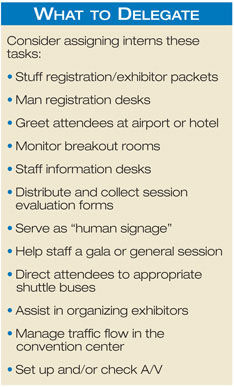
Note that students should not be considered for all tasks; see "What to Delegate."
Interns' enthusiasm makes them good candidates for assignments that require attendee interaction. For example, at MeetDifferent 2009, held in Atlanta this past February, MPI used volunteers to circulate among the attendees and invite them to come to a computer station and update their profiles, says Randy Crabtree.
"There's not too much student interns can't do," says PCMA's Corradino -- as long as there's some type of learning element incorporated into their duties. "We wouldn't assign them to something like coat check; we would hire temps to do that," she notes. "We have to be responsible for these students, because we want to have good relationships with hospitality schools. A professor is not going to be happy if his student has sat at a coat check for eight hours a day."
"The unfortunate thing is when planners are looking for students to do very grunt-level work," says Jeffrey Catrett, dean of Les Roches School of Hospitality Management. "We'd rather they get more involved."
Credit and beyond
 Most hospitality schools require students to complete a certain number of internship hours to graduate. As such, work is undertaken for scholastic credits, meaning there typically is minimal cost to the meeting host for using student help.
Most interns are compensated in some way, however. Incentives include a small per diem to defray transportation costs (e.g., $4.50 daily for a roundtrip subway ride in New York City), free meals, or discounted or free registration to the convention, general sessions or evening events.
Of course, for planner-wannabes who work a show in the meetings business, access to industry professionals is of high value. Working a meeting in any other field also provides great hands-on experience.
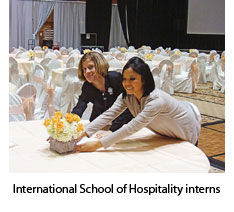
Some students -- depending on the event, the amount of work involved and the hospitality school -- do earn hourly wages. Donnell Bayot, director of academic affairs at the International School of Hospitality in Las Vegas, says his students sometimes snag paid internships at about $9 to $15 an hour.
One planner who has hired interns for pay is Pat Norman, CMP, director of conference services for the Washington, D.C.-based National Medical Association. Norman employed eight International School of Hospitality students for NMA's annual meeting this year, in Las Vegas, and paid about half of what she would have offered temp agency staff.
On the job
It is important to have a clear, up-front agreement about what will be required of student volunteers. "You have to make them understand that they should treat this like a normal job," says Katja Morgenstern. "You should outline expectations, hours and schedules, and treat them like any other professional."
Jeffrey Catrett suggests walking students through the show and, if possible, allowing them to be involved in setup and/or pre-con meetings, so they can see how decisions are made.
Adequate oversight also is necessary, notes Randy Crabtree. "You will be asking students to do things that many of them will be doing for the first time," he says. "As such, you need someone in charge who understands how to converse with ‘millennials' -- someone who is very factual, very detailed and who can express exactly what needs to be executed."
Pat Norman tells of one mishap that underscores this point. "I asked one intern to make sure there were 20 rounds ready for a meal -- but I forgot to say, ‘Is there any food?' " The intern confirmed the tables were in place but did not mention there was no food in the room.
It's also a good idea to spread out the students among different volunteer teams and not put too many together in one group. "Don't forget -- these are college students," cautions Morgenstern.
That said, youthful energy can be a positive thing, if channeled correctly. As Norman says, "I like working with students because they are so excited, and they re-energize those around them."
Because of their "very fresh book knowledge," adds Morgenstern, "students tend to look at situations very differently than those of us who've been in the business for a while -- they really want to use the knowledge they've just acquired."