It's been a tumultuous couple of years for the meetings industry, but optimism is on the uptick, and predictions for 2012 put the industry back on track, although not quite to levels seen three years ago.
To get a grasp on what's really going on in the meetings trenches, travel research company PhoCusWright, with the support of M&C and other industry partners, surveyed 629 corporate planners to compile its new report, Groups and Meetings: Driving Success in Business Travel's Most Complex Segment.
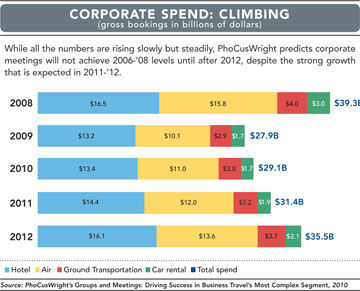
Overall, the Sherman, Conn.-based company found that corporations spent a total of $54.3 billion on meetings in 2009, down almost 30 percent from 2008. Meetings spend was split almost evenly between travel and nontravel costs, with food and beverage, hotel and air representing more than two-thirds of expenses. Travel spend -- including air, lodging, car rental and ground transportation -- fell 29 percent in 2009, to $27.9 billion.
While recovery for this year has been running at about 4 percent, PhoCusWright expects growth to accelerate and reach double digits by 2012, when travel spend will be more than $35 billion, although that number still is short of 2006-2008 levels.
Meetings profile The survey asked
planners what types of events they managed in 2009, and workshops and
education sessions were the most cited, with respondents working on an
average of 17 over the past year, including an average of six seminars
and six sales/incentive meetings.
Corporations spent 15 percent
of their meeting budgets on seminars and also on specialty events, while
training sessions and workshops accounted for 14 percent of the total.
User conferences ate up 13 percent of the budget, even though the
planners surveyed arranged an average of only four of these events each
in 2009.
While 64 percent of the events held in 2009 were small
meetings of up to 49 attendees, they accounted for just 11 percent of
corporations' meetings expenses. Conferences of 200 or more, just 7
percent of the events held in 2009, grabbed 59 percent of the total
meetings spend. Overall, 35 percent of the meetings held in 2009
welcomed 10 to 24 attendees, 29 percent hosted 25 to 49 people, 18
percent had 50 to 99 attendees, 11 percent welcomed 100 to 199
delegates, and 7 percent were for 200 or more.
 Managing the decisions
Most corporations have adopted some sort of meetings or travel policy,
sometimes with the rules married together in one document.
Managing the decisions
Most corporations have adopted some sort of meetings or travel policy,
sometimes with the rules married together in one document.
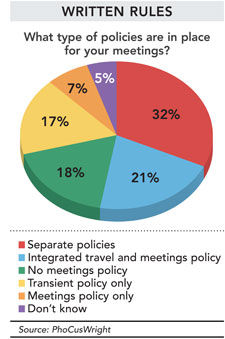
One-third
(32 percent) have separate meetings and transient travel policies,
while 21 percent have an integrated travel and meetings policy. Seven
percent have only a meetings policy, 17 percent have only a transient
travel policy, 18 percent are working without any such policy and 5
percent of the sample didn't know what policies were in place.
More
than half of the meeting managers (56 percent) polled indicated the
procurement department helps with determining the process used for
processing and tracking expenses; procurement helps 55 percent manage
budgets, assists 55 percent in negotiating with suppliers, and provides
general oversight and leadership to about 50 percent.

Virtually speaking
The PhoCusWright study found that just 24 percent of the meetings
respondents held in 2009 included video- or virtual conferencing. For
2010, just 15 percent said their meetings incorporated virtual elements,
and another 7 percent said meetings were replaced by virtual
conferencing. Seventy-eight percent of the 222 respondents who answered
the question said their events did not include a virtual component.
Twenty
percent of survey respondents had implemented virtual conferencing at
their most recent meeting, which allowed 28 percent of the attendees to
participate without leaving home.
Where the action is
A wide majority of those polled held events in hotels in 2009 (86
percent) and 2010 (84 percent); business or conference centers welcomed
meetings for 48 percent of the sample in 2009 and 45 percent in 2010;
internal/corporate office locations were meeting sites for 45 percent
last year and 46 percent this year. Sixteen percent used virtual meeting
rooms or a telepresence center in 2009; that number rose to 22 percent
this year.
When choosing a destination, the study found that 57
percent of planners and 62 percent of managers surveyed visited cities
they had used the year before. Low rates and special deals factored into
the decision for 54 percent of the planners and 56 percent of the
managers, while air accessibility was important to 38 percent of
planners and 59 percent of managers. Executives often weigh in on
destination decisions, as 42 percent of both planners and managers said
opinions from higher-up are taken into consideration.
Most
planners rely on previous experience with a venue to guide the selection
process, with 87 percent of planners and 86 percent of the managers
depending upon familiarity to make their choice. Meetings policy also is
a driver for 68 percent of the planners and 66 percent of the managers.
The location of the property is a top priority for 52 percent of
planners and 51 percent of managers. Interestingly, just 2 percent of
planners and 1 percent of managers said their venue decisions were
helped by referrals from colleagues or through the use of social
networking.