This is the second in M&C's special three-part series on emerging meetings markets. India boasts the second-largest hotel pipeline in the region (after China), as well as one of the world's fastest growing economies. A highly educated and trained work force, and the fact that English is the secondary official language, have lured many international companies, and the country's meetings infrastructure is growing apace. Watch for the upcoming feature on Brazil in our April issue.
The cities of India brim with a restless energy, the populace seemingly attempting to keep pace with the country's increasing importance to the global marketplace. Urban highways pack in more traffic than appears logical to the Western eye: Trucks, buses, cars, scooters, pedestrians, three-wheeled "auto rickshaw" taxis and the occasional bovine perform a seemingly choreographed race across an often-undefined number of lanes. The contrasts among these types of transportation -- as well as among the countless buildings being constructed alongside the highways -- are representative of those being experienced by the country as a whole. Backpackers seeking enlightenment and traditional culture arrive alongside business travelers participating in the world's second-fastest-growing economy (following China), based on projections from the International Monetary Fund.
International corporations are investing heavily in the nation's infrastructure. In the hospitality industry in particular, ambitious expansion plans are underway to satiate growing demand. Nearly 80,000 hotel rooms are in the construction pipeline, according to the Lodging Econometrics' Fall 2010 Asia Pacific Real Estate Trends Report. That's a small fraction of China's pipeline (which accounts for more than 336,000 rooms), but it's enough to make India's pipeline the third largest globally -- and to help make the Asia Pacific region the fastest in recovering from the worldwide recession, in Lodging Econometrics' assessment of the hospitality industry.
The International Congress and Convention Association held its 2010 Congress in Hyderabad, India, last October -- in part, according to CEO Martin Sirk, to expose delegates to India's potential while taking advantage of Hyderabad's new facilities. "An understanding of the importance of international meetings has been present amongst Indians for a long time," he says, "but only now is their infrastructure catching up to their aspirations. The rest of India is sprinting to match what Hyderabad offers, with new modern convention centers being announced in city after city."
Ambition and optimism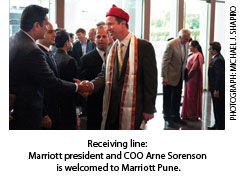
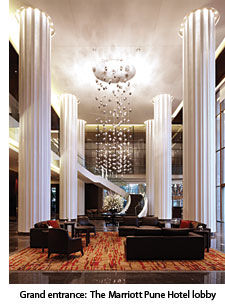
Marriott is among the
many lodging companies seeking to expand its presence in India, and last
November the company opened its 12th property in the country, the
418-room Marriott Pune Hotel & Convention Centre. The chain's top
executives were present (as was this M&C editor) to celebrate the
opening of the 500th Marriott hotel worldwide as well as to tour the
nation and outline Marriott's ambitious plans there.
"We have
deals in place to quadruple our presence in the next four years," says
Marriott president and COO Arne Sorenson, "and that's not including any
new deals we make along the way. We should have 100 properties in India
within the next five years." By 2015, Sorenson says, the company expects
75 to 80 percent of its Indian properties to fall under the
Ritz-Carlton, JW Marriott, Renaissance, Marriott and Courtyard by
Marriott brands. They anticipate about two dozen Fairfield properties to
open there as well -- a flag not yet represented in India, but for
which developers have shown great interest, according to Sorenson.
In
a sense, what's happening in Pune is emblematic of the ambition and
optimism in the hospitality sectors throughout the country. This city of
nearly 6 million -- long known as the Oxford of the East for its many
universities and huge student population -- is making a name for itself
in the information technology and automotive manufacturing fields. As
such, many related international corporations now have a presence in
Pune. Yet the contemporary new Marriott, with 40,000 square feet of
meeting space, is the first large meetings facility to open in the city,
and Pune still isn't listed by the India Convention Promotion Bureau as
a conference destination.
Marriott Pune owner Atul Chordia
expects that to change, and he's focused on attracting major
conventions. "This property is the infrastructure for the education, IT
and automotive markets," he explains, "and will be the driver for MICE
business."
 By sometime this spring, Marriott intends to have
nearly 800 rooms in the Pune area, following the opening of the
Courtyard by Marriott Pune City Centre. (Another Courtyard property is
on the highway on the way to Mumbai.) The 222-room Hyatt Regency Pune
opened last November, with 20,000 square feet of meeting and event
space, and the 217-room Four Points by Sheraton Pune, Nagar Road, was
due to open last month, offering nearly 12,300 square feet of function
space (and giving Starwood a total of 671 rooms in the area). By year's
end, the Langham Place, Koregaon Park, Pune is slated to open, also with
meeting space.
By sometime this spring, Marriott intends to have
nearly 800 rooms in the Pune area, following the opening of the
Courtyard by Marriott Pune City Centre. (Another Courtyard property is
on the highway on the way to Mumbai.) The 222-room Hyatt Regency Pune
opened last November, with 20,000 square feet of meeting and event
space, and the 217-room Four Points by Sheraton Pune, Nagar Road, was
due to open last month, offering nearly 12,300 square feet of function
space (and giving Starwood a total of 671 rooms in the area). By year's
end, the Langham Place, Koregaon Park, Pune is slated to open, also with
meeting space.
The expansion in Pune, a three-hour drive via
highway from Mumbai, is occurring despite the limited international
service currently available at Pune Airport, where Lufthansa and Air
India fly to Frankfurt and Dubai, respectively. But that could change:
At the Marriott grand opening celebration, two prominent local
politicians underscored the importance of building a new airport in the
city (and made not-so-subtle overtures to hotel owner Atul Chordia for
the funding).
Room boom One
characteristic that makes India unique in the region, according to a
number of hotel executives, is the large number of local travelers.
"India is a very important market, particularly with respect to its
young demographic," notes Simon Cooper, president and managing director
for Marriott's Asia Pacific region. Long-haul travelers make up the
minority of Marriott's India business; about 60 to 65 percent is
domestic and inter-Asia travel. The variety of business travelers
translates to demand for different brands and service levels. According
to some estimates, nearly 50 international hotel brands are entering
India.
Additional Marriott plans for this year include the
345-room Jaipur Marriott, with 30,000 square feet of meeting space, as
well as JW Marriott properties in Chandigarh (160 rooms), Bangalore (318
rooms) and Chennai (379 rooms). India's first Ritz-Carlton is scheduled
to open in 2012, in Bangalore.
Many of the major companies have outlined ambitious pipelines.
• Carlson, which operates 33 properties in India, plans to have 100 hotels in the country by 2015. Nineteen hotels are slated to open this year, including properties under the Radisson, Country Inns and Suites by Carlson, Park Inn and Park Plaza brands. The Radisson brand accounts for 11 of this year's planned openings, with hotels slated for Amritsar, Noida, Chennai, Hyderabad, Ghaziabad, Agra, Goa, Haridwar, Ahmedabad, Ranchi and Rudrapur.
• Starwood Hotels & Resorts, which first entered India with a Mumbai Sheraton in 1973, operates 30 hotels throughout the country, with two more -- the 173-room Aloft Coimbatore Singanallur and the 122-room Four Points by Sheraton Visakhapatnam -- set to debut this month. An additional 14 deals have been announced, including five Sheraton hotels, three each from Aloft and Le Méridien, two Westin properties and the country's first W, set to open in Mumbai in 2015.
• Hyatt Hotels and Resorts, which currently has
six hotels in the country, is planning to open four more this year --
the Hyatt Regency Chennai, Grand Hyatt Goa and two Park Hyatts, one in
Chennai and one in Hyderabad. Another 25 properties are in development
and could open within the next three to five years. Hyatt has a presence
in Delhi, Goa, Mumbai and Kolkata, and intends to expand into 15
additional markets.
• In January, Hilton opened its third
property in India, the 171-room Hilton Mumbai International Airport. Six
more are slated to debut this year, to the tune of about 1,000 rooms
among the Hilton, Doubletree by Hilton, Hilton Garden Inn and Hampton by
Hilton flags. The company intends to open 13 additional properties by
2016.
• InterContinental Hotels Group plans to open 33 new
properties in India by 2015, adding to its current 12. Most of the new
rooms will be Holiday Inn or Holiday Inn Express hotels. The
InterContinental and Crowne Plaza brands already have a presence in the
country.
• Fairmont Raffles Holdings plans to open six
properties here by 2015, under the Swissôtel brand. The first targeted
destinations, scheduled to open in 2013, are in Guragaon (near New
Delhi) and Bangalore.