Saving Money on F&B

America's Health Insurance Plans, a Washington, D.C.-based association of health-care insurance executives, saw its conference costs rise and attendance dip by 20 percent in 2009. Among other changes, AHIP has had to cut down on the event's F&B budget. Barbara Ketcham, senior consultant of hotel operations for the association, lays out four steps she has taken to reduce costs without disappointing attendees.
• Shorter receptions. In the past, a two-hour reception before dinner would practically constitute a meal itself. This year, it's "a chunk of cheese, a glass of wine and they go off to dinner," says Ketcham.
• Delayed dessert. Attendees eat a two-course meal for lunch, while dessert -- frugal cookies instead of something plated -- is added to the afternoon break, eliminating the need to pay for an extra snack.
• Less bottled water. Instead of plastic bottles, Ketchum uses pitchers of water with a few lemon wedges floating inside. So far, hotels haven't charged her for that.
• Whole fruit. By putting out whole bananas and apples at breaks instead of sliced fruit, Ketcham can leave it out all day without having to replace it. "It makes attendees feel like there's a little extra value to the registration fee," she says.
In boom times, everyone wants to know about the hottest cuisine. Planners aim to find exotic foods that attendees haven't tried and to serve them in the flashiest, most memorable way -- even if that means paying a premium.
But 2010 is not shaping up to be a boom year. And, when money is tight, the F&B budget is one of the first to be cut. Therefore, the question on planners' lips is not "What's in vogue?" but "What's inexpensive?"
Most of the food trends on M&C's 2010 hot list are cost-cutting tips in disguise. Even organizations that still can afford caviar and lobster will be opting for modesty this year. Opulence has become tacky.
"All the out-of-the-box stuff is back in the box," says John Vingas, the San Diego-based senior vice president of convention centers for Centerplate, which caters five of the 10 busiest convention centers in North America. "The 'Did you see that?' days were left behind in 2006." Besides budget-slashing, the catering world is making food approachable, healthful and sustainable; setups have become simple and practical. In a word, food is becoming real.
Classic dishes are new again Every year, it seems, foodies designate a newly discovered ethnic cuisine as the latest must-eat. This year, though, the fads are on hold. People are looking to sophisticated interpretations of familiar foods -- though that doesn't necessarily mean meatloaf or mac and cheese. "Honestly, it's about good food, well-executed," says Brad Nelson, Marriott International's Bethesda, Md.-based corporate chef and vice president of culinary.
Stacy Zeigler advocates a return to Julia Child, as repopularized in the movie Julie & Julia. "Beef bourguignon, coq au vin, apple tarte tatin," recites Zeigler, CMP, director of sales for Bold American Events and Catering in Atlanta, as well as first vice president of the National Association of Catering Executives. "They sound fancy, but they're really simple, warm comfort foods. It's an inexpensive cuisine, but it has some flair and specialness to it. Julia Child has made simple cool again."
Chicken is king In 2009, for the first time in memory, Marriott saw chicken outsell filet mignon at final-night banquets. "On the surface, filet seems extravagant," says Brad Nelson. "There's been a pretty strong movement toward the anti-luxe."
In addition to filet becoming less prevalent, Nelson has seen less king crab and lobster, and the reason is only partly due to price. Often, a planner will choose a less gourmet option that doesn't actually cost less, simply due to concerns about perception. "In many cases, the perception of 'less is more' is more important than the actual cost," Nelson says.
Cows are versatile A different cut of beef can do the job. "There are only two tenderloins on a steer," notes chef Gregory Griffie of the Renaissance Boston Waterfront Hotel. "There's always a lot of other product that not a lot of people use, so it can be obtained at a great price."
Griffie has gotten kudos for a hearty pot roast, which is considerably less expensive than filet. And for the price of a traditional filet, he can do something more exciting with a different cut, like braised short ribs with ginger, chilies and hoisin, served on steamed jasmine rice. Using more of the animal is friendlier for the environment, too.
Small surprises still surprise Even on a budget, planners can include just one "wow" item during the meal, suggests Stacy Zeigler. She recommends a hot doughnut station or fish and chips served in a newspaper cone -- creative elements that will build some buzz.
Breakfast can be tweaked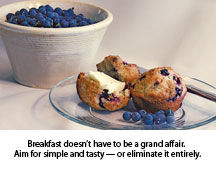 Planners looking to cut costs often target the morning meal. For small meetings, instead of giving each gathering a room and breakfast setup of its own, Loews Hotels has begun opening up its dinner restaurants to house a handful of groups at once in the morning. A single buffet serves everyone, which saves on labor, space and food costs -- and guests get the experience of eating in the beautiful restaurant setting.
ASE Group Inc., an independent planning firm based in Overland Park, Kan., has been able to save clients money by offering brunch. Coffee and pastries are served in the morning, and then at 10:30 or 11:00, a hearty brunch replaces breakfast and lunch. For groups that want breakfast, ASE's vice president, Marissa Schaffner, CMP, advises doing a continental spread plus just one hot item, which saves considerably over a full buffet.
Some meetings are dispensing with breakfast entirely. Mariano Stellner, Fairmont's San Francisco-based corporate director of food and beverage, notes that the standard meal progression used to be breakfast, break, lunch, break, dinner, but nowadays, planners are requesting an a.m. break table that stays out all morning and has enough food to satisfy those who didn't eat breakfast.
Barbara Ketcham, senior consultant of hotel operations for America's Health Insurance Plans, based in Washington, D.C., has obviated the need for breakfast by moving the meeting's start time later. She makes it clear in conference materials that breakfast will not be served, and she leaves a coffee break out for the constant flow of attendees in the public areas. (For more on how Ketcham has cut costs, see "Saving Money on F&B" at left.)
Vegan Showstopper
Boston-based Ceres is a national network of investors, environmental organizations and other public interest groups that work with companies to help them become environmentally and socially responsible. No surprise, then, that its own conferences are on the cutting edge of sustainability, as proven in 2008.
For a lunch at the Renaissance Boston Waterfront Hotel, Marilyn Castriotta, conference and events manager, planned a strictly vegan meal: no meat, no dairy, no eggs. On the menu was an appetizer of Bibb lettuce and spring vegetables with lemon-basil vinaigrette, followed by an entree of soft garlic polenta, braised Tuscan kale, white beans and tomato fondue. For dessert: toasted coconut sticky rice with fresh mango.
The meal, a great success, was a major factor in Ceres' decision to book the hotel again for 2010.
Easier prep is better Because much of the
cost of a meal comes from the labor required to make it, frugal
planners choose foods that don't require extra sauces, individual
preparation or careful plating. For example, the Loews Coronado Bay
Resort in San Diego recently served paella for 500: A huge mound of the
rice dish was carted into the dining room on a stunning 8-foot pan.
Attendees lined up, and a chef customized each scoop depending on which
items -- chicken, shrimp, mussels, sausage or fish -- the attendee
favored. Also, because the dish left out pricey seafoods like lobster
and scallops, it was relatively inexpensive to make.
Desserts,
too, are moving toward treats that can be made en masse and plated
quickly, like rice pudding. "If it takes six hours to make, there'll be
a high cost involved," chef Griffie explains.
Meals can allow for mingling
Planners and attendees alike want to get more bang for their buck.
"We're hearing, 'Don't offer me a big buffet where it takes forever to
get through the line. Instead, offer me something that allows attendees
to network,' " says Mariano Stellner. Fairmont is responding to that
request with grab-and-go tapas-style lunches, made with inexpensive but
tasty food.
Nelson has noticed that planners are replacing all
but the final-night dinner with receptions. "It's not necessarily less
expensive," he says. "I think it's an experience issue. People want
things to be much more casual." In fact, that drive toward the casual
sometimes means a food presence in the registration area, to get people
mingling right from the start.
Along the same lines, John Vingas
sees lunches and dinners held in the exhibit hall -- perhaps the
ultimate way of pleasing exhibitors.
Some events cut dinner
entirely. ASE Group handles meetings that might offer just drinks for
an hour or 90 minutes before sending folks off to dine on their own.
"It gives vendors a chance to take attendees out," notes Marissa
Schaffner.
Décor is going organic
Table settings are getting less expensive, too. "Specialty linens and
pin tucks have gone away," Zeigler says. "Poly-cotton now is just
fine." Zeigler has been doing low-cost candlescapes instead of florals.
And a colored napkin might give the table enough panache to skip the
charger.
From Nelson's perspective, anything flashy has
quickly gone out of vogue. For example, underlit Lucite tables are
disappearing in favor of an organic look: linenless farmhouse tables
and, as he puts it, "more wood and bamboo and living and breathing
things." These items aren't necessarily less expensive but give off an
air of simplicity and goodness -- just what we need when times are
tough.
Now serving: food with a story
One of the major effects of the green movement is that people now like
to know where their food came from. "There are more locally sourced
items that have a story and involve little culinary manipulation," says
Nelson. If the cheese plate of the past was a huge mirror loaded with
diced varieties, this year's plate is a smaller cutting board with
local artisanal cheeses and signage that tells a little about each.
Loews
Hotels takes this one step further, with an Adopt-a-Farmer program.
Meeting breaks use foods from specific local farms -- for example, a
Florida citrus break at the Loews Royal Pacific Resort at Universal
Orlando, or a smoothie break with local yogurt at the Loews Regency
Hotel in New York City -- and include a map of where the farms are, in
case attendees want to stay an extra day to visit them. Through this
program, Loews supports 136 farms to date.
In Tucson, Ariz., the
104-room Lodge on the Desert recently reopened its restaurant with a
"farm-to-table" concept. "We start with the freshest products and
ingredients, most locally grown and locally sourced," says chef Ryan
Clark. "And we believe our guests have a right to know the source of
the food they are enjoying as well as the methods used to prepare it.
Our role is to facilitate the food's journey from farm to fork."
Vegetarian is viable
Vegans, who once had to settle for the meat plate minus the meat,
finally are getting their due. Hotels are designing creative vegetarian
entrées that appeal even to carnivores. At the Renaissance Boston
Waterfront, for example, Griffie's braised fall vegetables in red wine
replicates the richness of the classic beef bourguignon. He says about
one-third of meeting planners have selected a vegetarian dish when
offering a choice of two entrées, and about half have included one
among a choice of three.
In the two years since the hotel
opened, Griffie has even served completely vegetarian and vegan meals a
few times (see "Vegan Showstopper" at left). Ditching the meat
entirely lessens a meal's carbon footprint and also can cost
significantly less.
"You're not eating rice and beans the entire
time," Griffie notes. "You can add some very exciting items to your
menu with unusual seasonings that might not be in the American palate."
Waste can be winnowed
A banquet can produce a staggering amount of waste. To ease the problem
at receptions, F&B departments are serving smaller quantities that
are replenished more frequently. That also saves money and keeps the
food fresher.
Then there's the question of disposable plates,
flatware and cups, when it's not possible to opt for reusable goods.
Centerplate has substituted compostable tableware for disposables, but
such items are worthless if they're thrown into the landfill; the
company also is working on finding nearby composting facilities for all
of its convention centers and, where such facilities don't exist, doing
the composting on-site.