The Allergy-Safe Kitchen
Planners should be in close contact with the kitchen staff, before as well as during the event. Here's what to look for.
• Cleanliness. To serve people with allergies, chefs must keep the
kitchen immaculately clean. Allergy-free work should be done in a
separate part of the kitchen, or at least after surfaces and knives have
been sanitized. "Our biggest concern is cross-contamination," says
Laurent Poulain, executive chef of Boston's Fairmont Copley Plaza. "We
take it very seriously."
• Attention to every detail. Chefs should know about every ingredient
that goes into each dish. This gets complicated when using premade
products, as allergens often are hiding among the minor ingredients as
thickeners and stabilizers, in which case some kind of printed
information should be available.
• Well-informed servers. If the waitstaff isn't aware of allergy
information, mistakes can happen. Ideally, everyone on the banquet team
should know what allergens are in what foods, and which diners have
special requirements.
• Innovation. Creating allergy-friendly menus should be an opportunity,
not a limitation. A good chef should be able to design varied and
delicious options for every meal. -- J.V.
As if planning meals for the masses weren't complicated enough, the masses have gotten much pickier. According to a recent M&C Research poll, 43 percent of meeting professionals say attendees have become more aggressive about asking for foods that align with their allergies, other health restrictions and lifestyle choices. An increased awareness of allergies and diet-related sensitivities is a driving force behind the growing number of special requests, say 80 percent of planners polled. (For more, see "F&B Gets More Complicated".)
Catering to dietary restrictions is a serious matter: One wrong bite and an attendee could get very sick. "You don't want someone to miss the rest of a meeting because he or she is in the hospital," says Jennifer Grove, president and creative director of Sky Blue Events, based in Baltimore. Grove, who is allergic to all nuts and legumes, is careful to spare her guests from the frustration that she has faced as a result.
It's not just the right thing to do -- it's the law. Technically, meeting planners are legally obligated to provide safe meals to all attendees. In 2008, eating was added to the Americans with Disabilities Act as a "major life activity." In other words, people with medically necessary dietary restrictions must be provided with food they can eat, just as a person in a wheelchair is entitled to access to a ramp to enter a building.
"A food allergy, if it truly threatens someone's life, is something that is covered by the ADA," affirms Jonathan T. Howe, senior partner of the Chicago-based firm of Howe & Hutton Ltd. and M&C's legal expert. "Planners are obligated under the ADA to provide what is reasonable or readily achievable under the circumstances. Some might declare that they're vegetarians, but that's a choice. If it's medically dictated, it's not a choice."
"It becomes an EEOC [Equal Employment Opportunity Commission] issue for corporations," notes Tracy Stuckrath, CSEP, CMM, president of Atlanta-based Thrive! Meetings and Events. "You need to accommodate dietary needs at an equal value and quality, or refund the food portion of registration money so attendees can go out and eat."
To safely feed a crowd requires careful advance planning and a flexible, knowledgeable and talented kitchen staff. The first step for planners is understanding the reasons for all the special orders.
Food Allergies 101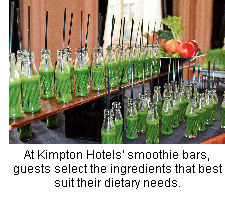 According to Food Allergy and Research Education (formerly the Food Allergy & Anaphylaxis Network; foodallergy.org), some 15 million Americans -- about 5 percent of the U.S. population -- have at least one food allergy. In addition, more than 21 million people are vegetarian, and one million of them fall under the more strict category of vegan (those who consume no animal food or dairy products). Clearly, planners should expect to accommodate at least some special dietary needs at most meetings and events.
Research by the Rochester, Minn.-based Mayo Clinic and other major medical organizations has identified the "top eight" food allergens as responsible for up to 90 percent of allergic reactions. The key culprits are peanuts, tree nuts, shellfish, fish, wheat, soy, dairy and eggs (problems with the last four usually lessen or cease altogether after childhood, say experts).
But people can be allergic to almost anything: meats, corn, gelatin, mustard and various preservatives, to name a few. Of 8,000 attendees at a recent event catered by Stamford, Conn.-based Centerplate, some 240 different combinations of food allergies and other dietary restrictions were in some way acknowledged. These included religious restrictions, such as kosher and halal; lifestyle choices, including the many variations of vegetarianism; and diets prescribed for people with diabetes.
While some allergies can be so mild that those who have them don't realize it, others can cause serious bouts of throat swelling, inflamed skin, a drop in blood pressure and even death. In most cases, ingesting the offending food is necessary to cause a reaction, but sometimes even contact with airborne particles can trigger the allergy. For example, people who are severely allergic to peanuts might be in danger if someone across the table merely cracks open a peanut shell.
Food "intolerances," marked by the digestive system having difficulties processing certain foods, are not allergies per se, but they can be just as serious. Celiac disease, for example, is a severe intolerance in which even a few molecules of gluten -- a protein substance most often encountered in wheat flour -- can damage the intestinal wall. More than two million people in the United States have the disease, according to the National Digestive Diseases Information Clearinghouse (digestive.niddk.nih.gov), a service of the National Institutes of Health.
Clearly, these considerations put a new twist on selecting event menus. However, planners can take heart in knowing that effective communication with both attendees and chefs or caterers can solve most problems.
Following are tips from experts for providing safe and enjoyable meals for attendees with special dietary needs.
On-Site Strategies
A few extra measures can help resolve issues during the meeting.
• Send snack baskets. Breaks often are a problem for people who
can't
eat wheat, for example. If planned snack breaks won't accommodate
everyone's dietary needs, Tracy Stuckrath, CSEP, CMM, president of
Atlanta-based Thrive! Meetings and Events, arranges for a welcome basket
to be
sent to the select attendees' rooms, stocked with safe snacks they can
bring to the meeting. She includes a note that reads, "We acknowledge
your dietary needs. Here's something for you to snack on."
• Find a nearby eatery. If a hotel is incapable of providing adequate
meals to an attendee, Stuckrath will issue a gift certificate to a
restaurant or grocery store in the vicinity and ensure there's an
in-room refrigerator to store perishables.
• Keep a first-aid kit handy. Even with careful planning, accidents
happen. If an attendee has an allergic reaction and goes into
anaphylactic shock (for information, go to 1.usa.gov/15Ty2sK), have an
epinephrine injector close at hand. Keep allergy medication such as
Benadryl in the kit as well, for less serious reactions.
• Enjoy the kudos. All of these efforts won't go unnoticed. "For most
people, what you serve doesn't matter," says Neil Donaway, executive chef of La Chefs
Catering and Events in Lethbridge, Alberta. "A pork chop and
mashed potatoes are good enough. But if you take care of people with
food allergies in a better fashion than they're used to, they tout your
praises to the world." -- J.V.
Working with attendees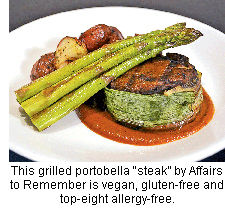 "It's critical for the
caterer to know what menu items can be potential issues and work to
find satisfactory substitutions," says Lisa Hopkins, CPCE, president of
the National Association for Catering and Events, based in Columbia,
Md., and director of catering at the Houstonian Hotel in Houston. "This
task is much easier when the special needs are identified as early in
the process as possible."
"It's critical for the
caterer to know what menu items can be potential issues and work to
find satisfactory substitutions," says Lisa Hopkins, CPCE, president of
the National Association for Catering and Events, based in Columbia,
Md., and director of catering at the Houstonian Hotel in Houston. "This
task is much easier when the special needs are identified as early in
the process as possible."
• Ask in advance. There are a number of ways to canvass attendees before
an event, whether adding such a query to registration materials or via a
simple email or dedicated social-media platform. Tracy Stuckrath sends
attendees a query card to fill out and return, listing the top eight
allergens, plus vegetarian, vegan, kosher and an open-ended "other" box.
The responses will help determine the strategy in the kitchen.
• Discuss restrictions, not preferences. "If you ask for food
preferences, you will end up having to custom-design meals for each
person," warns Melanie Brzozowski, event design consultant for Chef's
Expressions, a caterer in the Baltimore area. "It's a nightmare."
In the course of this discovery phase, if you suspect that someone has
listed a food as an allergy just because he hates it, it's better to
plan around that item than ask too many questions and risk aggravating
an attendee, says Stuckrath.
Vegetarianism technically is a preference, but it, along with medically
prescribed diets for diabetics and dietary restrictions on religious
grounds, must be taken seriously.
• Confirm on-site. Once Stuckrath has collected all of the attendee
food-restriction cards, the information is entered onto a complete
attendee list for reference, and the cards are returned to attendees at
the registration table for them to show their servers at each meal. This
confirms that their needs will be met and reminds them that they made a
special request in advance. At the same time, a list is prepared for
the kitchen, detailing what type and quantity of special meals will be
required for each meal function.
• Involve the kitchen staff. Neil Donaway, executive chef of La Chefs
Catering and Events in Lethbridge, Alberta, posts a banquet captain at
the registration table to help coordinate special requests and answer
questions about F&B.
Mindful menus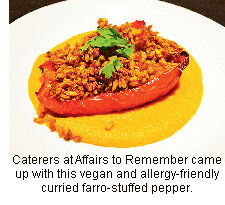 Many individual hotels and chains have established health-focused meal
options that extend to their banquet menus. For example, Fairmont Hotels
and Resorts developed Lifestyle Cuisine Plus in 2010, a program to
accommodate not just allergies but also requests for heart-healthy,
diabetes-friendly, vegan, raw and macrobiotic foods. These special menus
are listed at the front of banquet menus, to show planners that these
foods can be the norm, not the exception.
Many individual hotels and chains have established health-focused meal
options that extend to their banquet menus. For example, Fairmont Hotels
and Resorts developed Lifestyle Cuisine Plus in 2010, a program to
accommodate not just allergies but also requests for heart-healthy,
diabetes-friendly, vegan, raw and macrobiotic foods. These special menus
are listed at the front of banquet menus, to show planners that these
foods can be the norm, not the exception.
"We offer it before you ask," notes Laurent Poulain, executive chef at the Fairmont Copley Plaza in Boston.
Whether or not a hotel offers such a plan, consider the following when planning food and beverage.
• A buffet can be beneficial. Instead of creating special plates for
each attendee with a special need, a buffet can help meet a range of
needs more easily. At his property's buffets, chef Donaway includes
signs listing all the ingredients for each dish, highlighting in color
the allergens found therein. He also stations a banquet captain at the
head of the serving area to guide wary guests, and sometimes makes an
announcement right before the meal asking people with allergies to bring
questions to the banquet captain and have him assist in assembling
their plates. Vegetarians can select side dishes at the buffet while a
server brings out a separate entrée, if necessary.
A well-labeled buffet also helps the sizable population who aren't vocal
about their dietary requirements; for example, someone who simply is
trying to eat more healthfully or someone with a mild lactose
intolerance.
The more choices on a buffet table, the more guests' needs will be
satisfied. Kimpton Hotels and Resorts, for example, includes a range of
organic fruits and vegetables, plus grains such as farro and quinoa, in
its salad bars.
• Set off the safe foods. When many attendees have special needs, David
Skorka, who oversees catering at the Dallas Convention Center as senior
executive chef for caterer Centerplate, creates an entirely separate
allergy-friendly buffet and instructs servers to explain the setup to
diners.
• Eliminate common allergens at the get-go. If a significant portion of
attendees are allergic to, say, shellfish, it might make sense just to
nix that shrimp appetizer for everyone. If it's a group with a number of
lactose-intolerant attendees, consider making the meal dairy-free. Good
chefs are practiced at deleting ingredients without ruining the food.
"Nobody's going to know as long as it tastes good," Stuckrath says.
• Use smart substitutions for all. Some caterers avoid certain allergens
as a matter of practice. Chef's Expressions uses rice flour in place of
wheat flour in everything it serves except bread, so if someone has a
gluten intolerance but didn't say anything, she won't get sick from the
food. Melanie Brzozowski promises that nobody can taste the difference.
The company avoids the use of peanut oil for the same reason. (For more
ideas, click here to see "Simply Delicious Substitutions.")
Sky Blue Events' Jennifer Grove, who has worked with Chef's Expressions,
is relieved when she sees a menu without nuts on it, for herself and
her attendees. "If there's no reason to include something that's a
common allergen in a certain dish, better safe than sorry," she says.
• Make sure it tastes great. Ashley Mitchell, executive sous chef at
Affairs to Remember Caterers in Atlanta, takes such care in elevating
her top-eight allergen-free, gluten-free and vegan dishes, that many
people without allergies request them. "Who knew that beautiful,
delicious food could make a beef eater eat more veggies?" she muses.
Similarly, Elise Wiggins, executive chef at the Hotel Monaco in Denver,
recently earned raves for a vegan lasagna made with nutritional yeast
and a "ricotta" of whipped pine nuts.
• Go natural. Brzozowski has encountered guests with allergies to red
and, occasionally, blue food coloring. To be safe, she recommends using
natural colorants -- strawberry juice, for example. Avoiding chemicals
in food can prevent other reactions, too.
The same theory holds for beverages. Natural juices like carrot and
orange not only are more wholesome than sodas, but they can be safely
enjoyed by almost everyone.
• Ask about price. Often, accommodating special requests is included in
the banqueting costs. However, foods such as gluten-free baked goods can
be costly, notes David Skorka. Planners should make sure to ask about
surcharges when making special requests.
• Be discreet. "We try not to single guests out as having allergies,"
chef Donaway says. To that end, special meals are brought without a
fuss. In the case of a buffet, the special meal is served at the same
time as the attendee's table gets up to gather their food. Also, Donaway
tries to get the allergy-free meal to look as similar as possible to
the standard fare.