M&C Web Exclusive: Three Coping Skills
1) Put attendees first. Planners will need to consider the mindset of attendees and the challenges they face. Showing empathy -- providing them with information about alternative travel options, for instance, such as flying into a cheaper, if more distant airport -- will help encourage strong attendance, says Amy Ledoux, vice president of meetings and expositions for Washington, D.C.-based ASAE & The Center for Association Leadership.
2) Be smart about videoconferencing. Advito's forecast heralds "the coming of age of technology in the meeting space" -- both increased use of videoconferencing technology to eliminate small, internal meetings, and meetings management technology that will help planners gain greater visibility into their spending patterns, resulting in better leverage in negotiations with suppliers. Carla Clements, director of videoconferencing and meeting rooms for Regus conference centers, notes that videoconferencing doesn't always save companies money. "It's a more effective use of one's time," she says, citing how one set of executives can conference with leaders in San Francisco, Chicago and London in a single day and still sleep at home that night.
3) Think long-term. Ledoux insists that planners, especially association planners, will need to give time and resources to reshaping meetings and trade shows for the future. "Where are we going to be three or five years from now?" she asks. "We need to be thinking and planning for this, or else we'll see our very own recession within the association community." Along with the economy, Ledoux says the issue of how to keep meetings relevant, affordable and convenient for a new generation of attendees will be a top concern. -- T.I.
 Uncertainty dominates the outlook for meetings in 2009, as planners and suppliers brace for the ripple effects of a recession and search for strategies to survive tough economic times. "Things are so unstable at the present time," says Ty Helms, senior vice president, revenue, for Chicago-based Hyatt Hotels Corp., adding, "I think we may have a way to go before we hit bottom here."
The cost of meetings is expected to rise next year, outpacing any increase in planners' budgets, consultants say. Business travel forecasts generally predict higher airfare, hotel and car rental rates for 2009, but the increases will be smaller than those in recent years due, in part, to decreased demand for air travel and hotels. Many forecasts predict that average domestic airfares will increase between 7 to 12 percent next year and hotels will raise rates by as much as 3 to 8 percent in major cities, despite an expected drop in occupancy nationwide.
But others, including American Express Business Travel and Egencia, predict that domestic economy airfare and midscale hotel room rates actually could decline next year in certain markets. Overall, American Express still expects the average overall cost per trip for business travelers to increase, by less than 2 percent within North America, in 2009.
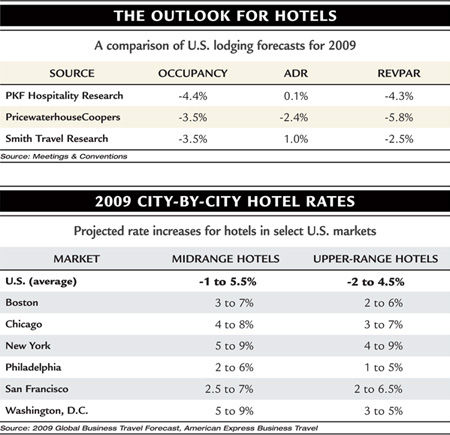
On the hotel front, PKF Hospitality Research, PricewaterhouseCoopers and Smith Travel Research all expect occupancy to slide, with estimates of decline ranging anywhere from 3.5 to 4.4 percent. If occupancy slips even more, hotel rates will follow, says Kathy Pruett, senior director, consulting, for Advito, a consulting unit of travel management company BCD Travel.
But dropping occupancy might not translate automatically to deals for planners. "Everything dropped after 9/11, and we gave away the farm," says David Scypinski, senior vice president, industry relations, for Starwood Hotels & Resorts Worldwide, on discounts and package deals that Starwood created to generate more meetings business. "We are trying not to be ridiculous about the deal. We saw what it did in the years when things got better. We are more sophisticated now, so we will be dealing carefully."
Still, PKF, PricewaterhouseCoopers and STR all predict declining revenue per available room (RevPAR) for 2009, by 4.3 percent, 5.8 percent and 2.5 percent, respectively, below 2008 levels. At the same time, major cities that have been affected the least by airline capacity cuts still will see growth in the hotel sector, according to the American Express forecast.
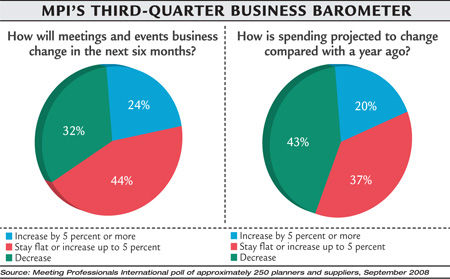
Meeting Professionals International's latest quarterly Business Barometer survey, sent to planners and suppliers before the stock market sustained significant losses in October, charts rising worries about 2009. While most of the 250 respondents remained optimistic that the level of meetings business would increase over the next six months, the percentage of respondents expecting meetings business to decline by 5 percent or more increased, continuing a year-long trend. In addition, more people reported a drop in attendance (34 percent) for recent 2008 meetings, compared with a year ago, than they did in the first-quarter survey. According to MPI's Barometer, large majorities believe that "travel cost trends" will have a negative impact on the business (73 percent), as will "airline flight schedules" (70 percent).
Furthermore, the Center for Exhibition Industry Research's latest Index report, with data from the first half of 2008, showed the first consecutive quarters of decline in the trade show industry (vs. the same period a year ago) since 2002.
"Next year, it will take a lot more work to maintain what we've done this year," says Amy Ledoux, vice president of meetings and expositions for Washington, D.C.-based ASAE & The Center for Association Leadership. Planners will have to work smarter and make more of an effort strategizing how best to spend precious dollars, she notes.
Uncertainty extends even to the impact industry trends will have on planners and how planners should react. Take, for instance, the trend of larger corporate groups booking meetings with shorter lead times. According to Tim Brooks, founder of Chicago-based Meeting Trader, a web-based revenue management and budgeting tool for hotels and meeting planners, that's good news for planners when it comes to getting deals from hotels desperate to fill rooms. "If you can book 60 days or nearer to the event, then, as always, you will get an exceptional deal at any hotel that still has space," he wrote in a white paper titled "Buying and Selling Meetings and Groups in an Economic Downturn."
But others aren't so sure. Advito, a consulting unit of travel management company BCD Travel in Atlanta, says the trend of short-term bookings robs planners of negotiating leverage.
Airlines: Clipped Wings
On Oct. 24, the International Air Transport Association released its traffic results for September, which showed a global drop in passenger numbers of 2.9 percent. (North America showed a drop of 0.9 percent.) In a statement, Giovanni Bisignani, director general and CEO of IATA, said, "The deterioration in traffic is alarmingly fast-paced and widespread. Even the good news that the oil price has fallen to half its July peak is not enough to offset the impact of the drop in demand."
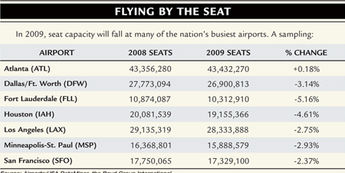
Flight capacity also has fallen, and fares have risen. An Oct. 29 report from the Official Airline Guide (to which all airlines report schedule changes) estimated that 265,000 flights will be lost in fourth-quarter 2008 -- 11 percent fewer departures than during the same period in 2007. Data from the Bureau of Transportation Statistics (BTS) shows that, in second-quarter 2008, the average U.S. domestic airfare was up about 8 percent over second-quarter 2007.
What follows is a look at how these three factors -- fares, capacity and demand -- will affect air travel next year.
Fares
American Express Business Travel predicts that domestic, short-haul, economy-class airfares could rise or fall by 5 percent in 2009. Fares for U.S.-origin business-class, international or long-haul flights are projected to rise by 1 to 6 percent.
"In keeping with global trends," the Amex report states, "the North American segment likely will see reduced capacity, increased ticketing restrictions, menu-based pricing (especially in the U.S. market) and stricter contract enforcement." Factors that could exert downward pressure on fares include decreased demand and potentially falling fuel prices.
Capacity
Flight capacity also is uncertain. Mike Boyd, president of aviation consulting firm the Boyd Group International, says he expects capacity to drop by 8 or 9 percent nationwide vs. 2008. But a spokesperson for the Air Transport Association, a trade group for U.S. airlines, notes, "Several carriers are revising their capacity numbers for 2009 and are reducing by less than they earlier said they would."
Demand
According to BTS, in July (the latest month for which data was available), 70 million people boarded planes in the U.S. -- a drop-off of more than 2 million passengers, or 2.9 percent, compared to July 2007. When taken together with IATA's report -- and considering what befell the financial markets in October -- it appears demand is on a downward slope.
But the airlines may not see things the same way. The ATA spokesperson says the airlines' scaling back of 2009 capacity cuts "shows that they are somewhat bullish on demand for next year." -- HUNTER R. SLATON
Other trends to note:
Scaling back on F&B. "The costs for
food-and-beverage suppliers and other groups that support hotels are
going up, and these increases will be passed to consumers," says George
Odom, senior director of global business development for Advito.
Aramark, a Philadelphia-based food-service provider for conference and
convention centers, says planners already are cutting back F&B and
requesting "more customized menus with lower-priced items." Smaller
portions and bundled meals will continue to be popular in the coming
year.
Cutting nonessentials. As corporations and
organizations cut back on nonessential travel, planners also will be
asked to eliminate meetings that don't produce good return on
investment and to scale back large meetings.
There also will be
pressure to reduce or eliminate extraneous parts of a meeting's
schedule, such as underperforming spousal programs, to save money, says
ASAE's Ledoux. For some of ASAE's multiday meetings, Ledoux says she's
consolidating the schedule to eliminate the need for an extra hotel
night.
Renegotiating attrition clauses. Hoteliers
expect corporate business to decline more than association business,
but association planners still fear weakening attendance. Tim Brooks
says planners should review attrition and cancellation clauses in hotel
contracts and be willing to offer hotels greater cash security or a
future booking to win concessions.
Still, Hyatt's Helms senses
economic hardship might lead hotels to remain tough on attrition.
"Hotel companies appear to be a bit more lenient on short-term business
but still are holding the line for group bookings beyond 90 days," he
says. Starwood's Scypinski agrees: "You will see less in terms of legal
forgiveness and more in terms of concessions, like discounting on
F&B," he says. "I don't think we will ease up on cancellations.
Yes, we do need the business, but for any contract we have with
financial people, you can't suddenly restructure the deal." -- TOM ISLER
The International Congress & Convention Association, based in Amsterdam, surveyed more than 200 of its members about the economy.
80% expect a slight or significant negative impact on 2009 meetings
78% do not expect staff reductions in 2009
70% expect budgets to remain on par with 2008 levels
More than 8% already have suffered a significant downturn in meetings activity
Hotels: Room for Improvement
The long shadow of this fall's stock market collapse has
reached the U.S. lodging industry, abruptly halting four consecutive
years of record-breaking, year-over-year profits. Going forward into
2009, hotel companies are facing a very different and challenging
landscape.
Lodging entered the fourth quarter of
2008 in the final stage of a seller's market. Supply and demand were
moving in opposite directions, room rate increases were slowing and
occupancy levels were falling.
"With the declining economy,
and considering the significant increase in new supply, it has quickly
shifted to a buyer's market," says Mark Woodworth, president of
Atlanta-based PKF Hospitality Research, adding, "This condition is
likely to persist well into 2010."
At this fateful juncture, it
bears looking more closely into the trends shaping the late-decade
reality for the hospitality industry, and the impact they likely will
have on the way meeting planners do business.
Rates and occupancy
According
to Hendersonville, Tenn.-based Smith Travel Research, there were 5,926
active hotel projects, representing 654,590 guest rooms, in the U.S.
hotel development pipeline in September 2008 -- 12.8 percent more than
in September 2007.
A glut of new hotel rooms, particularly in
cities such as Denver, Houston, Orlando and San Francisco, means
stiffer competition among hoteliers to hold the occupancy line without
sacrificing room rate. This is a difficult task, because the souring
economy has spurred a drop in transient corporate travel as well as
group business.
At the end of the first week of October,
according to a report released by STR, the U.S. hotel industry had
posted declines in all three key performance measures compared to the
same period in 2007. Occupancy had fallen 7.2 percent to 63.3 percent;
average daily rate declined 1 percent to $106.28, and revenue per
available room -- the industry benchmark for hotel performance --
dropped an astonishing 8.1 percent, to $67.24.
Hardest hit
were both the luxury and upper-upscale segments, which saw room rates
dip by as much as 16.3 percent. That, says Brad Garner, vice president
of client services for STR, "indicates midweek group and corporate
business are particularly weak."
And 2009, says PKF's Woodworth,
won't be much different. PKF is forecasting a 3.3 percent decline in
average occupancy (to 61 percent) for 2008, compared with 2007,
followed by another 4.4 percent dip in 2009. "This is the first year
since 1988 that the U.S. lodging industry will experience two
consecutive years of decline in lodging demand," Woodworth notes.
According
to the American Express Business Travel 2009 Global Business Travel
Forecast, which was released in late October, the double-digit
increases in hotel room rates that were standard during the past three
years are over.
"The current economic weakness will have a
downward effect on prices," says Frank Schnur, Amex Business Travel's
vice president of Global Advisory Services for North America. For the
U.S. hotel market, Amex forecasts anywhere from a dip of 1 percent to a
5.5 percent room rate increase in the midrange hotel sector, and from a
2 percent decrease to a 4.5 percent increase in the upscale sector.
In
late October, White Plains, N.Y.-based Starwood Hotels & Resorts
Worldwide reported a 12 percent drop in profits during the third
quarter of 2008, and said it expected its global RevPAR to decline 4
percent to 6 percent during this year's final quarter.
Rumbles in the pipeline
The
credit crunch has hit the hotel development pipeline squarely, as
nervous investors pull back from projects, citing economic uncertainty
in the capital markets. That is bad news for chains such as Washington,
D.C.-based Marriott International, which mostly manages hotels for a
franchise fee and bases its earnings forecast on whatever the pipeline
holds.
In early October, Marriott reported its third-quarter
RevPAR had fallen to 3.4 percent from a second-quarter high of 5.6
percent, and said it expected its fourth-quarter RevPAR to decline a
further 3 percent. In a statement, the company said, "given the
deteriorating financial markets, the company owners or franchisees may
decide to delay or cancel some of the projects included in the
pipeline."
One such cancellation involved a $425 million complex
in Tampa, Fla., which was to include a 226-room Ritz-Carlton. However,
Marriott, which said it expected to add approximately 30,000 rooms to
its global portfolio by year-end 2008, also expects to grow by another
30,000 to 35,000 rooms in 2009.
Also in October, Strategic Hotels
& Resorts, owners of the Fairmont Chicago, took a $36 million
penalty hit when it dropped plans for a $100 million, 225-room
expansion at the adjacent Aqua Building, which already had been under
construction.
Meanwhile, British-owned InterContinental Hotels
Group, the world's largest hotel company, with 1,788 projects in the
development pipeline at the end of the third quarter, said it expects
some of the properties, especially on the luxury end, to be delayed for
at least several months. ICH, which counts Crowne Plaza, Holiday Inn
and InterContinental among its brands, currently earns almost 70
percent of its income from its U.S. portfolio -- a segment, like so
many others, now girding for tough times ahead. -- CHERYL-ANNE STURKEN
M&C Web Exclusive: Insights from an Independent
From his perspective as an Orlando-based independent planner, Jim
Rye says clients are in a holding pattern. "After 9/11, there was an
immediate drop-off," says Rye, president of Rymark International, a
site-selection and event management company. People were saying, "I
can't do my meeting right now," says Rye, whose company employs seven
account managers.
"This time around, there's a sense that the
downturn will be deeper and longer-lasting. And people are reluctant to
make long-term plans. I don't see the knee-jerk, let's cancel a meeting
now, but I do see people holding back, saying, 'I'm not going to make a
decision right now that I don't have to.' "
An example: In
September, one of his best customers, a consumer products company,
signed contracts for a meeting next spring. Fewer than six weeks later,
the client's higher-ups ordered cuts, including this event. "They're
willing to pay penalties that will cost them a quarter of what they
would have spent," says Rye. He started working to find a way for the
hotel to get the clients there, rather than just negotiating an
attrition/cancellation fee. "My client told me, 'Jim, you don't realize
how much value you provide when things get ugly.' I think there's a
compliment there."
Rye also had an insurance meeting reduce its
incentive program by two days and is seeing clients wait to book
meetings that should already be well under way. "This was a two-tiered
program where top qualifiers got two extra days," he says. "Now they
just get nicer rooms, and it will save them about 12 percent of their
overall budget on the program."
Rye is doggedly determined to
stay afloat: "Let's say the meetings industry reduces by X percentage
of meetings, somebody is still selling a bunch of meetings. It's the
strong planners who will survive. I'd better think I'm one of those."
-- S.B.
Job Market: Opportunity Slows
 "This is the worst I've ever seen it,"
 says
Dawn Penfold, right, president of
Meetingjobs.com, when asked about
opportunities for planners. And that's saying a lot, since Penfold
started her company, a New York City-based international recruitment
firm, during a recession in 1990 and weathered the storms of 2001 and
2004. "There's just nothing out there," she adds.
Data
from the U.S. Bureau of Labor Statistics backs these observations. In
October, the unemployment rate rose from 6.1 to 6.5 percent, as the job
market lost 240,000 jobs, and the number of long-term unemployed (out
of work for 27 weeks or more) rose by 250,000.
Penfold uses
her job board as a barometer, noting one or two positions had been
posted each day in September, but by mid-October, only two jobs had
been posted that month. Plus, traffic has increased: On Sept. 29, her
site got 25,000 hits, and a few days later, 33,000.
Sheryl
Sookman Schelter, CMP, who runs the Meeting Connection in Novato,
Calif., sees similar trends. Furthermore, she is getting more requests
to fill contract positions than full-time jobs. "This tends to be the
case when companies are tightening a bit," she says. "They're not
refilling full-time positions."
Planners' perspective
For
those out looking for a job, it's likely to be a very long hunting
season. One planner with a CMP and 20 years of experience lost her
association job in April during a change in executive leadership. "I've
had some successful interviews, but I still don't have a job," says the
planner, noting she has seen some positions for which she has
interviewed be reposted three to six months later. "I don't know if the
organizations didn't find what they were looking for or if they didn't
really follow up in a timely manner. I have reapplied, but it's
frustrating."
She and Robert Meisnere, a Washington, D.C.-based
association planner who has been out of work since June, are making do
with temporary work. "What I'm doing now is stagehand work," says
Meisnere. "It's in the industry, but totally different."
He
adds that job postings have dried up since the beginning of September.
"And I'm not even getting interviews for jobs that I'm qualified for,"
he says. "I wish I knew why. I guess companies are trying to see if
they can make it with one less person, to help their bottom line."
Hanging on
Some advice for hard times from Penfold and Schelter:
• Your job might be cut, so have your résumé ready.
• Don't be too dependent on your work computer and your work e-mail.
• If you're at a stable organization, make yourself the internal expert. You want to be the last person to go.
• Network, network, network.
• When
evaluating opportunities, be flexible: Open up your geographic range,
adjust your salary expectations and take contract work if you can get
it. -- SARAH J.F. BRALEY