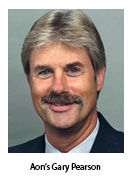
Gary Pearson had the good fortune in 2009 to deal with only two major meeting cancellations. Pearson, director of corporate meetings and events for Chicago-based Aon Service Corp., credits the insurance company's sound approval policy for limiting the number of ill-advised gatherings planned during the tumultuous time. But Aon's two cancellations were representative of the beating taken by the insurance and finance segments overall -- in both cases the decision to pull the plug was motivated by perception issues.
The first canceled event was to have taken place last January. Explains Pearson, "We were going to bring our top execs from around the world together in Miami, and with everything else that was going on [in the industry], our CEO just said, ‘No, that's not a smart move.' " The other axed event was the company's only incentive, set for last spring in Cancún, Mexico. That was postponed, due more to internal than external perception issues, says Pearson. "They froze salaries last year at around the same time, and I think they just decided, ‘How can we freeze salaries and let these guys go out and spend so much in Mexico?' So they decided to hold back on that, too." The incentive trip has been rescheduled for this April, again in Cancún.
In light of the hundreds of meetings canceled by high-profile recipients of Troubled Asset Recovery Program funds, Aon (not a TARP recipient) fared remarkably well. Pearson is confident that the company's group bookings will be strong in 2010, and there are indications elsewhere within the industry that financial and insurance company meetings are slowly getting back on track, while incentive trips proceed even more cautiously.
Taking the pulse About 100 meeting professionals gathered behind closed doors during last November's annual conference of Financial & Insurance Conference Planners, held in Toronto. "We asked them some questions about today and about moving forward," explains Jan Hennessey, FICP's vice president of communications. The FICP board was pleasantly surprised by some of the results. Although nearly everyone experienced cancellations in 2009, most in the room were back to booking meetings for 2010. Even more encouraging was the fact that about 20 percent of those gathered intend to book international events in 2010 and 2011.
A nearly unanimous show of hands indicated that meeting budgets would remain flat this year. Hennessey believes this validates the notion that meetings axed in 2009 are back on the books for 2010, even if they haven't yet been confirmed. Also reassuring: Among those who hadn't yet started booking meetings for 2010, several said their planning staffs were still intact. "To us, that means that leaders must believe meetings are coming back," Hennessey says.
Policy Matters
TARP guidelines issued by the U.S. Department of the Treasury require fund recipients to develop and post a policy and approval process that covers expenditures such as meetings and events. That served as a wake-up call to corporate officers -- whether or not they were TARP recipients -- that meeting policies must be in place and enforceable.
"We had a policy that was kind of loosey-goosey, and people were doing meetings all over the place," says Gary Pearson, director of corporate meetings and events for the Chicago-based Aon Service Corp. Then, in August 2008 -- well before the media maelstrom occurred -- Aon rolled out the StarCite meetings management platform to its U.S. employees. Pearson credits the platform with providing the means to gain control of meetings spend and policy, and avoid the pitfalls that could have otherwise occurred during last year's turbulence.
Upon rolling out StarCite, Aon instituted the "10-10-10 Rule": Any meetings with 10 or more people, or 10 or more room nights or a budget of at least $10,000 must be registered with StarCite and go through the approval process.
"StarCite changed our culture internally," says Pearson. "All we did was basically tighten up our policy a tad, but now we had a vehicle to help us enforce it. And it made everyone look and make sure that we were doing the right thing, that it was the right meeting to hold."
Such strategic planning has particular resonance in the financial and insurance segments, according to Charlene Rabideau, CMM, senior vice president of strategic meetings management for BCD Meetings & Incentives in Chicago: "We look very carefully at the business purpose and whether there is any risk, and we provide that information to the executive meeting sponsors."
Interest in strategic meetings management programs is particularly strong in these segments, says Kari Kesler, president and chief strategist of Minneapolis-based KK Strategic Solutions. "A well-designed SMMP provides the infrastructure to manage current business and regulatory requirements -- and, more importantly, manage changing requirements in a timely fashion."
Waiting game Despite the glimmers of a
rebound, financial and insurance types are slower to commit to meetings
business, and that reluctance is expected to continue. "Our lead times
were much shorter this year," says Aon's Pearson. "People were waiting
to see if they really could do it, or if they should do it or if they
could afford to do it -- and then, bing, they would enter a meeting
request into our group booking platform, and we would have to work with
the managers who needed to approve the meeting to make sure we could
get this thing going. But we were fortunate in the fact that because of
the financial situation, there was availability and decent rates."
Aon
is far from alone in this trend. Pam Ferguson, Chicago-based director
of global accounts, insurance, for Ritz-Carlton, is seeing a pickup in
short-term bookings for 2010 -- with a lead time in the neighborhood of
just 60 to 90 days. "It's meetings that typically would have been
booked further out, but finally they're realizing they need to have
those meetings," says Ferguson.
Isabel Mahon, Chicago-based
director of global sales for Fairmont/Raffles/Swissôtels, sees a
similar pattern. She's accustomed to clients booking events 18 to 36
months in advance. "But in the fourth quarter I definitely picked up
some business for 2010 from some of those big customers who canceled in
'09 and initially didn't book anything ahead, because they didn't know
what was going to happen."
Mahon and Ferguson both say they're
now booking more meetings for 2011. Meanwhile, the industry's hesitancy
over booking for the coming year promises to be a challenge for
hoteliers and planners alike. Hennessey and her colleagues at FICP had
the sense at their annual conference that many companies, though
intending to hold meetings in 2010, were waiting for 2009 to end before
making plans. "Our hospitality partners are thinking there's going to
be a real scramble -- a lot of short-term bookings in 2010. But once
people start having meetings and a precedent has been set, people will
come back into the water. Companies tend to follow the leader a little
bit. When one insurance company starts doing a rewards program for its
brokers, then others likely will follow."
Some companies are
being persuaded by third-party planners they've hired to book 2010
events now, notes George Aguel, senior vice president for Walt Disney
Parks & Resorts in Orlando. "The planners would like to lock in
some of these value opportunities while they're still there," says
Aguel. "It's just a matter of time; a lot of those values and
promotions out there will be scaled back."
Pearson is doing what
he can to change the mind-set of the meeting owners at Aon. "What I'm
worried about," he admits, "is the short lead time is going to come
back to bite us." A similar problem occurred after 9/11, when people
believed they could find availability and a decent rate at the last
minute. Adds Pearson, "We're getting in touch with the people who might
have booked a meeting a year ago, and saying, ‘Are you thinking about
doing this meeting again? Because if you are, I recommend you start the
process now and strike while the iron is hot. We can negotiate some
great rates.' We're trying to be proactive in that respect."
Toning it down Clearly, lessons have
been learned from the media backlash that occurred a year ago.
Companies in these segments must get back to meeting, but they're doing
so quietly and practically. "We heard that people were being a little
more conservative, trying to be a little more low-key," reports FICP's
Jan Hennessey. "People are being more cautious about luxury; they tend
to be more prudent. ‘Low-key' seems to be the term. And we're not
saying ‘under the radar,' necessarily, but not overly lavish. It's not
the time for that, and I wonder if that will ever come back. This is
the new normal."
For this market segment and others, a number of trends have emerged that define the low-key approach:
Stay on the continent. Despite
the international intentions revealed by FICP members, many companies
are booking closer to home. "Most are staying in North America," says
Mahon of her customers. "I certainly have booked some Europe, but
nowhere near what I historically have." Mahon also has booked a large
number of Mexico meetings in the last quarter, primarily among
customers who have traveled farther in the past.
Downsize. "Meetings
that were for 1,000 people are now for 500 people, with simulcasts and
webcasts added to extend the reach," says Hennessey. "That is common
and widespread right now. And if the meeting is successful at this size
and with those components, then it is unlikely that it will ever go
back to being a larger event."
Keep it quiet. "I've never
signed more confidentiality agreements than I have in the past few
months," says Fairmont's Mahon. Meetings are being carried out with
greater discretion and less publicity than ever before. According to
Pam Ferguson of Ritz-Carlton, that's just a necessary fact of doing
business now. "More than ever, we're being extremely cautious about our
pledge of confidentiality for our clients' programs," she says, "to
the point where if I'm in an airport on my cell phone, I will not say
the name of an insurance company that I might be talking to my office
about."
Choose words carefully. "Just what you call the
event is important," advises Hennessey. "It's a ‘program' or a
‘conference'. The word incentive is not used as much. And luxury is a
word that people are very careful about using."
Go to town. Urban
destinations, particularly in secondary cities, raise fewer eyebrows
than resort locations. "I've never seen our city hotels so actively
involved in the insurance market as they are now," says Ritz-Carlton's
Ferguson. "Even some of the incentive programs have gone to city as
opposed to resort locations."
Streamline. Attendees are
coming home from meetings and events with fewer goodies. "People are
cutting giveaways, turndown gifts, things like that," says Hennessey.
She adds, "Once that kind of thing gets cut, it's not so likely that
it's going to come back. When a trend like this takes hold, then if
you're out of line with what others are doing, it will get noticed."
Give back to the community. Companies
are diverting attention from the luxurious aspect of a rewards or
incentive trip by doing the right thing while at the destination. "When
we can, we definitely tie a social responsibility factor into it," says
Ferguson. "We have a community assistance program that we can tie into
a charitable activity, and we're finding that more and more companies
are incorporating that into their agenda."