WEB-ONLY EXTRA CITIES!
MontréalMontréal's wealth of fine French restaurants should come as no surprise. But the city's cuisine also is influenced strongly by its Greek, Italian, Portuguese and Jewish communities. The latter, in fact, is responsible for Montréal's smoked-meat deli sandwiches and bagels, commonly seen throughout the city.
Perhaps the most famous restaurant in town -- and just across from the convention center -- is the highly acclaimed Toqué! (514-499-2084; restaurant-toque.com/eng), which serves contemporary French cuisine with some fusion influences, spotlighting local Québec products. Private dining is available for up to 20.
Another popular -- though slightly less elite -- option is Chez L'Epicier (514-878-2232; chezlepicier.com), a combination restaurant and gourmet specialty-food boutique downtown. Chef Laurent Godbout serves creative variations on traditional Québec fare, combining local ingredients and international influences. The restaurant can accommodate groups of 10 to 100.
Seattle
The Pacific Northwest has become well known in the past 15 years or so for coffee, microbrews and local wine. Seattle has the foodie credentials to go with that beverage consumption, most notably in the way of fresh seafood and a pronounced Southeast Asian influence in much of its cuisine.
Perhaps no venue speaks more directly to Seattle's love of food than Pike Place Market (206-622-6198; pikeplacemarket.org). The nine-acre food and shopping venue began in 1907 as a way to connect farmers directly with consumers; today, it's a mecca not only for produce but also for fresh fish and a wide variety of restaurants.
Seattle residents place a heavy emphasis on environmental sustainability, an outlook that's well represented in the James Beard-nominated Tilth (206-633-0801; tilthblog.wordpress.com), which the New York Times named early this year as one of the top 10 best new restaurants in the country. Located in an unassuming house in Wallingford that seats just 40, Tilth is an intimate option for small groups. The restaurant has an organic certification from the organization Oregon Tilth, and chef/owner Maria Hines offers a seasonally changing menu featuring local organic produce, sustainable seafood options and homemade pasta.
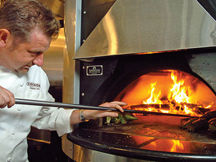 |
| Hog heaven: Cochon chef and co-owner Donald Link is fanning the flames of a revitalized New Orleans restaurant scene. |
If the way to your attendees' hearts is through their stomachs, the following cities should get you there fast. Each of these popular meeting destinations has food-love coursing through its major arteries, as evidenced by its food culture and varied restaurant options. Here we suggest a few good group venues that have won accolades from those who live to eat.
New Orleans
Even the names of New Orleans specialties carry an exotic tang, conjuring the smells and flavors of the region's unique culture: Andouille, boudin, beignet, jambalaya, chicory, po-boy, gumbo. The city's love of food has never been questioned, so it's no surprise that its recovery often is measured in terms of restaurants. According to the New Orleans Convention & Visitors Bureau, the city is now home to more than 950 restaurants, up from a pre-Katrina 809. Old landmarks such as Commander's Palace (established in 1880; 504-899-8221) continue the tradition of upscale dining, serving Creole specialties such as chef Tory McPhail's griddle-seared Gulf fish. Private dining is available in a variety of rooms, the largest seating 88.
The acclaimed Cochon (504-588-2123) is a relative newcomer, picking up a James Beard Best New Restaurant nomination in 2007. Here, regional concoctions such as fried alligator with chili garlic aioli are served in a casual setting with an open kitchen and a wood-burning oven. A private dining facility for up to 200 will open upstairs in January 2009.
San Francisco
This city, locals will tell you, is so rich in restaurants that every resident can eat out simultaneously and there will be a seat for all. To our knowledge this hasn't actually occurred, but odds are few would go hungry.
With nearly 5,400 restaurants, San Francisco ranks first in the United States in restaurants per capita, according to the National Restaurant Association. But even more impressive is the vast array of quality eateries. Two waterfront locations opened next to one another along the Embarcadero in January: Epic Roasthouse (415-369-9955) and Waterbar (415-284-9922) bear the touch of famed designer and restaurateur Pat Kuleto, and both feature second-floor private dining rooms with views of the bay. Epic, a modern steak house, hosts private groups of up to 60, while the aquarium-themed Waterbar, a seafood restaurant, can sit up to 50 in its private room.
Luce (888-811-4273) opened in February at the 550-room InterContinental San Francisco, just down the street from Moscone Center. Here California winemaker Michael Mondavi salutes Italy's Frescobaldi Winery with an extensive list of vintages complemented by Californian-Tuscan cuisine. A private dining room seats up to 14.
New York City
One of the world's undisputed culinary capitals, New York City is known as much for its snack staples as for its collection of celebrity chefs. When visitors (or residents) have had their fill of bagels and pizza -- and for some, this never occurs -- they needn't travel far to find an acclaimed restaurant.
Traditionalists can count on the classic American fare of Danny Meyer's Gramercy Tavern (212-477-0777), in business since 1994 and the winner of the James Beard Foundation's 2008 Outstanding Restaurant Award. Groups can take advantage of the elegant private dining room, which seats up to 22. For Mediterranean fare, try the "New Aegean" cuisine of Anthos (212-582-6900), opened last year in Midtown Manhattan by the team of Michael Psilakis and Donatella Arpaia and a 2008 James Beard Foundation nominee for the country's Best New Restaurant. Insieme (212-582-1310) opened last year in the 178-room Michelangelo hotel in Midtown, with a mix of classic and contemporary Italian fare. A private dining room seats 30.
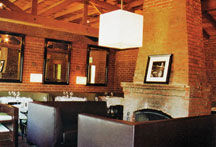 |
Where the hearth is: West
Hollywood’s Lucques |
Los Angeles
America's second-biggest city is a sprawling metropolis packed with neighborhood pockets of ethnic delectables. There's Koreatown, the varied Asian cuisine of the San Gabriel Valley, an Ethiopian oasis on Fairfax, even a James Beard award-winning taco stand called Yuca's (323-662-1214) in Los Feliz -- and that barely scrapes the surface.
Two of the hottest destinations to debut last year were Osteria Mozza (323-297-0100) and the neighboring Pizzeria Mozza (323-297-0101), opened by the foodie supergroup of Mario Batali, Nancy Silverton and Joseph Bastianich. Osteria has the more varied menu of the two and features a mozzarella bar, at which Silverton concocts delectable antipasti with a heavy emphasis on fresh Italian cheeses. Both provide private dining, with Osteria offering the larger option, for up to 40. Or consider chef-owner Suzanne Goin's Lucques (323-655-6277) in West Hollywood, an acclaimed local institution that has helped define Southern California cuisine for nearly 10 years.
One to Watch: Charleston
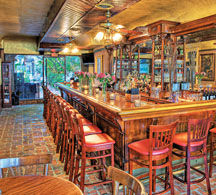 |
| Southern comfort: 82 Queen |
As a small city, Charleston, S.C., has a disproportionate amount of culinary talent. Unadorned low-country fare still is easy to find -- look no further than Jestine's Kitchen (843-722-7224). But an influx of cosmopolitan chefs has resulted in a unique strand of sophisticated Southern cooking, combining traditional dishes with flavors from around the world.
McCrady's (843-577-0025) offers dishes such as Hudson Valley foie gras with Carolina peaches, hazelnuts and black truffle; chef Sean Brock was named a rising star by the James Beard Foundation. At the Hominy Grill (843-937-0930), chef Robert Stehling took home the foundation's prize for top chef in the Southeast for items such as sesame-crusted catfish and classic shrimp creole.
For a more authentic, old-time Charleston atmosphere, and killer she-crab soup, 82 Queen (843-723-7591; ) has 11 private dining rooms spread among vintage 1788 colonial homes. -- TOM ISLER
Chicago
The big-shouldered Midwestern city known for its deep-dish pizza and
stacked beef sandwiches caters equally to the highbrow foodie and is
home to celebrity chefs such as Charlie Trotter and Rick Bayless.
In recent years, Chicago also has become a hotspot for the
science-driven, cutting-edge cuisine of young stars like Grant Achatz,
described by Chicago Magazine as "the perfect chef for the 21st
century." The 2008 recipient of the James Beard Foundation's
Outstanding Chef award, Achatz offers a wildly creative tasting menu at
his four-star Alinea (312-867-0110) in Lincoln
Park, one in which Guinness might be a foamy accompaniment to a navy
bean puree, and where caramel popcorn is served in liquid form.
Similarly postmodern cuisine is served at Moto in the Meatpacking
District (312-491-0058), where executive chef
wunderkind Homaro Cantu might be found experimenting with liquid
nitrogen and edible ink. Private dining for 30 is offered in the Red
Room.
Las Vegas
While all-you-can-eat prime rib buffets may have a certain charm, it's
safe to say Las Vegas isn't known for its rich and varied culinary
tradition. Its foodie history is remarkably short, born in the early
'90s with the growth of the Strip's sprawling casino hotels.
Wolfgang Puck was the first big name to arrive, in 1992, with Spago at
Caesars Palace (702-369-6300). Other acclaimed chefs
followed, such as Thomas Keller, Emeril Lagasse, Charlie Palmer and
Michael Mina. Most big-name chefs now run multiple restaurants in the
city, and it seems almost a necessity to feature a collection of these
names when opening a new resort.
Early this year, the Palazzo trumpeted the opening of new outposts by
Puck, Lagasse, Mario Batali and Charlie Trotter, with a SushiSamba
thrown in for good measure. This year also marked the launch of the Las
Vegas Michelin Guide, and 16 restaurants were awarded stars. The MGM
Grand's Joël Robuchon (702-891-7925), the only one
to earn a three-star distinction, marks the U.S. debut of the famed
French chef. Both six- and 16-course tasting menus are offered, as are
signature dishes such as La Langoustine. The restaurant holds up to 60,
and buyouts are possible.
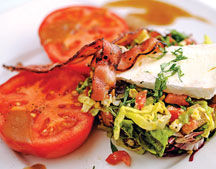 |
| Newberry Street treat: Sonsie's garden chopped salad with sheep's milk Camembert, sliced tomatoes and grilled slab bacon |
Boston
One would be hard-pressed to find traditional Boston cooking any more
traditional than in Durgin Park (617-227-2038) at
Faneuil Hall. A market fixture since 1827, Durgin Park's menu is a
tutorial in regional specialties: chowder, oysters, clams, lobster, New
England corned beef and cabbage. A variety of private rooms are
available for old-school-style events.
The North End is home to Boston's traditional Italian haunts, featuring
essentials such as the famous cannolis and "lobster tails" at Mike's Pastry (617-742-3050). For a more contemporary
interpretation of local cuisine there's Sonsie (617-351-2500;
sonsieboston.com), a favorite on Newberry Street since 1993 that now
offers a wine room downstairs for tastings and private events for up to
40. The James Beard-nominated Radius (617-426-1234) serves modern French cuisine and offers
private-dining options for groups of 18 to 60.