As a new year dawns, the many-faceted world of meetings continues to evolve in intriguing ways. Today, the industry is being appreciated as "absolutely critical in driving sales and marketing efforts for organizations," says Issa Jouaneh, vice president and general manager of American Express Meetings & Events. Among trends, he notes, "we're seeing compliance, risk management, global expansion and standardized processes playing increasingly important roles in enhancing the governance of events."
End-to-end meetings management is another key movement, notes Carlson Wagonlit Travel in its 2015 Meetings and Events Forecast, one that resulted in an average of 5 to 23 percent year-over-year global savings for CWT clients in 2014.
The practice of vendor consolidation is picking up steam in emerging markets across Latin America and Asia Pacific, based on success in North America and parts of Western Europe. Only China is bucking the trend, according to CWT, with most organizations there continuing to use a variety of suppliers for group air, hotel rooms, meeting space and ground transit.
Following is a more detailed look at major meetings industry segments and how they are expected to fare in the coming year.
HOTELS: Luxury Gets Pricier, Lead Times Shrink Further
"We've stopped using the term 'recovery' in the lodging industry," says Robert Mandelbaum, director of research information services for Atlanta-based PKF Hospitality Research, "and we're now saying it's in the 'sweet spot.'" Not only are occupancy levels reaching record highs and rates steadily climbing, but previously lagging group business has found its footing.
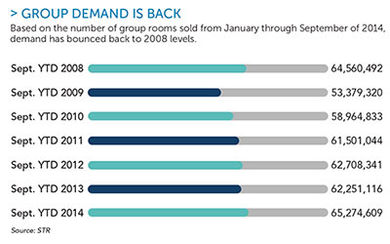
"Group demand is roaring back," notes Jan Freitag, senior vice president of strategic development for Nashville-based STR. "We are back to peak levels." In fact, the number of group hotel rooms sold between January and September of this year exceeds the same period in 2008 by more than 700,000 rooms.
And that means planners are likely to see significantly higher room rates in 2015. American Express Meetings & Events predicts group room rates will rise by about 4.6 percent in North America. PricewaterhouseCoopers, which doesn't separate projections for transient and group average daily rate, is forecasting a whopping 6.2 percent hotel rate increase.
Among other projections for the coming year in the hospitality realm:
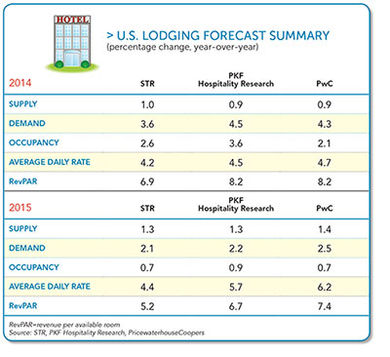
Top chain-scale segments will see the steepest rate hikes. "Our forecast for the luxury, upper-upscale and upscale segments have occupancy levels exceeding 72 percent for the next three or four years," notes PKF-HR's Mandelbaum. "At those levels, we're starting to see growth in room rates across the upper segments at two or three times the rate of inflation."
More planners will move to midscale. Given the higher rate increases at the top of the scale, it's only logical that more planners are turning to midscale properties to keep costs in check. It's the third consecutive year that American Express has noted a rise in group demand at mid-tier properties, points out Issa Jouaneh, vice president and general manager of American Express Meetings & Events, who adds that perception issues are still a major concern for planners in North America, Europe and Latin America. "Despite the overall recovery and positive outlook," he says, "that is absolutely still a focus." The midscale shift applies globally, adds Carlson Wagonlit Travel's forecast, although notable exceptions include Italy, Taiwan and India, where five-star properties still are considered the norm for meetings.
Shorter lead times could be trouble. Lead times for booking continue to get shorter around the globe, according to CWT's forecast. Germany's lead times have shrunk by half compared to a year ago, notes CWT, and lead times in India and Singapore can be as short as a week or 10 days for group air bookings. Lead times are down by 9 percent in North America as well, although planners who require high-end accommodations in large gateway cities won't be able to afford to wait, notes Mandelbaum, as availability will become increasingly scarce.
Hotels will hold firm on rates. Hoteliers increasingly have the leverage when it comes to room rates. "In general, if a hotel has to negotiate, it will be something other than rates," says Mandelbaum. "If they have to make concessions, it will be in things like Internet access, meeting breaks or meeting room rental."
Latin America rates could soar. Latin America likely will lead all regions in rate hikes, according to the 2015 Global Travel Price Outlook from CWT and the Global Business Travel Association. That report forecasts a 6.3 percent increase in managed rates in Latin America, well beyond the 2.6 percent global average rate for growth. North America is expected to have the second-highest increase, at 3.5 percent, while Europe's rates will be below average, at just 1 percent.
AIRLINES: Fares Up, Capacity Tight
"If you're making bets on anything," suggests Michael Boyd, president of Evergreen, Colo.-based aviation consultants Boyd Group International, "you can bet on airfares going up." The major North American carriers will continue to operate a lot of full flights, he points out, and they're not expanding their capacity by any significant numbers. A projected 1.1 percent bump in North America capacity, he adds, is due to some larger planes being put into service, but it won't be enough to keep fares in check.
According to the
American Express Meetings Forecast, a group air survey reveals anticipated rate increases of 2 percent for 2015 and 2.3 percent the following year -- steeper than this year's 1.6 percent increase. When broken down by region, group air experts expect North American-originating fares to increase by up to 5 percent. That's significantly higher than any other region, with hikes of 1.6 percent expected for Asia Pacific, 1.4 percent in Central/South America, and just 1 percent in Europe.
The annual price forecast from Carson Wagonlit Travel and the Global Business Travel Association, which looks at overall fares by region, paints a slightly different picture. While the global average forecast shows a similar 2.2 percent rise, Latin America leads all regions with a projected 3.5 percent hike in fares. The North American fare increase, according to CWT and GBTA, is a projected 2.5 percent.
Among other airline trends are the following.
Ancillary fees are here to stay. "We mere mortals can't dream of the fees that airlines will think up in 2015," says Michael Boyd. "There's no question they'll continue to increase." These fees are likely what's pushing the anticipated North American increase so high, according to American Express air experts, who add that carriers appear less willing to negotiate such fees given their occupancy levels. The positive side of such fees? "They have kept the fares down," says Boyd.
Lower-demand cities will be increasingly challenged by air capacity. The new, larger planes put into service will be done so strategically for markets in which a strong demand clearly exists, according to the Amex Meetings & Events Forecast. It will be hard to fly large groups into lower-demand destinations. "Convention centers in mid-size cities will have a hell of a time getting attendee movement from around the world, because there won't be the capacity to take them," notes Boyd.
Frequent-flyer award flights will be harder to come by. "Frequent-flyer programs have run their course and are outdated," says Boyd. "Airlines are really putting the squeeze on those: A free trip is going to eat up a lot more miles than it did five years ago, and you may not be able to get a seat anyway. Carriers will continue to be at 80 or 85 percent load factor, which means there simply aren't a whole lot of extra seats out there."
Group airfares will be reborn. "Our research shows that negotiating group air is worth the effort," says Issa Jouaneh, vice president and general manager of American Express Meetings & Events. "Integrating group air planning can benefit a meeting at all stages. Our survey shows that the integration of group air negotiations into meeting planning has become a common practice for roughly 30 percent of North American and European respondents, and nearly 50 percent of Central and South American respondents."
An air analysis, adds Jouaneh, is becoming increasingly useful to planners who need to ensure there is sufficient airlift into their potential meeting destinations.
Group Airfare Increases for 20152% Overall
5% North America
1% Europe
1.4% Central/South America
1.6% Asia Pacific
Source: American Express Meetings & Events Group Air Expert Survey,
August 2014TRADE SHOWS: The Slow Recovery Continues
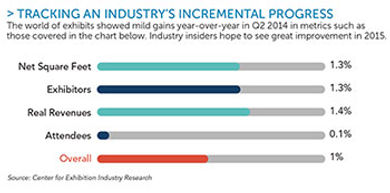
The trade-show industry has been steadily improving since the depths of the recent recession. In 2013, exhibition industry metrics (attendance, real revenues, exhibitors and net square footage sold) rose 1 percent on average, according to the Center for Exhibition Industry Research. This year, sources expect an increase of about 2 percent. Projections for 2015 show a 3 percent rise, says Brian Casey, president and CEO of CEIR. "The performance of the industry follows the performance of gross domestic product, which is good news because GDP is doing well." Models created by CEIR indicate that as long as the economy continues to grow, so will the exhibition industry.
Another good sign is dropping unemployment numbers, which generally go hand-in-hand with increased show attendance, according to Casey. "And if attendance is improving, the other three metrics are going to improve as well," he says, meaning more attendees will typically garner more exhibitor interest, which leads to more net square feet sold and additional show revenue.
While the industry outlook remains positive as a whole, this year and next are expected to remain tough for the government, education and nonprofit sectors. Other trends in the exhibition world include the following.
Industry consolidation will increase. On Nov. 18, Hanley Wood announced plans to sell its 17 trade shows and events to Informa PLC, a U.K.-based publishing and events company. The $375 million sale came just one month after UBM, a U.K.-based media company, purchased Advanstar Communications, which owns 54 trade shows, for $972 million. These were just two transactions in a year that saw an increase of 35 percent in mergers and acquisitions in the trade-show realm.
Such activity "continues to be a positive trend for our industry," says Dave DuBois, president of the International Association of Exhibitions and Events. As association or nonprofit shows, which tend to be more risk-averse, are purchased by for-profit companies, they are able to attain a better sense of security and growth, notes DuBois. But the trend goes beyond corporations buying association shows. "It's going both ways," DuBois says, noting that last year, the National Association of Broadcasters bought two events from JD Events, and this past September, PMMI, the Association for Packaging and Processing Technologies, owner and producer of Pack Expo, purchased Summit Media Group, a publisher and event producer for the packing industry.
CEIR's Brian Casey attributes the mergers and acquisitions to a stabilizing economy. "Businesses got conservative during difficult times and cut jobs, and they never replaced them even as business started to return," he says. "They have made money along the way and are sitting on cash, so as things begin to turn, they look at using that strategically to make those types of plays."
DuBois predicts the trend could continue into 2015. "There's still a lot of money on the sidelines," he says.
Attendees will be better informed. Show organizers will need to learn the ways of a work force increasingly dominated by Millennials. The good news is that "there's a high interest in face-to-face" among that demographic, says Casey. However, he notes, "They're coming to the floor much more educated because they've spent time researching, so on the exhibitor side, it's important that they have the right personnel to be able to answer questions as Millennials formulate their buying decisions."
Engagement will ramp up. With pressure on show organizers to engage their constituents, "Today we have to wow people on the trade-show floor," says DuBois. As an example, Casey cites the Healthcare Information and Management Systems Society's Interoperability Showcase, which was re-imagined for last year's annual show as an interactive exhibit designed to look like a hospital ICU unit. Attendees were able to view live product demonstrations in 22 clinical rooms and then take their experience and knowledge out onto the trade-show floor to meet with suppliers.
The fear factor could grow. Two major concerns that could affect industry growth are health scares and acts of terrorism, says DuBois.
Adds Casey, "When you take into account the economic impact of travel, hotels, exhibitors and convention centers, it's easy to see how fear can impact the economy."
INCENTIVES: A Rewarding Year Ahead
"This year has been a very good one for the incentive travel market, and the outlook for 2015 is positive as the global economy improves and business travel in general is on the upswing," says Kevin Hinton, CEO of the Chicago-based Society for Incentive Travel Excellence.
Two recent studies, by Site and the Incentive Research Foundation, support that claim. Per the IRF, 48 percent of 284 incentive professionals said their budgets would increase next year. When asked how they expect the economy to impact their travel programs, 67 percent reported either a somewhat or strongly positive outlook.
The Site study, based on 119 respondents whose firms use incentive travel, revealed that 52 percent of those polled expect the use of incentive travel will increase in the next six months, while 80 percent are similarly optimistic about the following six to 12 months.
Rising hotel and air rates remain a big challenge, says Hinton, requiring incentive pros to be much more thoughtful in planning their programs, e.g., booking travel 18 to 24 months in advance to get the best rates.
Other trends affecting incentive travel in the new year:
• Return on investment and/or return on objective continue to gain traction. Last year, 79 percent of Site respondents believed the emphasis on ROI/ROO would increase; this year 49 percent still expect the focus on such metrics will continue to intensify.
• In 2013, 80 percent of Site respondents said use of smartphone technology in program operations was important or very important, while this year the number jumped to 86 percent.
• Corporate social responsibility remains important for 56 percent of those polled by Site.
CONFERENCE CENTERS: Positive Signs; Slow Growth
Over the past five years, in step with the overall hospitality industry, conference centers -- purpose-built facilities as exemplified by members of the International Association of Conference Centres -- have watched their metrics improve in nearly every category. "There are no dramatic changes; this is the last sector coming back to the old normal," says Dave Arnold, CEO of Philadelphia-based PKF Consulting, which released its annual conference center trends study in November.
The report shows IACC facilities are again aiming to operate purely as conference centers, after seeking more leisure business to fill their rooms during the downturn, which IACC CEO Mark Cooper considers the most important finding. Yet, few new facilities are being built. Among projections:
No-builds will trump new-builds. "On a macro-level, across the industry, there isn't this gluttonous amount of development going on," says Alex Cabañas, president and CEO of The Woodlands, Texas-based Benchmark Hospitality. At least one project seems to be set: Benchmark has been involved with planning a center at a university; construction could begin next year. The company also is actively working on several other projects.
A slow pipeline is good news for current owners. The lack of new supply is helpful, says Cabañas, because group business is back and continues to grow. "Interestingly," he adds, "the booking cycle is still not as long as we would have thought. There are so many tools available for meeting planners to find space, it's giving them the freedom not to book so far in advance."
More hotels will tap into the conference market. "I think hotels are putting some effort into figuring out how to handle smaller meetings," says Arnold. "The exclusivity that conference centers used to have is being eroded by savvy hotels."