For the 10th consecutive year, M&C takes an in-depth look at the business of planning meetings, conventions, trade shows, incentive programs and other events outside the United States. Our survey of 411 meeting professionals -- 278 of whom mainly plan corporate events and 133 who chiefly organize association meetings -- reveals where U.S. groups met in 2012, where they will meet in 2013 and 2014, and the top international destinations for this year and next.
Among other topics addressed: what planners consider when choosing international destinations, the types of events they plan, the types of services they use, their budgets for international meetings and more.
Top Spots in 2012
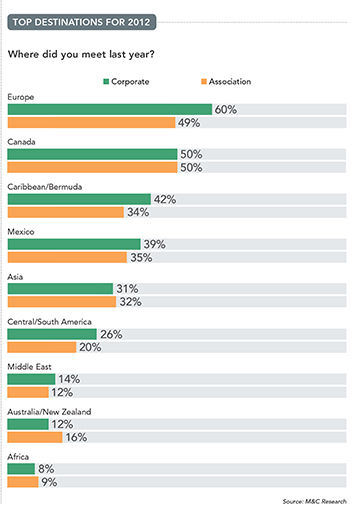
Europe was the top international destination for U.S. corporate events last year, according to 60 percent of those polled. Canada was the second most popular spot, per 50 percent of respondents, followed by the Caribbean/Bermuda (42 percent) and Mexico (39 percent). Rounding out the list were Asia (31 percent), Central/South America (26 percent), the Middle East (14 percent), Australia/New Zealand (12 percent) and Africa (8 percent). Seven percent said their company or clients did not meet outside the U.S. in 2012.
On the association front, Canada was the top destination (cited by 50 percent), followed closely by Europe (49 percent), Mexico (35 percent) and the Caribbean/Bermuda (34 percent). The list was rounded out by Asia (32 percent), Central/South America (20 percent), Australia/New Zealand (16 percent), the Middle East (12 percent) and Africa (9 percent).
Current Picks: 2013
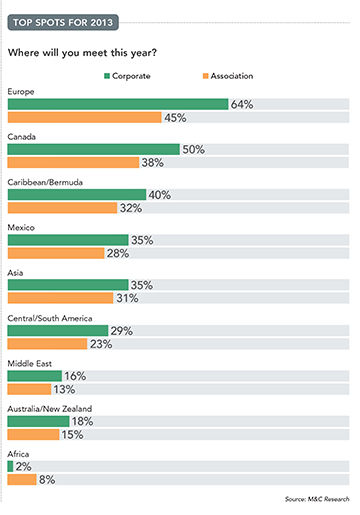
This year, Europe retains the top spot for corporate meetings held outside the U.S., according to 64 percent of respondents. The next most popular regions are Canada (50 percent) and the Caribbean/Bermuda (40 percent), followed by Mexico and Asia (each cited by 35 percent), Central/South America (29 percent), Australia/New Zealand (18 percent), the Middle East (16 percent) and Africa (2 percent). Just 5 percent of corporate respondents will not hold international meetings this year.
Europe (45 percent) edges out Canada (38 percent) this year as the top destination for association events, while the Caribbean/Bermuda comes in third place, according to 32 percent of those polled. Asia (31 percent) is next, followed by Mexico (28 percent), Central/South America (23 percent), Australia/New Zealand (15 percent), the Middle East (13 percent) and Africa (8 percent). Fourteen percent of association planners surveyed said their organizations will not meet outside the U.S. this year.
Planning for 2014
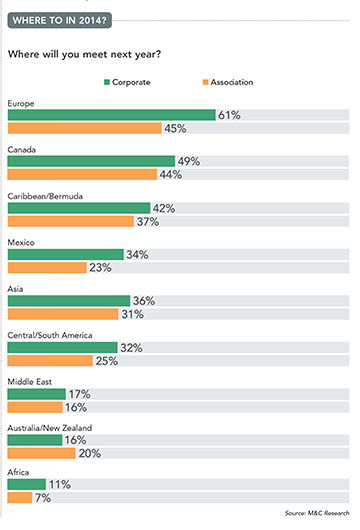
Next year, Europe will retain its top spot for 61
percent of corporate planners surveyed. Canada again will rank second,
as 49 percent will hold events there, followed by the Caribbean/Bermuda
(42 percent). Next most popular for 2014 will be Asia (36 percent),
Mexico (34 percent), Central/South America (32 percent), the Middle East
(17 percent), Australia/New Zealand (16 percent) and Africa (11
percent). Six percent of respondents do not plan to hold meetings
outside the U.S. in 2014.
On the association side, Europe (45
percent) will again edge out Canada (44 percent) as the top
international destination in 2014. Likewise, the Caribbean/Bermuda will
retain its ranking as the third most-popular global destination for
associations, per 37 percent of respondents, followed by Asia (31
percent), Central/South America (25 percent), Mexico (23 percent),
Australia/New Zealand (20 percent), the Middle East (16 percent) and
Africa (7 percent). Ten percent of association professionals polled said
their organizations will not meet internationally in 2014.
Events at a Glance•
Type of meeting. Among the types of meetings corporate planners hold
outside the U.S. are general meetings (72 percent), incentive trips (46
percent), board meetings (38 percent), trade shows (29 percent) and
product launches (21 percent).
For association planners, 74
percent plan annual meetings to international destinations, followed by
trade shows/conventions (52 percent), board meetings (42 percent) and
chapter meetings (27 percent).
• Number of meetings. A majority
(57 percent) of corporate respondents typically plan one to five
international meetings annually; 21 percent plan six to 10; 12 percent
plan more than 20; 6 percent plan 11 to 15, and 4 percent said they plan
16-20 meetings or more.
Seventy-three percent of association
respondents typically plan one to five meetings outside the U.S. per
year; 11 percent plan six to 10; 8 percent plan more than 20; 5 percent
organize 11-15, and 3 percent plan 16-20 meetings.
More than one
quarter (27 percent) of corporate planners said their companies will
hold more international meetings in 2013 than last year, 64 percent will
hold the same number of meetings and 9 percent will see a decrease in
the number of global meetings this year over last.
The majority
(71 percent) of association planners said the number of international
events this year will stay the same; 21 percent will see an increase,
and 8 percent said the number will decrease from 2012.
Looking
ahead, 28 percent of respondents will hold more meetings outside the
U.S. next year, compared with 2013; 66 percent foresee no change and
only 6 percent expect a decrease.
For associations, 70 percent of
the planners polled expect the number of events to stay the same in
2014 compared with 2013; 27 percent predict an increase and just 4
percent expect the number to decrease.
• Size of groups. More
than half (54 percent) of corporate respondents said their group size
for international events will stay the same this year compared with
2012; 22 percent said the number will increase, and for 9 percent it
will decrease; 15 percent were unsure.
The majority (51 percent)
of association planners also said group size will remain the same in
2013. Twenty-seven percent of those polled expect there will be an
uptick in group size, and 8 percent said there will be a decrease.
•
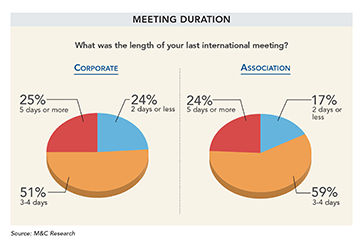
Duration of events. The majority (51 percent) of corporate respondents
said their last international meeting ran three to four days, while 25
percent met for five days or more, and 24 percent gathered for two days
or fewer.
Among association planners, the duration of their last
meeting was three to four days for 59 percent of those surveyed,
followed by five days or more (24 percent), and two days or fewer (17
percent).

Positive Influences
What factors
matter to corporate planners when they evaluate international
destinations? Top criteria are reputation of the destination, cited by
72 percent of those polled, closely followed by quality of
accommodations (71 percent), security (65 percent) and good airlift (64
percent).
Size and availability of meeting facilities matter most
(59 percent) to association planners polled, followed by good airlift
(58 percent), reputation of the destination (54 percent) and quality of
accommodations (52 percent).
Decision Makers
While
planners research and recommend destinations and venues for
international events, others play a role in the decision process. For
corporate meetings, a plurality (47 percent) of those polled said the
choice ultimately is finalized by the CEO or other top-level executive,
followed by a team of planner and third party (15 percent), director of
marketing or sales (13 percent), the planning department (11 percent),
the travel manager/director (2 percent) and the procurement department
(1 percent).
Among association planners, 32 percent said the
board has the last word in international site selection, followed by the
CEO or other top-level executive (29 percent), a team of planner and
third party (17 percent), the meeting chairperson (11 percent) and the
planning department (6 percent).
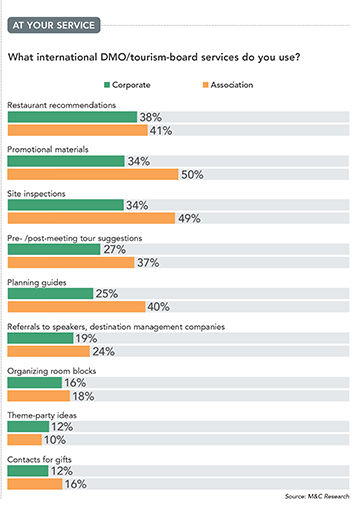
Seeking AssistanceWhen
reaching out to national tourist offices or other destination marketing
organizations, the services corporate planners most often seek are
dining tips (per 38 percent of those surveyed), followed by promotional
brochures, maps and videos (34 percent), and setting up site inspections
(34 percent).
For association planners, promotional materials
(brochures, CDs, maps) remain the top reason to consult DMOs, cited by
50 percent of respondents, followed by arranging site inspections (49
percent), restaurant recommendations (41 percent), requests for meeting
planning guides (40 percent) and pre/post-event tour suggestions (37
percent). (For more findings on destination services, see sidebar, "At
Your Service," page 20.)
Email is the best way for international
suppliers to reach corporate planners, according to 87 percent of those
polled, followed by familiarization trips (46 percent), trade
shows/networking events (41 percent), internet/other resources (34
percent) and in-person meetings with representatives (26 percent).
Most
association planners (87 percent) also prefer email from international
suppliers, followed by fam trips (47 percent), trade shows/networking
events (40 percent) and in-person meetings with representatives (38
percent).
 Bed and Heads
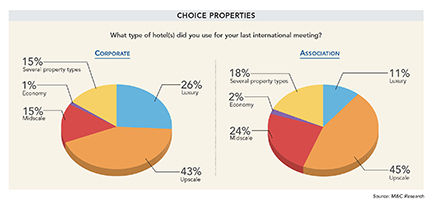
When it
comes to selecting accommodations for their attendees, 43 percent of
corporate planners polled bring groups to upscale hotels. Others use
luxury (26 percent) or midscale (15 percent) properties. Another 15
percent of respondents use a combination of the above. Just 1 percent
used budget properties for their international events this year.
Upscale
properties also are the top choice (45 percent) of association
planners, followed by midscale (24 percent), luxury hotels (11 percent)
and budget hotels (2 percent); 18 percent use a combination of hotel
types for their meetings abroad.
On costs, 86 percent of
corporate planners polled and 79 percent of association respondents said
guaranteed prices in U.S. dollars makes an international destination
more appealing.
INCENTIVE UPDATE
For the second year
in a row, more than 80 percent of corporate respondents who hold
motivational events will do so outside the U.S. this year and in 2014.
As
projected in our 2012 survey, the Caribbean/Bermuda is the top
destination by far for incentive programs this year, according to 54
percent of respondents. Mexico takes second place, cited by 41 percent,
followed by Europe (38 percent), Canada (23 percent), Central/South
America (18 percent), Asia (14 percent), Australia/New Zealand (10
percent), the Middle East (8 percent) and Africa (4 percent).
For
2014, the numbers are very similar. The Caribbean/Bermuda will retain
its top spot, according to 53 percent of those polled, followed by
Mexico (37 percent), Europe (34 percent), Canada (28 percent),
Central/South America (19 percent), Asia (16 percent), Australia/New
Zealand (10 percent), the Middle East (9 percent) and Africa (8
percent).
As for the size of incentive groups in 2013, half of
those polled will see no change from last year; 26 percent will host
more participants and 8 percent anticipate a decrease.

RELATIONSHIPS MATTER
National tourist
offices, convention bureaus and other destination management
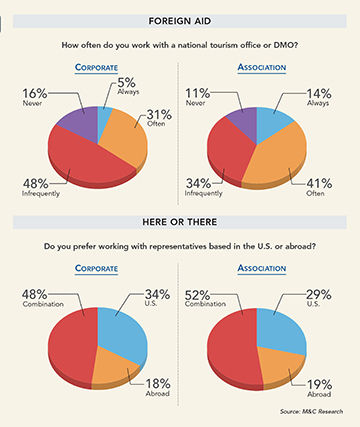
organizations offer assistance to planners, but nearly half (48 percent)
of corporate professionals surveyed say they use such resources
infrequently. Another 31 percent use them often, 5 percent always use
them and 16 percent never use their services.
Not surprisingly,
for 69 percent of planners, having a personal relationship with an
international supplier (such as a hotelier or destination management
executive) influences their destination decisions. Another 15 percent
said such connections matter very little, and 9 percent said they have
no effect.
Association planners are more apt to take advantage of
NTO/DMO offerings: 41 percent use them very often, and 14 percent
always use their services; 34 percent use them infrequently, while 11
percent never use them.
Seventy-one percent of association
planners said personal relationships affect their destination decision,
while 17 percent said they had little influence and 4 percent said they
had no influence.
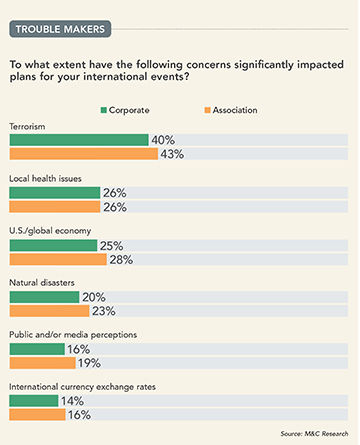
WHY THEY WORRY
Terrorism remains the
most pressing concern for both corporate and association meeting
professionals; 40 percent and 42 percent of respondents, respectively,
said it significantly influences their plans concerning international
events.
Another key consideration affecting plans is the
U.S./global economy, according to 25 percent of corporate and 28 percent
of association respondents.
Other worrisome factors include
local health concerns (per 26 percent of both corporate and association
planners) and natural disasters (according to 21 percent of corporate
and 23 percent of association planners).