Defining Carbon Neutral
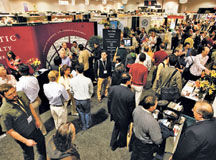 |
| Bean there: The SCAA's 2008 event |
What's a carbon-neutral conference? It helps to first define a "carbon footprint." According to the Environmental Protection Agency, that term describes "the amount of greenhouse gases emitted into the atmosphere each year by an entity." The process of correcting this imbalance is called "carbon offsetting," which means reducing emissions through projects such as reforestation and investment in renewable energy sources. An event that incorporates such efforts to counteract its total carbon emissions is considered carbon neutral.
However, running a green meeting requires a commitment to sustainable practices that goes beyond neutralizing the carbon footprint. According to Shawna McKinley, former executive director of the Green Meeting Industry Council and project manager for Portland, Ore.-based green meetings and events company Meeting Strategies Worldwide, planners need to adopt practices such as meeting closer to where most attendees live, reducing giveaways and promoting the reuse and recycling of materials. (For more ways to green a meeting, see this month's
Checklist.) -- K.H.
The Long Beach, Calif.-based Specialty Coffee Association of America is serious about sustainability. For its 2007 and 2008 annual conferences, the group offset all carbon emissions produced by the events (which drew approximately 8,000 attendees each) while working actively with host convention centers to create sustainable programs. But what sets this association apart from other green-meaning groups is this year's unlikely source of funding: the attendees themselves.
At the 2008 conference, held in Minneapolis in May, the SCAA collected $28,000 -- about 80 percent of the total cost of offsets for the event -- from conventioneers alone, by establishing a mandatory but modest carbon-offsetting charge. Instead of asking for voluntary contributions, as the group had done the year prior, attendees were required to tack on $7.
There was more involved than simply mandating the extra fee, however, and the SCAA's efforts can serve as a blueprint for other groups that wish to improve their record on environmental impact.
Choosing a partner
The first step for the SCAA entailed selecting a company to work with that specialized in carbon offsetting and whose method -- whether tree planting, investing in renewable energy or promoting energy efficient projects -- was a good fit for the association. SCAA executive director Ric Rhinehart and the group's sustainability committee researched various organizations and ultimately decided to go with Trees for the Future, based in Silver Spring, Md.
The nonprofit TFF, a reforestry company, "has an agroforestry background, so they know what kinds of trees to plant together, and what plants will do more damage than good," notes Jason Long, SCAA sustainability committee member and a longtime advocate of carbon-neutral initiatives. For the communities benefiting from the replanting, he adds, "it's less about going carbon neutral and more about people needing trees."
Choosing tree planting as a carbon offsetting method made sense for the SCAA, says Rhinehart, "quite simply because coffee grows on trees. Coffee is grown under very specific conditions, so climate change is a huge concern for us. We are hyperaware of its effects."
Crunching the numbers
To estimate the total emissions expected to be produced by the conference, including activities such as attendees flying or driving to the event, staying in hotels, using public transportation, etc., TFF executive director Dave Deppner performed a "carbon count." By his calculations, charging an additional $4.85 per person would raise the funds needed to offset the group's carbon damage. This would be listed as a separate charge on top of the basic registration fee of $385 for members and $585 for nonmembers.
Implementing the fee
Introducing a mandatory charge at the point of registration proved
somewhat problematic, in part due to the event's convoluted
registration process. For starters, a small percentage of delegates,
including retailers, new entrants and staff members of exhibitor
companies, traditionally are invited to attend the conference free of
charge. "Once there was a charge involved, free was suddenly not
exactly free," Rhinehart confesses.
The solution was to raise the fee from $4.85 to $7 per attendee, and to
make the charge optional for those who normally would have attended for
free. "They were encouraged to pay the offsetting fee," says Rhinehart,
"but they were not required to do so."
Though the majority of those given a choice did pay the fee, the
organization fell short of its monetary goal. "We had to supplement the
payment to Trees for the Future by $7,000 out of pocket," notes
Rhinehart.
Lessons learned
Postconference feedback to both the SCAA and TFF was positive.
Rhinehart was proud of the reaction to the carbon-neutral program. "We
believe we got the message out loud and clear, and we will continue to
be very vocal about it," he enthuses.
Indeed, the association plans to put an even greater emphasis on
environmental initiatives in future registration campaigns. "You need
to really market and implement the concept, and let attendees know how
they're making a difference by contributing," says Rhinehart.
TFF's Deppner was equally pleased with the response: "We had a booth at
the trade show, and hundreds of people came over to congratulate us,"
he says. "It was well received by the attendees."
According to Deppner, it costs TFF an average of 10 cents to plant a
tree. After administration and fundraising fees, the SCAA's total
$35,000 contribution will allow approximately 350,000 trees to be
planted in developing communities across the globe.
The SCAA is committed to keeping the annual conference a carbon-neutral
event and in time hopes to extend the concept to all of its association
meetings. More immediate initiatives are in the works. For example, at
next year's gathering, to take place in Atlanta, the cost of offsetting
the conference will be bundled into the admission price, as opposed to
being highlighted as a separate fee.
Moreover, the group will roll out a new initiative at the 2009
conference: Water-filtration company and SCAA member Cirqua Customized
Water will use an on-site purification system to purify Atlanta's tap
water for brewing coffee at the event and providing bottles of water to
attendees, thus saving the carbon emissions produced from shipping
bottled water to the conference.
In other words, for SCAA events, environmental stewardship has become standard operating procedure.