Meeting planners and procurement specialists don't always see eye to eye -- and that's putting it mildly. "The bottom line is, procurement doesn't understand the value of relationships and networking," says one corporate planner, "which in our minds is a key component. Everything is just black and white to them, or numbers on a computer screen. They just don't get how important relationships are when working with hotels."
Sound harsh? The planner quoted above actually works within the procurement department, but proximity hasn't helped the two sides come together at all. In fact, he occasionally uses vacation days in order to attend conferences or networking events his boss in procurement deems unnecessary. Discussion of the subject has led nowhere.
"Many people kind of roll their eyes and say, ‘Oh God, here comes procurement,' " says Kevin Iwamoto, who served as global travel commodity manager at tech giant Hewlett-Packard for more than 10 years, where he managed procurement contracts and suppliers, and was responsible for worldwide purchasing strategies. While he readily admits that the interaction between planners and the purchasing folks can be dicey, he also knows that it doesn't always have to be that way.
Iwamoto was one of the first industry executives to publicly recognize the benefits of converging corporate travel and meetings management, and he founded the Groups and Meetings Committee of the National Business Travel Association in 2003. As such, he has witnessed firsthand the evolution of a sometimes uncomfortable synergy. "It's a complex relationship," he says, "but more and more companies are demanding that synergy takes place, especially in light of what's happened with the economy, and with some companies being criticized for their spending or their lack of process when it comes to spending or documentation."
Now vice president of enterprise strategy for the Philadelphia-based meetings technology provider StarCite, Iwamoto is quick to add that he's seen great relationships develop between meeting organizers and procurement specialists. But he says there remains a need to demystify procurement's role.
"At the end of the day, you both want what's best for the company," says Iwamoto. "And it's not going to go away. If dealing with procurement is a part of your job, you need to figure out the best way to do that."
Survey numbers back up Iwamoto's assertion. According to a study conducted by the CWT Travel Management Institute between September 2009 and March of this year, 50 percent of meeting professionals expect procurement's involvement to either increase or strongly increase in the coming years. An additional 35 percent of the 222 international planners who responded predict procurement's influence will remain at current levels.
Aligning objectives A procurement department's priorities will differ based on an organization's size and needs. That said, their motives generally will be driven by three key perspectives, according to Issa Jouaneh, vice president, Maxvantage and Global Meeting Solutions for New York City-based American Express Business Travel. He breaks it down as follows.
• Transparency. Procurement wants to understand an organization's total spend across the company.
• Control. "Procurement is looking to have a process in place that approves and documents the meetings that are happening within an organization and have a clear process in place to protect the organization," Jouaneh explains. An effective process mitigates risk, an increasingly important concern in a number of industries.
• Savings and value. Procurement is focused on driving savings throughout the organization by reducing the total cost of meetings.
It's important to keep in mind those drivers when communicating with members of the procurement department. "Being proactive is critical," advises Jouaneh. "It's important for planners to demonstrate the cost savings that can be generated from their meetings, and also the business impact and results that meetings will drive to the organization."
Sharing expertise 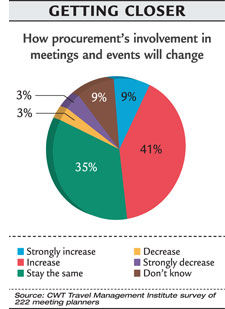 While speaking the
language of procurement is key, the sharing of information and
priorities should be a two-way street, notes Tony Wagner, vice president
of meetings and events for Minneapolis-based Carlson Wagonlit Travel. A
meeting planner should understand and acknowledge procurement's
objectives, says Wagner. "The more that a planner can be proactive and
say, ‘I understand those things, but these are my requirements, and this
is how we measure them internally,' the more effective the relationship
is going to be."
While speaking the
language of procurement is key, the sharing of information and
priorities should be a two-way street, notes Tony Wagner, vice president
of meetings and events for Minneapolis-based Carlson Wagonlit Travel. A
meeting planner should understand and acknowledge procurement's
objectives, says Wagner. "The more that a planner can be proactive and
say, ‘I understand those things, but these are my requirements, and this
is how we measure them internally,' the more effective the relationship
is going to be."
This approach is important, Wagner notes,
because procurement specialists might not have the depth of
understanding of what goes into a meeting or event, and will make
certain assumptions based on the experience they do have. If they're
more involved with transient corporate travel, for instance, they might
try to apply a more transaction-based approach to meetings and events.
"And that can lead to some challenging relationships internally," Wagner
says.
To counter these concerns, planners should share
information such as what kind of experience is required from a supplier;
the level of service needed; expected response times for given
situations; and metrics the department typically uses to measure success
for various types of events.
"The more of that work that can be
explained up front, the more procurement can be an ally vs. a threat,"
says Wagner. "But a lot of times, planners don't articulate those unique
requirements or their metrics or their scope of service. In that case,
the default for procurement will be to go to the lowest common
denominator -- which may be the benchmark from transient travel, it may
be price -- and procurement will not understand the unique service
requirements of those meetings or events."
If those lines of
communication are not wide open, planners should take responsibility to
address the problem, says Kevin Iwamoto. "If somebody's not getting it,
and they're getting in your way, it's incumbent upon you to make sure
that they at least get the fundamentals to understand what your business
is, so that they can help you," he advises. "The reverse -- ‘You don't
understand me so I'm not going to cooperate' -- is not going to work."
Rules of engagement The
biggest complaint Iwamoto hears from planners about working with
procurement concerns the turnaround time required in their processes --
specifically those related to contracting. The procurement folks might
have lengthy processes to follow, while the meeting planner needs to
make quick decisions to cope with truncated lead times.
"I always
ask the planner, ‘Have you communicated to procurement the nature of
your urgency and your short lead times?' Because if you do, they can do
things that will speed up the process," notes Iwamoto. He points to
hotel or venue contracts as one example: "What a lot of companies have
done to short-cycle that process, and make sure they're adequately
covered legally and financially, is to come up with a specific addendum
for a hotel contract that's presented to the planner. An addendum
overrides the contract and has basic safeguards in place. That can turn
around the need for a complete review process."
Most effective is
when the timetable-related "rules of engagement" are set out ahead of
time and addressed on a case-by-case basis when required.
Because
adherence to process is so important for a procurement department to
operate effectively and efficiently, it's important to discuss how to
handle exceptions to that process. "Everything doesn't always run
perfectly," acknowledges Iwamoto. "You're going to have one-offs, you're
going to have exceptions. So it would be really good to establish an
exception process with procurement, so if something you're working on
doesn't fall within the norm, you know exactly what to do."
With
an exception process already in place, planners and procurement
specialists can save a significant amount of time when those one-offs
arise. But don't expect miracles, advises Iwamoto -- one-offs are going
to take more time. Procurement might need to consult with legal, and
higher-ups might need to authorize the override. "Those people aren't
just waiting around for that paperwork to come to their desks," he adds.
The right involvement Ideally,
procurement's involvement in meetings and events should be welcome. As
internal process and efficiency experts, they can streamline many
aspects of the business -- and perhaps even lighten planners' workloads
by taking on more duties centered around contracting. It's only when
planners are not forthcoming with data, or are less than cooperative in
adhering to procurement's process, that procurement's involvement is
more likely to be intrusive.
"The more you can come across as
being the expert in your field, and back it up with data and metrics in
their language, the better that relationship can be," says CWT's Tony
Wagner. "You'll be viewed as internal experts, and not barriers to
achieving the goals of savings and risk reduction."
The opposite
is all too common, Wagner admits. "A lot of times we'll see planners
who want to resist providing any data to procurement," he says. By
holding on to that information, planners might maintain more complete
control of meetings, but only in the short term. "If you resist sharing
that information and you don't speak their language, it may not hurt you
in year one or year two, but eventually procurement will make a
business case to get more involved, and you may be left out of that
discussion."
Click on the chart to see how procurement can help.