Though each has its own signature charms, Monaco, Dubai, Hong Kong and South Africa share an alluring image of glamour and luxury. The Lifestyles of the Rich and Famous aspect made them appealing destinations for U.S. meetings and incentives in the past, but in this buttoned-down era of corporate responsibility, has the reputation for glitz become a liability? M&C spoke with government officials and suppliers about how they are coping with recent drops in business and what they're doing to woo U.S. groups back.
Monaco
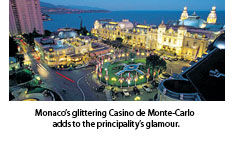 In this jewel-like Mediterranean principality, still ruled by a royal family, U.S. corporate business -- chiefly from the financial and insurance sectors -- came to a screeching halt in late 2008. Besides the large number of cancellations of programs set to take place this year, "we had months with virtually no requests," according to Cindy Hoddeson, director, meeting and incentive sales, for the Monaco Government Tourist Office in New York City. Overall, business from North America was down 31 percent in 2009 from 2008 figures, according the MGTO.
Hoddeson says Monaco definitely suffered because of perception: No corporations wanted to risk bad press for meeting in a European playground. She cites one financial firm that gave its employees cash rewards in place of a trip to Monaco -- a move that ultimately cost more than the scrapped Monaco program.
"We are starting to see business come back slightly," says Hoddeson. However, she adds, the type of business is different now: Direct-sales firms (meaning independent, home-based sales reps) are the main focus of Monaco's sales effort, since many use incentive travel as a big part of their compensation strategy, and "they're less concerned with perception than other types of companies."
The tactic has paid off. Among the direct-sales companies that will hold incentives in Monaco in 2010 are cosmetics firms Mary Kay and Avon. As for her former financial/insurance customers, Hoddeson is staying in touch, keeping them up-to-date on developments and letting them know about the special guaranteed U.S.-dollar rates that a number of properties are offering (see visitmonaco.com for details). "We want to keep a presence so that when things do turn around, they will not have forgotten us," she notes.
Meanwhile, the Monaco Government Tourist Office is not downplaying its luxe factor. "You can't be everything to everybody," says Hoddeson. "We are focusing on value, but not trying to change. We are known for luxury."
Hong Kong
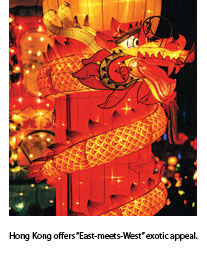 With its stunning harbor, world-class shopping, five-star-plus service and East-meets-West exotic appeal, Hong Kong has earned its spot as one of Asia's premier meeting and incentive capitals. But the global recession has taken its toll on the destination, now the Special Administrative Region of the People's Republic of China. Business is down nearly 20 percent over last year, notes James Lavalle, manager, North America, Meetings and Exhibitions Hong Kong, for the Hong Kong Tourism Board. Lavalle says this was mainly due to company budget cuts, rather than perception.
The HKTB does not try to hide its luxurious image when promoting to groups, notes Lavalle. "It is a fact of this destination. You go to Hong Kong to do business as well as enjoy it." What he emphasizes to clients is value. For example, "even if they can't afford The Peninsula, Hong Kong's legendary luxury hotel, they can still get great service at hotels that cater to business travelers and conventions," he says. Properties in this category, an area of growth over the past 10 years, include the 828-room Harbour Grand Honk Kong, the 480-room Hotel Mira and the 384-room Hyatt Regency Tsim Sha Tsui.
Peggy Lau, regional general manager for destination management firm Pacific World LTD, Hong Kong, agrees. "Clients nowadays consider four-star and even three-star hotels for their groups, because in Hong Kong these options are not necessarily less luxurious." She adds that U.S. groups continue to request top-notch restaurants and private clubs "as long as we can offer them good value for the money." To accomplish this, she says, she has been proactive in dealing with her suppliers to renegotiate and reduce costs for meetings and event venues, passing the savings on to clients.
Lavalle says the destination also is reinventing itself for changing tastes as well as budgets. The approach is two-pronged: "We promote ourselves as the ideal first-time international incentive -- good airlift from the States, English is spoken, etc.," he explains. For groups that have experienced Hong Kong before, the HKTB has repackaged it as a new experience, offering more cultural activities, team-building activities or as part of a Hong Kong/China program, like an outdoor tai chi lesson or a private "breakfast with the pandas" at Ocean Park's Amazing Asian Animals attraction.
To introduce or reintroduce planners to the destination, Lavalle says the HKTB is stepping up its promotion efforts for the end of 2009 and will continue to offer familiarization trips into 2010, part of a five-year plan the government launched last year to make Hong Kong the top MICE (meeting, incentives, conventions and exhibitions) destination in Asia.
Looking ahead, Lavalle says he is beginning to receive a steady, though "not multitudinous" flow of RFPs for all MICE segments, for 2010 and beyond.
 Dubai
Dubai
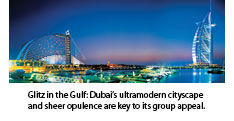
This modern Arab emirate, home of
what many consider to be the world's most opulent hotel, the Burj al
Arab, is the very epitome of global glamour. Other "mosts" here include
the most exquisite jewelry emporium (the Dubai Gold Souk) and the most
elaborate, high-stakes sporting events (the Dubai Desert Classic and
the Dubai World Cup). But Dubai's glitter has not been immune to the
events of the past year. "We've seen a shift in our incentive
business," says Jerad Bachar, director of the Dubai Convention Bureau.
"We have seen a small amount of cancellations or postponements from the
obvious [financial and insurance] business sectors."
But those
losses have been mitigated by an upswing in meetings and incentives
business from rising markets such as India and China. And, Bachar adds,
while Dubai continues to cater to high-end customers, the country has
had a recent wave of openings of properties targeting the business
travel and meetings market, including the 438-room Sofitel Dubai
Jumeirah Beach, the 260-room Media One Hotel, the 246-room Centro
Barsha and the 180-room Suitehotel.
The destination is now
focusing on large-group business. The Department of Tourism and
Commerce Marketing launched the Dubai Bid Alliance this year, a group
that involves the Dubai Convention Bureau, Emirates Airlines, the Dubai
World Trade Center, local service providers and hoteliers, who provide
incentives and a unified contract/request-for-proposal approach for
international associations or corporate meetings of 1,500 or more
attendees.
To drive more business from the United States, the
Dubai Convention Bureau is continuing to strengthen its alliances with
industry trade organizations based in the States, such as ASAE and The
Center for Association Leadership, the Professional Convention
Management Association, Meeting Professionals International and Site.
"We
are encouraged by the interest that we receive directly from clients
and from our website statistics. We often see a large portion of our
web traffic is now coming from the U.S.," Bachar adds.
When
asked if Dubai is toning down its opulent image for the U.S. market,
Bachar says, "It is difficult to hide the luxury aspects of Dubai.
After all, that is what attracts most visitors. What we have to remind
buyers of is that Dubai is also the center of business for the region.
It remains a gateway city to the Middle East for commerce and trade."
South Africa
Though
tourism, including business tourism, is one of the fastest-growing
sectors of South Africa's economy, "of course, we lost business in the
past year," says Laura Saeger, CMP, CMM, business tourism manager,
South Africa Tourism USA. While figures specifically for business
travel and meetings are not available, Saeger says overall U.S. travel
to South Africa was down 13 percent for the first half of 2009.
But
one segment of business has grown: religious meetings. Saeger has had a
number of inquiries and several bookings, including a 5,500-person
Jehova's Witness conference, to take place next month. And she predicts
the 2010 FIFA World Cup, coming next year, "will help us weather the
economic storm and give us the opportunity to prove our global
competitiveness." In addition, Site's 2010 International Conference, to
be held next in Cape Town, will showcase South Africa's incentive
appeal: cosmopolitan cities, glamorous safari camps, scenic beauty,
magnificent wildlife, culture and world-class wines.
Though
South African suppliers don't downplay the luxury, they point out the
favorable exchange rate (at press time, US$1 equalled 7.6 rands),
which, says Saeger, "makes it is possible for groups from the U.S. to
experience extraordinary experiences at very affordable prices." She
also is making clients aware of the myriad opportunities to engage in
meaningful corporate social responsibility, which can be arranged by
South African Tourism and local destination management firms.
Web Exclusive
For more insight from suppliers from these countries, and a profile of Bermuda, see mcmag.com/webexclusives.