Deals & Discounts
How far are hotels willing to go to attract business? Individual properties and corporate sales teams have been devising creative offers for groups, particularly for those booking short-term business. Some offers expire soon but nonetheless give insight into the mindset of hotel salespeople.
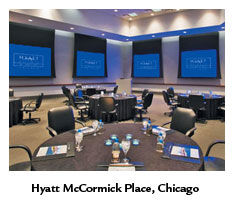
Hyatt Hotels & Resorts, for instance, launched a corporate initiative to give groups a 6 percent rebate off the master bill. The Hyatt Regency St. Louis Riverfront, emerging from a $63 million renovation this July, upped the rebate to 20 percent off the master bill for certain meetings held before June 1. At the Hyatt Regency McCormick Place in Chicago, the 6 percent rebate is valid through March 31, 2010.
The Hamilton Park Hotel & Conference Center in Florham Park, N.J., has devised discounts of up to 30 percent off the master bill, depending on how the Dow Jones Industrial Average performs on the day of the meeting -- the more the Dow drops, the bigger the discount -- valid through June 30.
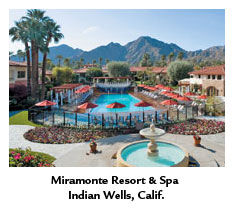
The Miramonte Resort & Spa in Indian Wells, Calif., has cut group rates by 40 percent for Sunday arrivals and tossed in a host of other freebies, such as complimentary breakfast and meeting breaks. Meetings must be booked before Aug. 31 and held before Dec. 31, 2010.
The Homestead, in Hot Springs, Va., has offered to throw in a free golf tournament or other recreational activity for groups booking 75 rooms or more by June 30, for meetings held by the end of 2010.
Omni Hotels, in addition to waiving attrition penalties for qualified meetings, has extended through the end of 2009 its 10K Flyaway program, which gives planners or corporate clients up to 10,000 frequent-flyer miles on Delta, United or American Airlines for every 100 room nights used -- planners can earn up to 25,000 miles per meeting -- plus 5 percent off the master bill. -- T.I.
Hotels are ready to deal. Forecasts for the lodging industry keep getting worse and now predict 2009 will be one of the toughest years for hoteliers in memory. Industry consultants expect revenue per available room to plummet as much as 14 percent this year vs. 2008 and occupancy to slide by anywhere from 4 percent to 8 percent.
For meeting planners, this is an interesting backdrop for contract negotiations.
"People who have meetings not booked yet for the short term really are in a nice position," says Gary Schirmacher, senior vice president of strategic sourcing for Experient, an integrated meeting services company based in Twinsburg, Ohio. Planners can expect to find hotels more flexible on most contract provisions, from attrition to rebooking clauses to overperformance incentives. As Joan Esneault, vice president of resort sales for Foxwoods Resort Casino, in southeastern Connecticut, puts it: "Everything's negotiable."
Robert Mandelbaum, director of research information services for Atlanta-based PKF Hospitality Research, says hotel salespeople are particularly focused on getting revenue on the balance sheet for 2009. "Things have gotten so bad so quickly, any cash is good cash," he says.
According to an M&C survey conducted in January for the Research column ("Hotels Are Bending," March), 71 percent of 110 planner respondents said hotels have been "somewhat" or "very flexible" during recent contract talks. (When M&C polled planners on this subject back in May 2008, only 60 percent reported this level of flexibility.) Fifty-five percent of planners said they had won concessions on room rates, and 35 percent of planners managed to eliminate attrition fees, cancellation fees or both. More than half of planners who asked for discounts in exchange for larger deposits were successful.
The buyer's market has its limits, though, Mandelbaum notes. Planners looking to book a few years out, by which time the economy will have had a chance to recover, might not find the same flexibility from hotels as they would for 2009 meetings. Additionally, planners looking to secure peak dates in first-tier cities still will have to work hard to win concessions.
Some hoteliers even argue that they will not repeat mistakes made after 9/11, when they heavily discounted rates and made other concessions to groups, pledging to be tougher this time around to protect their own business needs. Terry Sloan, director of Carlson Wagonlit Travel Meetings & Events, based in Minneapolis, says he's heard hotel salespeople take this stance, but he doesn't believe it. "Hotels are all trying to outsell each other," he says. "Hotels are sitting in a position where they're quite eager for business." If planners are booking a meeting for 2009 or 2010 and tell hotels that a certain clause in the contract is a deal-breaker, hotels will be flexible, Sloan argues. "Hotels are listening and they're willing to work. Things are totally different today than they were two years ago."
Just like hoteliers, planners are facing an uncertain year with respect to budgets, attendance and cancellations. Consultants, planners and their lawyers agree there are a number of clauses in hotel contracts that should be rewritten to reflect today's economy -- in many cases limiting the risk planners take when they sign on the dotted line.
Legal Loophole?
According to the APEX glossary, a force majeure clause "excuses performance" of a meeting contract as a result of "an event...or effect that cannot be reasonably anticipated or controlled." Typically, a force majeure is considered an "act of God," such as severe weather or other natural disaster. But a war or a labor strike typically qualify, as well.
If those man-made "disruptive circumstances" count, could a savvy lawyer also argue force majeure clauses cover an unforeseen, uncontrollable precipitous decline in the economy?
"The simple answer is no," says Jonathan T. Howe, senior partner of the law firm Howe & Hutton in Chicago. "It's not a force majeure. However, if someone included [the recession] as a cause for cancellation without liability, the answer would be yes.
"There is a doctrine of 'commercial impracticability,' " Howe continues, "but that requires that no one ever could contemplate such an event occurring in the future when the contract was entered into." If that argument was ever going to work, it would have worked last fall, but it certainly wouldn't win over a judge now, he notes. -- T.I.
AttritionA top concern for planners, particularly for association
meetings, is shrinking attendance and the specter of attrition
penalties, which kick in if groups don't fill an agreed-upon percentage
of rooms in the room block or spend a certain amount on food and
beverage. In a seller's market, typical hotel contracts allow for a
maximum of 10 to 15 percent attrition -- meaning groups pay damages if
they fill fewer than 85 or 90 percent of the contracted rooms.
 Cut
minimums. Planners say lowering the threshold for attrition penalties
to 20 percent below the contractual guarantee has become standard.
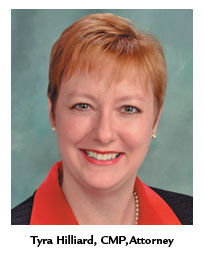
"Now, meeting planners are negotiating 25 percent to 30 percent
slippage in some cases," says Tyra Hilliard, CMP, an attorney who
teaches meetings management at George Washington University in
Washington, D.C. Commonly, hotels will ask for something in return if
attrition allowances are upped -- perhaps the right to renegotiate the
amount of meeting space the group uses.
Cut
minimums. Planners say lowering the threshold for attrition penalties
to 20 percent below the contractual guarantee has become standard.
"Now, meeting planners are negotiating 25 percent to 30 percent
slippage in some cases," says Tyra Hilliard, CMP, an attorney who
teaches meetings management at George Washington University in
Washington, D.C. Commonly, hotels will ask for something in return if
attrition allowances are upped -- perhaps the right to renegotiate the
amount of meeting space the group uses.
Ask for no penalty. Omni
Hotels launched a "zero attrition" initiative in February for planners
who sign contracts by June 30 for meetings that will be held before the
end of 2009. Only meetings of up to 150 rooms on peak automatically
qualify for the deal, but Caryn Kboudi, vice president of corporate
communications for Omni, says the offer will be extended to larger
groups on a case-by-case basis.
Similarly, Rosen Hotels &
Resorts, which operates seven properties in Orlando, has developed an
"attrition relief" program, which reduces or eliminates penalties for
certain groups. And Palace Resorts, which has 12 all-inclusive
properties in Mexico and the Caribbean, announced last month a "no
attrition" deal for groups that book 25 percent or fewer of the
resort's total rooms per night. Properties most willing to offer such
deals are those that are owned and operated by the same company.
Clarify
the calculation. There are a variety of methods used to calculate
attrition penalties, and planners might convince a hotel to use a more
favorable formula if the property won't budge on the amount of accepted
slippage. According to tips published by Experient and APEX, the
Accepted Practices Exchange of the Alexandria, Va.-based Convention
Industry Council, planners can offer to base penalties on the lost room
profit, instead of room revenue; apply attrition only to peak nights or
the cumulative pickup, depending on which is more favorable; or make
sure that if the hotel is able to resell rooms, those are subtracted
from the number of rooms on which the group owes penalties. Planners
also could argue that damages should be calculated based on the lowest
rate available for those dates, either from the hotel directly or an
online booking engine, if the lowest rate is not the group rate.
Push
for auditing rights. Already standard for many planners, auditing the
hotel's guest list helps identify attendees staying at the hotel who
did not book within the block but should be counted toward the group's
room pick-up. In most cases, such attendees find cheaper rates online
than the publicized group rate.
Change deadlines. Hilliard says
some planners have been more aggressive in their room block management,
asking hotels to allow adjustments up until the day of arrival.
Although that will be too extreme for most hotels, if the room block
can be reset close to the opening date of the meeting, there's less
risk that planners will face any attrition penalties.
Add
rebooking clauses. Hilliard adds that contracts can be written to allow
planners to put any attrition penalties toward a future meeting at the
same property. For planners, it's a way to get more mileage out of
money that otherwise doesn't return value to the group; for hotel
salespeople, it's a way to bring in more revenue down the road.
Room ratesAlthough
hotels need business, meeting planners might not want to waste too much
negotiating effort on lowering room rates, according to PKF's
Mandelbaum. "The last item hotels wish to negotiate is room rate --
that's just the way the industry is structured," he says.
Still,
more than half of planners surveyed by M&C in January said they've
negotiated lower rates in recent months, with most achieving reductions
of 7 percent or less. Issa Jouaneh, vice president of global meeting
solutions for American Express Business Travel, says his company's
meeting clients have seen room rate reductions of up to 20 percent. In
downtimes, Jouaneh says, planners can benefit from the buying power of
third-party meeting providers to get reductions they otherwise couldn't
get on their own.
Lock in "best available rate." With hotel
rates in flux, planners can attempt to negotiate a "best available
rate" clause, which stipulates groups will not pay rates higher than
the lowest available over their meeting dates, including specials on
the Internet, advises attorney Jonathan T. Howe, a senior partner at
the law firm Howe & Hutton in Chicago and an M&C contributor.
If
such deals are struck, adds Experient's Schirmacher, planners should
check websites such as hotelscombined.com or kayak.com, which aggregate
online hotel deals, to monitor how low rates drop. But both Howe and
Schirmacher warn that hotels aren't likely to embrace such clauses
without other major concessions from the planner.
Cancellation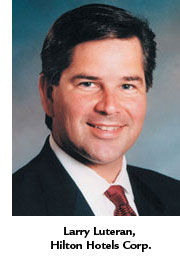 Larry
Luteran, senior vice president of group sales and industry relations
for Hilton Hotels Corp., says cancellation clauses actually aren't a
major point of contention now. "Most people are not confirming business
unless they know it's going to happen," he says. And while some
planners have seen cancellation fees waived (18 percent, according to
M&C's survey), most hotels will be reluctant to do that, Luteran
warns.
Larry
Luteran, senior vice president of group sales and industry relations
for Hilton Hotels Corp., says cancellation clauses actually aren't a
major point of contention now. "Most people are not confirming business
unless they know it's going to happen," he says. And while some
planners have seen cancellation fees waived (18 percent, according to
M&C's survey), most hotels will be reluctant to do that, Luteran
warns.
Frequently, hotels allow planners to rebook meetings
instead of cancel them outright, for the sake of building long-term
relationships, even if such an option wasn't originally mandated in the
contract. "Hotels do a lot they don't legally have to do," Tyra
Hilliard notes.
But now hotels are starting to do the math,
according to Mandelbaum, and might decide to pocket cancellation
penalties just to get revenue on the balance sheet today -- revenue
that is almost pure profit -- instead of waiting for the meeting to
actualize sometime within a year or 18 months. "Things are so desperate
in the short term, they're willing to roll the dice on damaging
long-term relationships," he says.
Define cancellation as
credit. One way planners can write a cancellation clause is to allow
the penalties, or a portion of them, to be used as a credit against the
master bill of a future meeting, says CWT's Sloan. "Rebooking" also can
be defined as moving the meeting to a property within the same brand or
under the same ownership as the original hotel. Jouaneh says planners
can try to extend the window for rebooking past the traditional 12
months, although hotels probably will push planners to hold the meeting
within the fiscal year.
Delay cancellation deadlines. Jouaneh
also says planners can mitigate their risk of cancellation by trying to
push back deadlines by which they're allowed to pull out with minimum
penalty. Additionally, they can agree to pay cancellation fees only at
the time of the originally scheduled meeting -- not before.
Food and beverageLisa
English, CMP, CMM, director of operations for Carlsbad, Calif.-based
Concepts Worldwide, a meetings management company, has had some success
building rewards into contracts for groups that exceed revenue
expectations, to balance out penalties for missing guarantees.
Reward
"overperformance." English negotiates for "overperformance clauses." If
her group exceeds the contracted F&B minimum by a certain amount,
for instance, she's eligible for a percentage discount on all F&B.
"The
challenge with overperformance is hotels believe you're going to
underguarantee anyway," English says. "Overperformance works really
well for big meetings with lots of history." If groups can document
what they've spent on F&B in the past, hotels will be more likely
to set appropriate goals and concede discounts if groups outperform
expectations, she notes.
Adjust the numbers. Monitor attendance
numbers as the meeting date approaches. Schirmacher says planners
should argue for lower F&B minimums based on the latest projected
attendance.
Payment termsWhile meeting planners initially
might want to extend the deadlines to pay their bills, hotels probably
aren't able to be too lenient, Hilton's Luteran says. "No one's in a
position to float cash for extended periods of time," he observes.
Discount
early payments. "Everyone is paying everything later," English says,
but as hotels crave cash, groups can negotiate small discounts if they
agree to pay their bills early. The discount clause could be a
companion to any penalties for paying bills late.
Other concessionsAccording
to M&C's research, planners have gotten hotels to discount, or
throw in for free, the following items: meeting space (61 percent of
respondents), room upgrades (50 percent), complimentary rooms (48
percent), A/V equipment (24 percent), cocktail receptions (18 percent)
and coffee breaks (13 percent).
Planners also should find out if
other events are scheduled for the hours or days immediately preceding
their meetings, and possibly negotiate more set-up or tear-down time
for any staging or displays, a move that could save planners from
paying overtime labor charges, Schirmacher adds.
Negotiating advicePlanners
can -- and should -- be aggressive in their negotiations, without
concern about damaging their relationships with salespeople, insists
Bjorn Hanson, a professor at the Tisch Center for Hospitality, Tourism
and Sports Management at New York University. When the hotels aren't
performing well, many sales executives warn clients not to take
advantage of the situation, pointing out that when the market swings
back, planners won't want to be bullied by hotels, Hanson says. "But
when the hotel cycles change, all of that is forgotten. Be wary of that
offer of cooperation."
Still, planners can go too far. "My
feeling is many planners out there feel like hotels should take a hit,"
Schirmacher says of the current negotiating environment. "I don't
necessarily agree with that. Contracts have to be advantageous for both
parties."
The point of renegotiating terms that are more
favorable to planners is not to take advantage of hotels but to find a
partner to "share the risk" that planners bear, explains Shelley E.
Griffin, a third-party planner and president of Griffin Conference
Group in Belmont, Mass. If planners are granted concessions, they need
to be prepared to give something back, such as freeing up meeting space
the group doesn't need or shifting dates to fill needs of the hotel.
Groups might need to book multiple meetings at a single property in
order to get the specific concessions on already booked business. "It
might hurt a little," Schirmacher admits. Planners need to prioritize
their requests, fight for the most important concessions and let the
rest go.
Luteran says getting contracts signed shouldn't be
viewed as an accomplishment but rather as the first step of a larger
partnership. "Now more than ever, we need to make sure potential
attendees are well aware of the return on investment or return on
objective they're going to get personally," he says. "They have to
realize the value proposition of meetings, and that's the
responsibility of the meeting professional and the hotel."