It's been three years since M&C last surveyed meeting planners about their jobs, including how much they earn, how happy they are and what kind of benefits they get. But while those years encompass the worst of the Great Recession, most salaries actually have risen since 2007, and a great majority of planners -- 95 percent -- still are somewhat or very satisfied with their jobs.
Those are just some findings in this year's survey, which also includes statistics on base salaries, benefits, overtime pay and more, broken down by corporate vs. association planners.
To gather the statistics, M&C worked with San Diego-based CIC Research (which is not affiliated with the Convention Industry Council), which conducted an online survey this spring. The market-research firm then compiled the responses from a total of 648 respondents, including 264 association and 384 corporate planners.
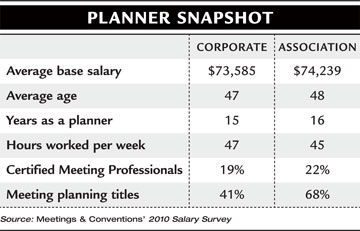
Across the board This year's survey shows association and corporate planners now earn about the same amount of money. Association planners reported an average yearly salary of $74,239, up substantially from the $61,561 reported in 2007. Corporate planners' pay averaged $73,585, compared with $71,929 in 2007.
In 2007, corporate base salaries jumped by 16 percent and association salaries by 10 percent, compared with our 2005 survey results. This year, it's the association salaries that have risen significantly, up by 21 percent, partly due to a higher number of executive-level respondents this year, while the corporate base pay rose by just over 2 percent.
As in 2007, the planning community has grown slightly older. Association respondents this year averaged 48 years of age, vs. 47 in 2007; similarly, the age of the corporate planner rose to 47 in 2010, up from 46 in 2007.
This year's sampling did not include as many Certified Meeting Professionals as in the past. Just 19 percent of corporate respondents have their CMP, down from 24 percent in 2007. Four percent hold the Certification in Meeting Management, up one percentage point from 2007. On the association side, 22 percent are CMPs, down from 26 percent three years ago, and just 2 percent have the CMM, up from 1 percent in 2007. About 4 percent of the association respondents are Certified Association Executives.
Having a certification makes a big difference in the corporate world. CMPs earned an average of $83,288, almost $10,000 more than the overall average. CMMs averaged $92,167, more than $18,000 above the overall average.
Meeting planner certifications do not seem to make as large an impact in the association world, where CMPs made $76,250, about $2,000 above the overall average, and association planners with their CMMs made $70,000, which is less than the average. However, the 10 association respondents with their CAEs earned an average of $106,786, more than $30,000 above the overall number.
The following pages look at corporate and association planner results separately, with findings on stress levels, benefits and more.
Corporate Compensation
When we last surveyed corporate planners,
in 2007, we noted that salaries had rebounded by 16 percent from the
dark period that followed 9/11, to an average of $71,929 in 2007. The
results of the 2010 Salary Survey demonstrate that the economy has kept
salaries from rising much in recent years, with the average corporate
compensation increasing just over 2 percent, to $73,585.
 Of the
384 corporate meeting professionals who responded -- from entry-level
planners to high-end executives -- a majority of 58 percent earn between
$50,000 and $89,000. Compared with three years ago, the number of
people making less than $40,000 has gone up from 8 to 10 percent; 16
percent, however, bring in more than $100,000. In addition, 23 percent
are paid between $40,000 and $59,999, followed by 30 percent earning
$60,000 to $79,999, and 21 percent making $80,000 to $99,999.
Of the
384 corporate meeting professionals who responded -- from entry-level
planners to high-end executives -- a majority of 58 percent earn between
$50,000 and $89,000. Compared with three years ago, the number of
people making less than $40,000 has gone up from 8 to 10 percent; 16
percent, however, bring in more than $100,000. In addition, 23 percent
are paid between $40,000 and $59,999, followed by 30 percent earning
$60,000 to $79,999, and 21 percent making $80,000 to $99,999.
Looking
at 2009, 37 percent of the respondents got an increase, 42 percent said
their salaries stayed the same and 21 percent had to deal with a cut in
their paychecks. That 21 percent is a marked difference from 2006, when
just 2 percent saw their salaries decrease.
For 2010, 31
percent said their companies have instituted a salary freeze, 23 percent
report certain positions will not get raises, 23 percent said increases
will be smaller than last year and 19 percent expect salary cuts, while
15 percent expect the same increase they got last year. Another 6
percent said some mandatory furloughs have been ordered.
Two-thirds
(66 percent) of corporate planners are extremely or somewhat satisfied
with their compensation in relation to their responsibilities, while 25
percent are not very satisfied and 9 percent are extremely unsatisfied.
Follow the money 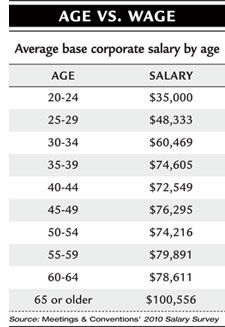 Pay
clearly differs by U.S. region. The Pacific states (Alaska, California,
Oregon and Washington) constitute the most lucrative area to work, with
an average salary of $84,245. Next is West South Central (Arkansas,
Louisiana, Oklahoma and Texas) at $83,864, and the Mid-Atlantic region
(New Jersey, New York and Pennsylvania) at $82,267.
Pay
clearly differs by U.S. region. The Pacific states (Alaska, California,
Oregon and Washington) constitute the most lucrative area to work, with
an average salary of $84,245. Next is West South Central (Arkansas,
Louisiana, Oklahoma and Texas) at $83,864, and the Mid-Atlantic region
(New Jersey, New York and Pennsylvania) at $82,267.
Averaging
$78,906 a year are planners in New England (Connecticut, Maine,
Massachusetts, New Hampshire, Rhode Island and Vermont), followed by
East South Central (Alabama, Kentucky, Mississippi and Tennessee) at
$77,813, and the South Atlantic (Delaware, Florida, Georgia, Maryland,
North Carolina, South Carolina, Virginia, West Virginia and Washington,
D.C.) at $72,418.
Earning well below the typical corporate salary
are planners in the East North Central (Illinois, Indiana, Michigan,
Ohio and Wisconsin), who earn an average of $64,096, the Mountain region
(Arizona, Colorado, Idaho, Montana, Nevada, Utah and Wyoming), where
planners make $63,269 a year, and the West North Central (Iowa, Kansas,
Minnesota, Missouri, Nebraska, North Dakota and South Dakota), where the
mean pay is $60,658. The lone respondent from Hawaii is earning less
than $30,000.
Whatever their pay or feelings about it, corporate
planners aren't moving around very much. About 95 percent held the same
job in 2009, while 5 percent changed positions last year. Eight percent
plan to switch employers this year. And recession aside, 89 percent
still feel somewhat to very secure in their jobs.
Gender issues While
71 percent of corporate respondents are women, a relatively consistent
statistic, women are earning just 73 cents for every dollar a man earns.
On the slightly upside, that is two cents more per dollar than in 2007.
The
men surveyed are making an average of $95,231 a year, up about $900
from three years ago. The women take home an average of $69,271, an
increase of about $2,000 from 2007. More men hold executive positions
(44 percent) than planning titles (15 percent), just like three years
ago, while more women hold straight planning jobs (47 percent) and only 9
percent are executives.
Male respondents have been in the
industry longer than the women (17 years vs. 15), and they work slightly
more hours (48 vs. 47) per week. Women spend more time on
planning-related tasks (64 percent of their workday) than men (44
percent). Overall, corporate planners spend an average of 61 percent of
their time on meetings. Most (87 percent) do not get overtime pay, while
about a third (29 percent) are entitled to comp time when they work
more than 40 hours (but 11 percent do not take it).
Corporate
planners as a whole have direct responsibility for much of the meetings
process. Of the 384 respondents, 87 percent influence selection of the
hotel or facility, and 86 percent also have a direct say in the choice
of the destination. Sixty percent set the meeting's budget, while 46
percent make the final decision on the hotel, and 37 percent make the
final decision on the destination. Close to half get directly involved
in the program, as well, with 46 percent setting the agenda.

Getting satisfaction Corporate
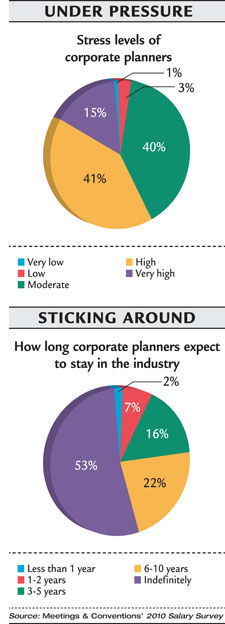
planners are relatively content in their work lives. Overall, 97
percent are somewhat or very satisfied with their jobs, with 55 percent
describing themselves as very satisfied.
What makes it a good
job? Corporate planners enjoy the opportunity to interact with different
customers and people (97 percent found this somewhat or very
satisfying). Also high on the list is the variety of tasks (96 percent).
Next is helping clients get the best value for their money (87
percent), which, interestingly, was chosen as a favorite part of the job
by 94 percent of those polled in 2007. This year, most corporate
planners (46 percent) are just as satisfied with their positions as they
were in 2009.
Not surprisingly, those queried cited more money
as the thing that would most make them happier at work (73 percent).
Much further down the list were more respect and appreciation from
management (42 percent) and better opportunities for advancement (40
percent).
Perks of the trade Some corporate planners got an
extra boost of cash at the end of 2009. Almost half of the group (47
percent) collected a bonus check for an average of $5,850, and 27
percent received profit-sharing proceeds valued at $4,759, on average.
Fourteen percent benefitted from both bonus checks and profit sharing.
Most
corporate planners are entitled to paid holidays, paid vacations and
paid sick days, averaging eight holidays a year, 17 vacation days and
seven sick days. Just over 85 percent receive health insurance, while 74
percent have dental coverage and 68 percent receive life insurance.
Other benefits include tuition reimbursement (44 percent), association
dues (41 percent) and a subsidized cafeteria (12 percent). The numbers
of respondents who can use flextime and/or telecommute are almost the
same as three years ago, at 28 percent and 21 percent, respectively. A
lucky 5 percent have the use of a company car.
Association Earnings
In
the 2010 Salary Survey, 36 of the 220 association planners who
responded to this question (16 percent) earn more than $100,000, and
nine of those people bring in more than $150,000 a year. Fully 22
percent of the sample earn more than $90,000. Due to these highly paid
respondents, the average association salary rose 21 percent, from
$61,561 in 2007 to $74,239 this year.
 If results are calculated
without the nine responses from the $150,000-plus group (seven of whom
are men), the average salary for association planners falls back to
$71,007, up 15 percent over three years ago.
If results are calculated
without the nine responses from the $150,000-plus group (seven of whom
are men), the average salary for association planners falls back to
$71,007, up 15 percent over three years ago.
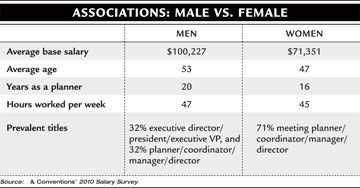
Of this year's
group, the men earn an average of $100,227, while the women, who make up
90 percent of association respondents, earn $71,351, just 71 cents on
the male dollar. This is comparable with the corporate world, where
women make 73 cents to the dollar earned by men.
Only 32 percent
of the men on the association side carry meeting planner titles, while
another 32 percent are executive directors, presidents or executive vice
presidents of their associations. For the women, 71 percent hold
meeting planning titles and 7 percent are executives.
The male
respondents, whose average age is 53, have worked as planners for an
average of 20 years, four years longer than the women, whose average age
is 47. The men also work slightly longer each week (47 hours vs. 45).
Overall,
association planners spend about two-thirds of their time on meetings.
Most influence their organizations' choice of destination (81 percent)
and hotel (86 percent), and about half (53 percent) make the final
decision on the hotel. Another 39 percent make the call on the
destination selected. Sixty-eight percent set the meeting's budget, and
52 percent handle the agenda.
On the money Taking a closer
look at salaries, the largest number of association planners (60
percent) earn between $50,000 and $89,999. Just 3 percent bring home
less than $30,000, and 15 percent make between $30,000 and $49,999.

Regional
differences in compensation are considerable. Association planners fare
best in the South Atlantic region (Delaware, Florida, Georgia,
Maryland, North Carolina, South Carolina, Virginia, West Virginia and
Washington, D.C.), with an average salary of $82,432. They are followed
by those in the Middle Atlantic (New Jersey, New York and Pennsylvania),
who earn $75,875 a year. In the East North Central section of the
country (Illinois, Indiana, Michigan, Ohio and Wisconsin), planners
earn $75,610, on average, and those in the Mountain region (Arizona,
Colorado, Idaho, Montana, Nevada, Utah and Wyoming) bring home $72,250.
Averaging
$70,938 are planners living in the Pacific (Alaska, California, Oregon
and Washington), followed by $64,750 in the West South Central region
(Arkansas, Louisiana, Oklahoma and Texas) and $57,500 in the West North
Central (Iowa, Kansas, Minnesota, Missouri, Nebraska, North Dakota and
South Dakota).
Just three people weighed in from New England
(Connecticut, Maine, Massachusetts, New Hampshire, Rhode Island and
Vermont), averaging $35,000 a year. The lone association planner in the
East South Central (Alabama, Kentucky, Mississippi and Tennessee) who
took the survey earns $35,000, while the one respondent from Hawaii
makes $75,000.
Pay rises quickly with years of experience.
Planners ages 25 to 29 average $42,273, while those 30 to 34 years old
jump to $64,792. Respondents who are 35 to 39 bring home an average of
$72,768, followed by $78,190 for those 40 to 44 and $79,779 for planners
45 to 49.
Association planners who are 50 to 54 take home
$70,000, but the numbers jump back up for those 55 to 59 ($81,167) and
60 to 64 ($80,600). Those 65 of age or older make an average of $75,833.
In
2009, a sizable number of association respondents (45 percent) saw
their paychecks increase, while the salaries of slightly more planners
(46 percent) remained steady. Nine percent had to take pay cuts. The
majority of those surveyed -- 89 percent -- are salaried workers; 6
percent are paid hourly, and 5 percent are independent contractors.
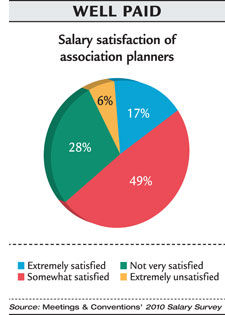
Just
like their corporate counterparts, 66 percent of association planners
are somewhat or extremely satisfied with how much they are paid relative
to their responsibilities. On the other side of the spectrum, 28
percent of association respondents are not very satisfied, and 6 percent
are extremely unhappy with their compensation.
Drilling down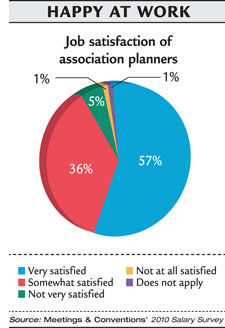 Like
their corporate counterparts, association planners enjoy their jobs; 93
percent are somewhat or very satisfied with their work. While most (45
percent) are just as satisfied as they were a year ago, 35 percent are
less happy, and 18 percent are happier than in 2009.
Like
their corporate counterparts, association planners enjoy their jobs; 93
percent are somewhat or very satisfied with their work. While most (45
percent) are just as satisfied as they were a year ago, 35 percent are
less happy, and 18 percent are happier than in 2009.
More
specifically, association planners enjoy interacting with different
customers and people (96 percent find somewhat or very satisfying), the
variety of tasks (94 percent), participating in education activities or
events (89 percent), and the opportunity to travel (89 percent).
What
would make association planners more content in their jobs? Answers
include more money (68 percent), more respect and appreciation from
management (44 percent), and less pressure and stress (43 percent).
Better advancement opportunities (34 percent) and working fewer hours
(31 percent) round out the top five on the wish list.
Understandably,
association respondents are feeling the pressure of today's business
world. The largest number (43 percent) feel moderately stressed, 40
percent are highly stressed and 12 percent call their stress level very
high. Just 5 percent described their stress level as low, and no one
described it as "very low."
In last year's volatile economy,
association planners held tight to their positions: 90 percent did not
change jobs in 2009 and have no plans to do so this year; 96 percent are
somewhat to very secure in their current situations.
For your benefit Associations
are taking good care of planners, according to those queried. Almost
everybody gets vacation days (averaging 17 a year), holidays (eight) and
sick days (nine); 89 percent are covered by health insurance.
As
for opportunities for continuing education, more than half said their
organizations pay their dues to professional groups, and 36 percent are
offered tuition reimbursement.
Flextime is an option for 35 percent, and 18 percent can telecommute.
A
third of the association planners (33 percent) received a bonus last
year, for an average of $4,357, while just 9 percent participated in a
profit-sharing program, getting a healthy $4,653 check.