They Make the Rules

As medical and pharmaceutical meeting planners well know, a whole host of codes and guidelines exists to keep meetings in line, dependent on the specific type of meeting as well as who's in attendance at the event. A growing number of state laws -- and now, federal health-care reform legislation -- provide additional concerns. Among the rule-makers:
• Pharmaceutical Research and Manufacturers of America (PhRMA) issues the Code on Interactions with Healthcare Professionals.
• Advanced Medical Technology Association (AdvaMed) issues the Code of Ethics on Interactions with Health-Care Professionals.
• Council of Medical Specialty Societies issues the Code for Interactions with Companies.
• The Office of Inspector General issues the Compliance Program Guidance for Pharmaceutical Manufacturers.
• The U.S. Food and Drug Administration issues guidance, compliance and regulation materials.
• The Foreign Corrupt Practices Act addresses, in part, potential bribery of foreign officials. The involvement of governments in foreign health-care systems makes this a concern.
• U.S. health-care reform legislation includes provisions of the Physician Payments Sunshine Act introduced in early 2009. Provisions will require disclosure of physician payments from the industry (pharmaceutical companies, device manufacturers) and call for a public, searchable database of that information to be established by September 2013.
• State laws have introduced strict legislation, such as those passed in Massachusetts and Vermont, regarding interaction with health-care professionals. Laws apply to interactions with doctors who practice in the states in question, and fines and penalties may be levied for noncompliance. A number of these laws set limits on the payments that may be received by health-care professionals. The effect of federal legislation on these laws is yet to be determined.
Photograph: ©iStockphoto.com/aluxum
In late March, President Obama signed into law a health-care reform bill that promises broad changes to the country's health-care system. After a contentious political battle to pass the legislation, the process of implementing the law, as spearheaded by government entities such as the Department of Health and Human Services, has only just begun. In fact, most provisions won't go into effect until September 2013. Just how the bill will influence meetings in the medical and pharmaceutical industries remains to be seen, but insiders already are anticipating change.
Disclosure and dissemination Likely the most significant effect on meetings will stem from the provisions of the Physician Payments Sunshine Act, introduced by U.S. Sens. Chuck Grassley (R-Iowa) and Herb Kohl (D-Wis.) in early 2009 and eventually modified for inclusion in the overall reform bill. In short, the provisions require disclosure of physician payments by industry (pharmaceutical companies, device manufacturers) and call for a public, searchable database of that information to be established by September 2013.
"Those provisions are going to put a tremendous emphasis, for pharma companies in particular, on understanding exactly how much money they're spending on a [guest] doctor," says Kim Slocum, president of West Chester, Pa.-based KDS Consulting, which works with health-care organizations. "And that's going to have to include everything they spend on that person -- detailing expenses, speaker's honorarium, meetings that they attend, the whole deal. I don't know exactly yet who's going to be the collector of that data, or who's going to have the enforcement mechanism -- but I think it's very clear that the onus is going to be on companies to start to track this."
That means a complete and efficient means of data collection will soon be absolutely essential for medical and pharmaceutical meetings that include health-care professionals -- potentially a tall order for some corporations, given that strategic meetings management programs (SMMP) are really just beginning to be rolled out on a larger scale. (SMMP is defined as a disciplined approach to managing enterprise-wide meeting and event activities, processes, suppliers and data in order to achieve measurable business objectives aligned with their organizations' strategic goals and vision.)
Without an SMMP in place, executives tend to underestimate their general meeting spend by as much as two-thirds, according to Kari Kesler, chief strategist of KK Consulting and a principal developer of the National Business Travel Association's Strategic Meetings Management Certification. That's the big picture; Sunshine Act provisions will require that detailed data be available for meetings on a per-attendee basis when doctors are involved.
Clearly, the new legislation continues to demonstrate the importance of centralized tracking of meeting activity, points out Teresa Bria, senior vice president of projects and operations for Phase to Phase Strategy LLC, a Weston, Conn.-based consulting organization offering strategic services to pharmaceutical clients. "It also underscores the need to ensure all initiatives are strategically designed to achieve legitimate and transparent objectives," she notes.
Of course, the data-collection requirements don't come as a surprise; federal legislation requiring strict disclosure policies has been discussed for several years, and a number of states already have passed such legislation. Rx Worldwide Meetings, an independent pharmaceutical event and meeting planning company, began collecting detailed data with respect to physician attendees about three years ago. The information is incredibly specific, says Judy Benaroche Johnson, CMP, president and CEO of the Plano, Texas-based firm. "It's not just about how much you spent on Dr. Smith," she explains. "It's about what you spent on air, hotel, this meal, that meal... it's really, really detailed."
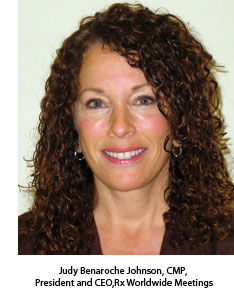 The resulting paper trail is immense. "In the last two years," notes Johnson, "for the bigger pharma clients that we have, it's five times the amount of reporting and forms than we've done in the past."
The pharma companies that haven't been as proactive have some catching up to do. "I think their systems are going to get better fast," says Kim Slocum. "They're going to have to. Very few pharma companies have any interest in being hauled up before the Office of the Inspector General, or any of the other potential enforcement agencies, and being accused of malfeasance."
Many companies already have been adhering to the self-regulatory guidelines set forth in the PhRMA Code for Interactions with Healthcare Professionals, but federal legislation still will likely require that they take their data collection systems -- and their audits of such systems -- up a notch. "Once there's actual money or sanctions on the table," says Slocum, "people get a lot more serious about this kind of thing. If there's any question of a violation, companies are going to have to produce records to what, generally speaking, are relatively unsympathetic audiences. In terms of the cast of characters that might be involved in the enforcement of this, basically they are not noted for having a sense of humor."
Doctors Weigh In
Pittsburgh-based ophthalmologist Dr. Irving Weinberger
doesn't
believe that health-care reform legislation will have any effect on his
attendance at professional meetings, as he prefers to stick with
presentations that bestow continuing medical education credits on
attendees. "I already generally do not attend most of the
industry-sponsored dinner or speaker-type programs," he notes.
(According to the new legislation, officially recognized CME programs
will not have to adhere to new disclosure laws.)
Yet, for other
health-care professionals, the question underlying restrictions on
industry-supported events is just what difference it should make whether
attendees receive a free meal, for example. Does that really influence
their professional conduct? "In theory," says Weinberger, "when you
receive something for nothing you consciously or subconsciously feel
indebted to the giver. Most of us do not feel that being given dinner
has much influence on our prescribing habits. But there are studies that
suggest otherwise, and the drug companies would not be spending
millions of dollars on the dinner and speaker programs if they did not
feel that they were getting a significant return."
By the same
token, pharmaceutical companies do need to ensure that medical
professionals are aware of their products, and their sponsorship dollars
have backed many types of educational presentations in the past. Dr.
John Mazuski, a surgeon in St. Louis and a faculty member at Washington
University, is in favor of disclosure laws but believes the extent of
the restrictions being placed on industry sponsorship are harming
medical education overall.
While most universities place no
restriction on their doctors' participation in any CME-accredited
activities, says Mazuski, regulations on speaking for most
industry-sponsored events have become very strict and already are
commonplace. As for the health-care legislation, "I can't imagine it's
going to make things any easier, but I don't know if it's a big factor,"
he says.
Mazuski fears the intense scrutiny won't only clean up
overly biased presentations, but also will stifle other education in the
process. "Many major meetings for medical organizations have had a huge
amount of support from industry sponsors," he says. "Clearly, this will
have some effects, as the big meetings aren't getting in the same
amount of money and can't provide the same amount of program material as
they once did."
The trend is happening on a smaller scale, too,
Mazuski adds. Universities no longer are running some events, such as
satellite symposia, that traditionally have relied on sponsorship. "This
was one of the few ways somebody out in a rural setting would get an
expert to come in and talk," notes Mazuski. Industry dollars haven't
always made the events strictly promotional, he adds: "Many were more
like CME talks."
As for the restrictions placed on academic
physicians in particular, Mazuski fears the end result is that they will
have to share their knowledge with fewer people. "The issue that a lot
of us have is that the experts who are asked to consult for and provide
advice to the drug companies and the like are being asked to do so
because they know a lot about the subject. So essentially you're saying
that the experts in the field can't be involved in teaching anybody if
they've been ‘tainted' by their association with the pharmaceutical
company. At some point," he sums up, "you have to rely on the integrity
and the professionalism of the individuals involved."
Illustration:
©iStockphoto.com/p2007
Education gets a break The Physician
Payments Sunshine Act originally had sought to require disclosure of
payments to faculty at commercially supported continuing medical
education conferences, according to Dr. Norman Kahn, executive vice
president and CEO of the Council of Medical Specialty Societies in
Chicago. However, Kahn explains, that is no longer the case.
Representatives
from CMSS were able to clarify some points with the Senate Finance
Committee staff when they were writing the law, says Kahn. "There was a
provision that originally stated that if the meeting were commercially
supported, the faculty would therefore have a relationship with the
supporting company," he explains. "And as we pointed out to them, that
was not the case -- faculty has a relationship with the CME provider,
not with the supporter. It's the CME provider that has a relationship
with the supporter."
The provision had also originally called for
disclosure of CME attendees at commercially sponsored educational
meetings. But again, CMSS was able to clarify that attendees have no
direct relationship to the corporate sponsor.
"To their credit,"
says Kahn, "the staff at the Senate Finance Committee, once they
understood that, didn't object to modifying the law. This frees up the
CME providers to hire the faculty they want, knowing that the faculty
wouldn't have to be concerned about having their names disclosed as
having accepted corporate payments."
Kahn adds that his
organization is very much in favor of the disclosure provisions in the
bill. "We believe that transparency is part of professionalism," he
says. The CMSS, in fact, recently adopted a voluntary code for
interactions with companies, in which they ask their member societies to
voluntarily disclose industry support.
The
up side While sources agree that the complicated legislation
could well add complexity to meeting planning in these fields, some are
quick to take an optimistic view.
For instance, major changes
almost always mean more meetings, says Tony Prusak, a 20-year veteran in
the field who recently was appointed vice president of communications
and technology for the St. Louis-based International Medical Meeting
Professionals Association. "You have to have the opportunity to train
and educate and disseminate this information to everyone in an
organization," he notes.
As one major example, Prusak points to
pharmaceutical companies. "The majority of the folks who work for the
companies are reps in the field, and they don't work in a corporate
office, per se. So a company is going to have to meet with all of its
sales reps, regional managers, district managers and so forth, and go
through all of this information."
For her part, however, planner
Judy Benaroche Johnson has yet to see the effects of the legislation
being addressed by her clients. "Honestly, I think it's because we're
still addressing other issues at this point," she says. "The biggest
concern is just getting through these economic times and getting
everybody back on track." The most serious problem, she notes, is the
issue of perceived extravagance and excess -- and of pharma companies in
some cases spending more money to avoid certain lodging or
destinations, merely to remain out of the public spotlight. The
prolonged health-care debate and media coverage only served to
exacerbate that problem, she believes.
Prusak, who has
professional motivation to be optimistic -- he's also the director of
convention sales for the Cleveland Medical Mart and Convention Center --
is referring primarily to internal meetings with respect to the uptick
he expects. But the need to process and parse the meaning of the
legislation will most definitely be a topic of discussion across the
industry and beyond. The legislation's impact was on the agenda for the
Healthcare Convention & Exhibitors Association Annual Meeting at the
end of June; the National Healthcare Reform Conference, the first
national conference devoted to addressing practical details of the bill,
is scheduled for Sept. 20-22 in Los Angeles.
Additional opportunities If we do see an
increase in meetings merely to work through the complexities of the
legislation, that effect will be a relatively short-term benefit to the
industry. But Kim Slocum foresees a potential longer-lasting benefit as
well -- one that is more intrinsically tied to the reform the bill is
meant to bring about.
"The new law really has some long-term
effects associated with reorganizing the payment and delivery system,"
Slocum says. "I think people have figured out that it really is the
delivery system, and the financing system for providing payment, that is
the root cause of health-care cost growth in the United States."
Although
specifics still are vague at this point, changes in how doctors are
paid will place a much greater emphasis on getting health-care
professionals to focus on outcomes, rather than sheer productivity,
Slocum believes, and that should lead to a lot more clinical trials to
prove the effectiveness of new drugs before they're approved.
"And
if you're going to be running more clinical trials, you're going to
need more meetings to get those trials organized and coordinated,"
Slocum says. "I think we're going to see a lot more focus on the
clinical side of things. And that will come, to some extent, at the
expense of what happens in sales and marketing. So if I'm a meeting
planner, I think the thing that I'm going to want to make sure I'm good
at doing is organizing and running meetings for clinical investigators."
Pharma
companies have had to significantly scale down their sales forces over
the past several years, notes Slocum, and he doesn't see that trend
changing. But planners shouldn't bemoan the shift away from a sales and
marketing focus; the overall number of meetings could actually increase,
he says. "I think what you're going to see is more smaller meetings and
more scientifically focused meetings, and probably more outreach to
other stakeholders. One of the things that emerges from the new law is a
need for people and companies to collaborate in ways they never have
before."
Stakeholders such as health plans and biotech/pharma
companies, for example, quite likely will need to come together to focus
more on overall wellness solutions. "That's going to speak to more
things like advisory board meetings," adds Slocum, "and all kinds of
exploratory discussions between these entities to get to deeper levels
of relationships than they have ever achieved in the past."
Planners
should be prepared to facilitate these meetings, advises Slocum. But
most importantly, he adds, they will have to watch how the wind is
blowing with respect to how the legislation is enacted, and adjust
accordingly. A lot of the new law will be particularly open to the
interpretation of government divisions responsible for enacting it.
"I
can promise you that we'll get some surprises over the next couple of
years," states Slocum. "And, if I was practicing in the discipline, I
would like to be as aware of those as I could, as early as I could, so I
could begin to adapt what I do to the new realities I'm going to be
confronted with."