(Pictured) Ashfield Meetings & Events uses second-screen technology to improve HCP engagement.
On the surface, health-care professionals (HCPs) don't seem like overly demanding attendees. Recent research finds that they most commonly attend meetings to learn about the latest scientific findings, meet with experts and hear about products -- fairly straightforward and common motives. But according to the same study, nearly four out of every 10 HCPs have not had positive experiences at many of these meetings.
That's a sizable, disheartening number for medical meeting planners. The study, commissioned by Ashfield Commercial & Medical Services, a U.K.- and U.S.-based provider of communications, research, and sales and marketing services to pharmaceutical manufacturers, proved eye-opening.
"When we saw that feedback, we just said, 'wow,'" recalls Katie Koziol, director of client services for Ashfield Meetings & Events US, a division of the firm that commissioned the study. "Forty percent? That's really high, and it's really upsetting."
Some experts believe the research is indicative of an industrywide trend, and they're concerned that attendee needs are playing second fiddle to exceedingly complex compliance efforts.
"We've kind of forgotten about the HCP experience," cautions Patricia Schaumann, CMP, HMCC (for health-care meeting compliance certificate, administered by Meeting Professionals International), senior director of health-care compliance for Maritz Travel in Fenton, Mo.
Schaumann is the author of Breaking the Code to Healthcare Compliance, considered the de facto industry resource on the subject, and the founder of the HMCC program, which has to date certified about 1,100 planners. She understands well the potential for getting swept away by the morass of international laws, codes and guidelines. "But we need to pay better attention to what HCPs want," she notes. "We must make them more a part of the process."
Medical complications
Compliance issues don't just distract medical planners from focusing on the HCP experience, they can severely restrict that experience. Given that doctors are VIP attendees, how can you convey that status given the strict limits on spending imposed by regulations?
"We talk about this quite a bit, and we say that it's our duty to bridge that gap," says Ashfield's Koziol. "There is that gap between what we are allowed to do in a regulated environment and accomplishing our job of ensuring the best attendee experience possible. From the HCP perspective, they're seeing medical meetings with a lot of limited meal options, some restrictions on flying -- maybe they can't travel on their preferred airlines. Everything is more regulated -- a lot more regulated, in some cases -- than what they have experienced in the past." Pharma companies have seriously beefed up compliance measures based on the reporting requirements of the Affordable Care Act, the European Federation of Pharmaceutical Industries and Associations, and much more around the globe.
It isn't only the experiences of past years to which HCPs compare current meetings -- parameters can be quite different from meeting to meeting. "Certain pharma companies have different interpretations of compliance," Koziol says. "So, depending on whose meeting you're going to, you may have a slightly different experience in the level of hotel, the quality of the meal, the location of the meeting. While compliance acts as a kind of band across the industry, there is a differentiation across that band, depending on which pharma meeting you're going to."
Unfortunately, there's not much medical meeting planners can do about the parameters they're given. "And it's not going to change significantly," says Koziol. "So we look at what we can do that doesn't have a significant cost and can't be interpreted in a negative way."
Deeper engagement
Three-quarters of the HCPs surveyed for the Ashfield study said they would very much like to have greater input into the agenda of the meetings they attend. According to that same survey -- the results of which Ashfield published in a white paper called
The Future of Meetings -- more than one-third of HCPs (36 percent) have never been asked to provide any input at all into meeting agendas or programs.
"Understanding that HCPs want to contribute in advance, to be partners in the meeting, is really important," notes Koziol. "And pharma companies are increasingly buying into this. We've always asked for feedback after an event, but we really should be getting insight prior to the event as well."
Doing so is a key to better engagement. "We've seen the benefit of increasing the communication earlier in the process," Koziol says. "We can easily add in a few questions to registration forms and include open-ended questions like what topics they most want to discuss. We can share that feedback with our stakeholders while they're creating the agenda, so they can focus on the right areas."
When it comes to agendas for clinical studies, there isn't much opportunity for HCP input, says Mozelle Goodwin, CMP, HMCC, a contracted meeting planner at the pharmaceutical company Eisai in Woodcliff Lake, N.J. "The HCPs are there for the information," she notes. "They must receive training on the study-protocol specifics and any necessary equipment used." But to make the event more interactive and boost engagement, second-screen technology has been playing a critical role for meetings at both Eisai and Ashfield.
At Eisai meetings, via the EM ARRAY platform from Educational Measures, attendees can ask questions, participate in polls, and take notes or draw on slides and then save them for future reference. "When attendees can submit questions anonymously," says Goodwin, "we tend to get more participation from the audience -- whether they submit questions from an iPad or text from their phone. It gives them an opportunity to be more a part of the discussion without feeling intimidated."
There's greater interaction during international programs, adds Goodwin, because posing questions and saving slides is even more valuable for HCPs whose first language isn't English. Plus, the event organizers can learn from the questions and notes, and better clarify the content for future meetings.
"The beauty of having all of this digital interaction is you collect a lot of data, and you can understand the level of engagement with your audience," adds John Gilbert, vice president of the Global Life Science Center of Excellence for BCD Meetings & Events and Plan 365 in Raleigh, N.C. Gilbert's teams use tech from Educational Measures, as well as apps such as SpotMe. "You can better understand the HCP engagement while they're there, and before and after. You really don't know the level of attendee engagement unless you have a hard way to track it."
Better content delivery
Health-care professionals are subject to the same adult-learning principles as any other attendees; they might be medical experts, but they're just as likely to be slain by an overlong lecture or endless PowerPoint presentation.
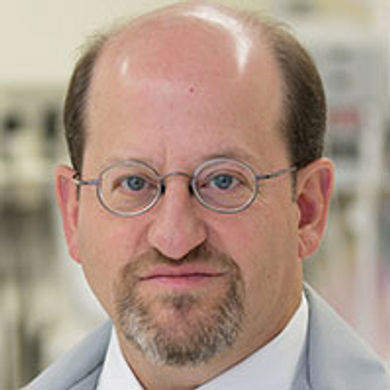 Dr. Steven E. Aks
Cook County Hospital, Chicago
Dr. Steven E. Aks
Cook County Hospital, Chicago
"Long lectures are dead," declares Dr. Steven E. Aks, an emergency physician and medical toxicologist affiliated with Chicago's Cook County Hospital. Aks has been on both the attendee and planner side for medical conferences. "Lightning presentations, or no more than 20- to 30-minute lectures, are really a huge improvement," he says. "That switch is making people streamline their lectures and really get to the point. More HCPs like multiple high-yield topics with innovative presentation modes than they do the standard long, one-hour lectures."
What can be a challenge for planners, however, is to convince the sponsors or presenters of that notion. There still is an expectation among many that research will be delivered in the old lecture format. "Some people are more open to change than others," says Koziol. "But there's still a time and place for delivering research results in that one-way talk. That challenges us to determine the best way to schedule it; it's important, but it shouldn't be the whole meeting."
Koziol suggests breaking up the presentation when possible, and perhaps splitting up the HCPs into small discussion groups in-between. "Or we might mix up seating," she says. "Does it have to be classroom-style seating, or can we make it more roundtable, more collaborative? Can people get up and move a little bit? Some of those ideas can help us move away from the pure lecture format for the whole length of the day."
Making it virtual
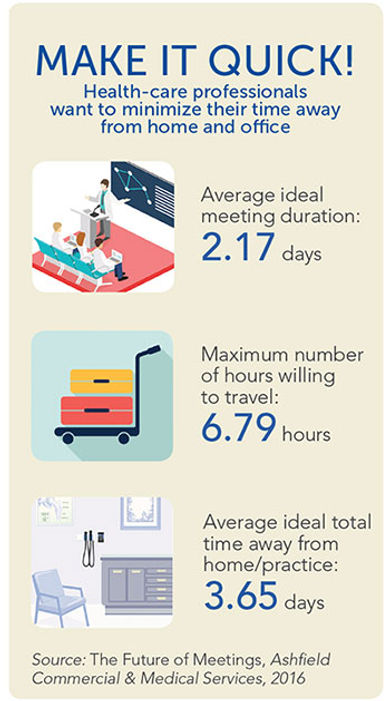
The prevailing view among the HCPs surveyed for The Future of Meetings report is that medical meetings will be mostly virtual in 10 years, with unrestricted access to materials and the ability to interact online with other attendees and presenters. That trend will be driven by convenience, as well as the increasingly complex travel restrictions imposed on HCPs. Many feel that they can't afford to spend a lot of time traveling, away from their homes and practices. (For more, see chart, "Make It Quick!,".)
Pharma manufacturers already are hard at work establishing virtual platforms and creating hybrid experiences with existing medical conferences. At least one global pharmaceutical company is finding that via the use of live streaming and hybrid meeting approaches, it is able to reach an average of 25 percent more HCPs at each event. Such efforts are attracting physicians from across the globe, many from emerging markets who never before had the opportunity to attend live.
Hybrid approaches that mix live-streamed broadcasts with regional, face-to-face breakout sessions are proving particularly successful, allowing the HCPs to meet regionally but still gain access to expert presenters who address the entire global audience.
Some BCD M&E clients are combining live, TED-type talks for about 50 in-person attendees while simultaneously broadcasting the talk to 50 satellite locations across the U.S. Second-screen technology is used at all the locations, so that all attendees interact with the presenter in the same way.
"You've got 50 people in a room," Gilbert says, "but they're interacting with 500 more people around the country. From an ROI standpoint, you're getting a large bang for your buck."
Service with a smile
Ultimately, says Katie Koziol, the only way to truly bridge the gap between compliance restrictions and a positive HCP experience is with good customer service. That might mean looking at attendee travel complaints on a case-by-case basis, and making a best effort to find travel and lodging solutions that meet whatever rules are in place. And then try to make every other logistical aspect of the meeting as seamless as possible. "We want it to be something attendees don't have to think about," says Koziol. "They're there to learn and to contribute to the meeting content. Everything else should be managed for them. They should see the planners as their lifeline, to help them get all their questions answered."