As president of the New Orleans Metropolitan Convention & Visitors Bureau since 2002, J. Stephen Perry has been a tireless advocate for the city, especially in the wake of 2005's devastating Hurricane Katrina. He also is the chair-elect of the executive committee of Destination Marketing Association International (he will assume the post at the close of DMAI's annual convention in Hollywood, Fla., in July); in addition, he serves on the U.S. Travel and Tourism Advisory Board and the executive committee of the board of the U.S. Travel Association.
M&C recently talked with Perry about a wide range of issues affecting the hospitality industry in 2010 and beyond.
M&C: What are the greatest challenges for destination management organizations now?
Perry: Maintaining revenue streams is one challenge; hotel taxes are down, and DMOs need to be creative in generating resources. Another challenge is the need to show stakeholders — politicians, taxpayers — how important DMOs are, how much they contribute to the economy of every county, city, state and the country as a whole.
M&C: What are the greatest challenges for DMAI?
Perry: The single greatest is to develop a national sourcing channel or platform for meetings that accentuates the role and added value DMOs bring to the meetings process. We are doing that with the EmpowerMINT program, a combination historical database and resource platform for DMOs and planners (see "How EmpowerMINT Helps Planners"). We need to review that diligently and refine it, and we need to be flexible, adaptable, and constantly upgrading and refocusing it as needed.
Another challenge for DMAI is to harness the national perspective on business travel. We have to be a power that supports national travel in partnership with the U.S. Travel Association; the two groups merged their foundations last February to form the Destination & Travel Foundation, and a different level of partnership was forged.
We also want to get more DMOs accredited [see "DMAP Today" for a profile of DMAI's accreditation program, known as DMAP]. It's important, because bureaus need the protection from political stakeholders who might question their value or funding. It improves the practices of DMOs and skill sets of individual employees.
Diversity is another key issue; we have real challenges to reach out across race, gender and culture to ensure opportunities for training and career growth, so we can be a model for the hospitality industry.
M&C: Do you think there is a need for more advocacy by DMAI and other industry organizations serving the meetings and travel sectors?
Perry: Over the past 18 months, DMAI and other industry organizations have been very effective advocates on a national level, getting across the importance of meetings and conventions and demonstrating the bottom-line impact they have on companies. I would like to see more of it, by combining with other industry groups to communicate about research. For example, I'd like to adopt the recent study conducted by the Greater Phoenix Convention & Visitors Bureau on the tax revenues hotels generate for the city [bit.ly/8cwe3D] and use it as a national model and template. It shows the tremendous power our industry has, and it will help political stakeholders continue to fund DMOs.
M&C: Are there any new initiatives or research you'd like to see from DMAI?
Perry: We hoped to expand DMAI internationally, in Latin America, Asia and Europe, but had to slow down because of state of the U.S. economy last year. As for research, I'd like to see more on job creation and job sustainability; those topics resonate with political stakeholders.
M&C: Do you see future joint ventures between DMAI and USTA, and is there any possibility the two might merge?
Perry: We need to examine the future with a careful eye. We have difficulty because we are so fractured as an industry. It's a legitimate question, and it depends on what our future needs are, though DMAI has plenty to cover on its own.
Global Reach
One of DMAI's goals, according to chair-elect J. Stephen Perry, is to further expand overseas. In 2007, the organization made its first major foray in that direction with the launch of the 12-member European Advisory Council and the opening of a European office in Brussels, Belgium. DMAI now has 35 European members, according to Sandi Talley, recently retired senior vice president of business development and membership, and has the potential to grow to 250.
Last month, M&C spoke with Charles-Eric Villain XIIII, managing director of the Lille (France) Convention Bureau, DMAI board member and chair of the EAC, and Molly Doheny, head of the convention bureau of the Glasgow (Scotland) City Marketing Bureau, one of the founding members of the council, about the overseas connection.
M&C: What are the challenges facing European DMOs at present?
 Villain:
 Not enough recognition by our politicians. Most European DMOs are funded by their governments, and unlike in the United States, most bureaus don't have bed taxes or the same type of membership fees. Our politicians need to understand the impact of the meetings industry and tourism on the economy. Now, they don't see us as a real sector.
Doheny: I suspect we are all facing the same challenges: more competition, clients demanding more for less money, differentiating ourselves from other destinations, staying creative and innovative in our product offering, staying on top of new technology, changing the way we operate at such a rapid pace and dealing with the airlines.
M&C: What benefits are there to being a member of DMAI?
Villain: The education and the accreditation program [DMAP]. We were the first accredited bureau in Europe; it gave us great exposure and immediate recognition.
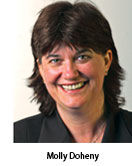 Doheny:
 There are many benefits. We can always learn something from our colleagues in other destinations. The networking is good and the education is fantastic. Also, I believe that much of what happens in the U.S. — regulations, market trends, etc. — eventually will make its way here. Belonging to DMAI allows us to get a head start in understanding and adapting our business to the challenges that lie ahead.
M&C: Does Europe have a similar group for DMOs?
Doheny: Not really. The European Federation of Conference Towns was an organization made up of European convention bureaus. When EFCT merged with European Cities Tourism to form European Cities Marketing in 2008, it became a more generic organization with less focus on meetings and events. Similarly, in the U.K., we used to have an organization called the British Association of Conference Destinations, which has now merged into a larger trade organization called Eventia.
M&C: How can DMAI improve its offerings for international members?
Villain: We would like a European version of EmpowerMINT [DMAI's database of meeting histories]. I'd like to see them expand the staff and invest more in the European office.
M&C: Do you think DMAI is truly international in its scope and offerings or primarily U.S.-focused?
Doheny: I think that DMAI has grasped that its offerings in Europe need to be tweaked slightly from what is offered in North America. It is adapting quickly to the changes, such as in its use of words and spelling, that are required to operate in the European sphere.