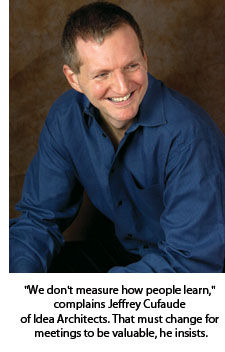
 The meetings industry is in a giant rut, and if we don't do anything to shake things up dramatically, there will be little reason for meetings -- as we know them -- to exist. That's the strong opinion of folks like Jeffrey Cufaude of Idea Architects in Indianapolis, who specializes in creating keynotes, workshops and conferences that promote learning and community.
"Adult learners tend to want to bring their life experiences into the learning format and share it with others," says Cufaude. "This demands more participatory, peer-to-peer formats."
"Thinking is the most important thing that happens at a meeting," insists Jeff Hurt, the Dallas-based director of education and engagement for Velvet Chainsaw, an industry consulting firm. "In all the events I've ever planned, I've said, 'Let's cut your content in half.' "
Proponents have a number of names for this paradigm -- most prominent are Meeting Architecture and Meeting Design -- but it boils down to a few truths:
A) All of the straightforward information your potential attendees need -- whether they are corporate employees, trade association members or members of an esoteric social group -- now can be found online.
B) People attend events to network and learn.
C) Events that are built up from defining concepts, goals and desired learning outcomes have a better chance of engaging attendees and bringing them back for more.
That means meetings where people don't sit in rows but in circles or groupings; where participants (not "attendees") interact via iPads or other devices; and where everyone plays an active role in the learning experience. Sessions (sans PowerPoint) might last about 30 minutes, with 30-minute breaks in between to allow thoughtful discussions to take place in the hallways.
"I don't think the industry has a choice in going in this direction," says Hurt. "Our registrants have become more sophisticated. And over time, you can't stay competitive presenting an experience that is passive in nature. We don't want to go to a meeting where we are spectators."
An evolution of imperatives The shift in focus toward enhancing the participant experience has been prompted by factors such as the stubbornly anemic economy and the ever-burgeoning Internet. At the same time, there has been a growing emphasis on strategic meetings management programs -- essentially the gathering of data surrounding events, including sourcing, to manage spend, increase efficiency and streamline costs. A well-implemented SMMP allows meetings departments to articulate the return on investment of events in concrete business terms.
But in the wake of the Great Recession and the resulting downturn in the industry, which saw many events canceled and others come under intense scrutiny, content and interaction have come into the spotlight to make conferences important enough to attend.
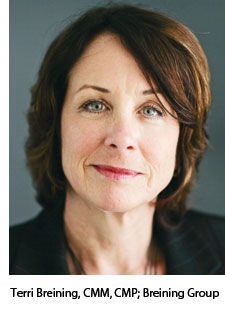 "Meetings are on the radar in a way they never have been before," says Terri Breining, CMP, CMM, a 30-year industry veteran and principle of the consulting/training firm the Breining Group in Encinitas, Calif. "The effect of canceling events, the introduction of procurement into the process, the growth of SMMP, the shift in looking at meetings as a whole instead of as a decentralized concept -- all are creating greater interest in this evolution we are experiencing."
Making this shift requires meeting professionals to get in earlier on the planning process, asking stakeholders what they want participants to learn, asking potential attendees what they want from the event, and then surveying participants at the end to measure the experiential return on investment instead of a monetary ROI.
But step one requires taking a look at the science of learning.
At the core Meeting architecture begins with the concept of how adults learn, something that has largely been ignored in the past.
"We
don't measure how people learn at events," says Jeffrey Cufaude. "We
should be asking, 'What percentage of the conference content can you see
yourself applying personally or professionally?' "
And adults
need a way to process what they've heard. Consider Cufaude's idea for
the follow-up to a keynote: Right after the general session, have a
track of 30-minute breakouts, all of which relate to different aspects
of the keynote. "Maybe you repeat them twice so people can go to two
different ones," he suggests.
The breakouts could approach the
information in different ways. For instance: Do you want to discuss what
you heard? Gather in room 101. Do you want to work on a case study? Go
to room 102. Want to read about it? Find that in room 103. Want to
answer some questions about it? Get together in room 104. The most
important element this model offers is time to reflect on the
information that has been presented, which is essential for adult
learners.
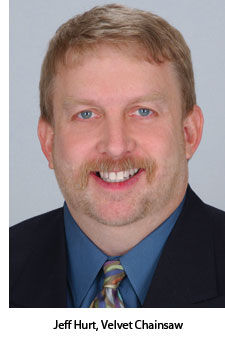 This falls in line with the concept of streamlining
prepared content. "I'll ask speakers to tell me three things they want
the audience to remember when they leave," says Jeff Hurt. "I design the
program around those things and give people a chance to work on them."
This falls in line with the concept of streamlining
prepared content. "I'll ask speakers to tell me three things they want
the audience to remember when they leave," says Jeff Hurt. "I design the
program around those things and give people a chance to work on them."
To
implement such changes, however, planners need be involved right from
the meeting's inception, which doesn't happen very often, observes Debi
Scholar, CMP, CMM, a New Jersey-based travel, meetings and training
consultant with particular expertise in strategic meetings management.
In the corporate world, she says, planners aren't brought in early
enough to contribute to the aesthetics and content design of an event.
Scholar
suggests that planners arrange monthly meetings with typical customers
-- department heads, executives, association boards, independent-planner
clients -- not to talk about a particular event, but about the annual
calendar of meetings. "Having regular, ongoing conversations gives
participants a great chance to talk about the architecture of the
meeting before it's actually all planned out," she says.
Hurt
believes planners should throw out the play book and try to plan even
oft-repeated events from scratch. "Ask executives what the goals of
their meetings are and how effective they think their meetings are," he
suggests. "It becomes about designing the experience, asking a lot of
tough questions of people, like why are we doing this, and why this way?
Is there a better way to get a better outcome for our participants?
Stop looking at the face-to-face meeting as a one-time experience, and
see it as part of a larger ecosystem of touchpoints with our customers,
so it blends well with a whole year's worth of experiences."
A
young industry gathering called Event Camp was built with learner
outcomes as the focal point. People who were regularly communicating on
Twitter using the hashtag #eventprofs wanted to put faces to names, and a
conference was born, cobbled together in two months via a process of
considering only the experience the participants and planners wanted to
get out of it.
"The real spirit of the event is collaboration
and experimenting with concepts," says Michael M. McCurry, strategic
account manager for third-party planning firm Experient and a founder of
Event Camp, which was first held in February 2010. A number of events
have been held since, and two will take place concurrently this month in
Washington, D.C., and Vancouver, British Columbia.
At Event
Camps, meeting professionals attend in person, watch webcasts and/or
participate in Twitter conversations. "We experiment with technology and
how it works with events, with an expectation that some of it will
fail. It's a catalyst to promote change within our own organizations,"
says McCurry.
A Word About Speakers

Richard Saul Wurman (above), creator of the TED Talks, has a new venture, the WWW.WWW Conference,
which pairs disparate experts talking on all sorts of subjects. The
first event, on Sept. 12, 2012, features people like theoretical
physicist Geoffrey West and Huffington Post matriarch Arianna
Huffington. Wurman shared his thoughts on the art of choosing
presenters.
• If you people your conferences with CEOs and
politicians, already you have reduced your conference to people not
telling the truth. However, if you can sit those people down and not
have a podium in front of them, and talk about their passions and not
their work, they will have more success in the marketplace of ideas.
• Invite people to speak because they have passions about something.
Don't let them sell anything except ideas, and the gestalt of how they
do business and what they think might be the next great idea.
• I don't think it's a big reward to speak at a conference -- it's a big reward to listen to something meaningful.
Going global  Three years ago, Maarten Vanneste, president of the Meeting Support Institute and an A/V and production expert in Belgium, decided to put on paper how strongly he feels that the industry needs to change. The result, his self-published manifesto called Meeting Architecture, has evolved into a movement to create an entirely new education module for meeting professionals.
"We want to develop educational packages," says Vanneste, who is launching the Fresh Conference (thefreshconference.com), Jan. 15-17, 2012, in Copenhagen, Denmark, to explores his concepts. "We are figuring out what needs to be inside the toolbox, what the core knowledge needs to be for a meeting architect and how we bring it to potential architects. Then we want to roll it out for the entire industry, globally, using the existing channels."
Breining is on
Vanneste's bandwagon. "This is a very interesting idea, something that
can become a profession on its own," she says, envisioning a meeting
architect as being in on the event design from the beginning,
influencing all the elements that go into it, from site selection and
room layout to lighting, A/V, food, agenda and how the information is
presented, all in support of the objectives. In fact, Breining has
joined Vanneste in presenting to organizations and corporations, talking
up the concept as much as possible. "It is the idea of starting with
the development of objectives," she says. "It sounds absurdly simple,
but most meetings are not begun with objectives, but with aspirational
ideas."
 One long-time industry expert notes that these concepts
aren't new -- and they're difficult to set in motion. "Meeting
architecture is the ideal," says Joan Eisenstodt, a Washington,
D.C.-based meetings and hospitality consultant, trainer and facilitator,
who has been frustrated for years in her efforts to get the facilities
she uses simply to set rooms in ways more conducive to interaction ("If I
even want to put chairs in a circle, hotels have a nervous
breakdown!"). She is a firm believer in the idea that bringing a sense
of play to a meeting also enhances participants' learning experience. "I
want this to work, but meeting professionals aren't dealing with
content first. After the venue is booked, they are fitting square pegs
into round holes. My gut is that we keep tilting at windmills."
One long-time industry expert notes that these concepts
aren't new -- and they're difficult to set in motion. "Meeting
architecture is the ideal," says Joan Eisenstodt, a Washington,
D.C.-based meetings and hospitality consultant, trainer and facilitator,
who has been frustrated for years in her efforts to get the facilities
she uses simply to set rooms in ways more conducive to interaction ("If I
even want to put chairs in a circle, hotels have a nervous
breakdown!"). She is a firm believer in the idea that bringing a sense
of play to a meeting also enhances participants' learning experience. "I
want this to work, but meeting professionals aren't dealing with
content first. After the venue is booked, they are fitting square pegs
into round holes. My gut is that we keep tilting at windmills."
Nevertheless,
industry associations such as the Chicago-based Professional Convention
Management Association have started employing some of the new-wave
design initiatives. And Dallas-based Meeting Professionals International
just granted to Maarten Vanneste this year's RISE Award for Meeting
Industry Leadership.
According to Didier Scaillet, chief
development officer for MPI and the MPI Foundation, "We are not just
looking at forms from last year anymore and picking the most popular
speakers and topics, but also learning how our members want to interact.
They can consume content online in any format they want."
When
determining what will work for the organization's events, Scaillet says
the conversation now centers on how the interaction will take place and
how people will learn. "The purpose of our meetings, such as our World
Education Congress, has changed drastically, and the need to design them
to meet these objectives is imperative," he says.
To that end,
MPI is exploring the concept of meeting architecture and its
implications for the many facets of our industry. The organization is
conducting research as part of its continuing Future of Meetings study.
Heading the project is John Nawn, CEO of the Perfect Meeting in Chicago,
who is an organizational psychologist by training. "We are soliciting
feedback from traditional planners, learning professionals and the
design community, including sensory designers and emotional designers,"
he says. "We have completed about 150 interviews of meeting
professionals to date, and we will go back and explore what we've found
in more detail."
The goal is to analyze the results and present
them at MPI's European Meeting and Events Conference in Budapest in
February 2012. Nawn, who this past July took groups of World Education
Congress attendees in Orlando around the Orange County Convention Center
to analyze room sets and design elements of the building, will apply
the design findings to sessions, room layouts and more at the venue (the
Novotel Budapest Congress) for the EMEC.