 |
 |
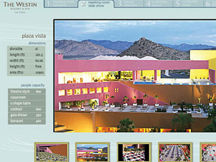 |
Online tours (from top):
Sheraton Hacienda del Mar
via Virtual Planner,
Mandalay Bay via MotionVR,
Westin Los Cabos via Virtual Planner
|
The sky-high cost of fuel is causing some companies to redefine essential travel. As a result, site inspections might have to hold up to closer scrutiny. With heightened pressure to cut costs, planners could be pressed to explore ways to evaluate a property — at least in the early stages of consideration — without getting on a plane.
At the same time, an increasing number of hotels and other venues are tricking out their websites with virtual tours. But just how useful is this to someone planning a meeting?
"It's always better to do a physical site inspection," insists Washington, D.C.-based meetings and hospitality consultant Joan Eisenstodt, although she is a vocal proponent of cutting-edge technology. Obviously, she notes, there are things you can't tell virtually: "You can't tell if there's a musty smell to the hotel. You can't see how staff interacts, either with guests or with each other. You can't tell if there are bleed-through air walls. You can't look under the bed to see if there are fleas. There are things that, at least in my lifetime, I don't think we'll be able to do virtually."
Ideally, a virtual tour should at least help to refine one's list of candidates, says meetings technology consultant Corbin Ball. "They're not used as much as I would hope they would be," adds the Bellingham, Wash.-based principal of Corbin Ball Associates. "But from a meeting planner's standpoint, I think the big questions about a new facility are, ‘Is this going to work for my group? Is it big enough? Does it have the capacity? What is it like?' " Virtual tours can be particularly helpful in answering those questions before deciding which venues merit a physical visit, notes Ball.
Degrees of usefulness
Unfortunately, the term virtual tour has no agreed-upon standard definition; it can range from a 360-degree photo to video tours to virtual-world 3-D modeling in Second Life, and everything in between. Obviously, the value of a virtual site inspection will vary considerably according to the technology employed and how it's used by the venue.
Worth noting, however, are the new approaches some properties are taking. While smelling the room must still be done in person, the online inspection experience could be more revealing than one might expect.
The 360-degree image tours have been around for years, but they've become progressively easier for properties to produce and for planners to view online. These "panoramic" views allow the viewer to pan or tilt through the environment using a mouse or keyboard arrow keys. In the past, specialized browser plug-ins often were required to view the images; today, most such tours can be viewed with a minimum of fuss.
Quality varies considerably and is heavily dependent on how the panoramic image is "stitched" together and how much wide-angle distortion there is in the photo. "In a sense," says Eisenstodt, "it's a step up from looking at a flat brochure. At least you can see what the room looks like, you can see pillars." But scale can be hard to gauge due to distortion, along with the fact that these tours are usually devoid of people.
"I look at these big rooms with all these chairs set up," says Eisenstodt, "and it tells me nothing. I don't see bodies in those chairs. A room with chairs is not what I'm interested in."
One step beyond
Mandalay Bay, in Las Vegas, has offered virtual tours of its convention
facilities since spring 2007, and part of that solution is a 360-degree
pan around empty ballrooms. "No one really likes those," confesses
Robert Hoffman, director of interactive marketing at the resort. What
people do like, he adds, is the 3-D model of the facilities, which
provides context for the 360-degree photos.
Hoffman's team is in the midst of a major site redesign, and new
virtual tours are being produced by Sarasota, Fla.-based MotionVR, a
company that combines the traditional 360-degree view with a
walk-through. MotionVR tours are made using a camera with a 360-degree
lens mounted on a dolly. The photographer captures still shots as the
dolly is wheeled through the space. So those viewing the tour online
can "move" in various directions through a venue, stopping at any point
to look around.
In addition to the walk-through element, part of MotionVR's appeal,
says Hoffman, lies in the variety of information that can be presented
using the interface. Walking tours will be available through the
ballrooms and reception areas, as will strategically placed
"full-screen tours," which will offer high-resolution, 360-degree views
of those locations. Still photos taken during live events will be
linked to the various locations as well, so planners can see design
ideas, people and traffic patterns, and even load-in vehicles.
"Planners want to go online and see how the place can be used," Hoffman
explains. MotionVR also offers a "remote tour" function, whereby
someone from the property can take control of the virtual tour while
describing it by phone, in real time.
"We want a solution where a planner can go and get all of the
information they need," says Hoffman. "Will they still have to make
phone calls? Probably. And I don't know if you can sell a huge
convention without seeing the space in person, but this will give them
a much better idea of what we have to offer."
Planners will be able to reference both floor-plan layouts and 3-D maps
during these virtual walk-throughs, so it's always clear where in the
building a given tour is taking place. The resort also will provide
direct links to downloadable CAD (computer-aided design) floor plans
for use in design programs after the space is booked.
Mandalay Bay already has a number of MotionVR tours on its website,
primarily for leisure-oriented spaces. Hoffman expects the convention
facility tours to be live by this fall.
Interactive advantage
Computer-generated 3-D environments still are largely untapped as tools
for virtual site inspections via a property's website. But these tools
could be of great use to planners.
Eisenstodt is enthusiastic about the possibilities. While discussing
Virtualis, a virtual convention center in Second Life with which she is
involved, she points to the potential benefits this interactivity could
provide for real-world venues. "One thing I love is that somebody can
click and see what a room looks like with different table sets, or with
different room sets. If a hotel had that ability so that I could see
different configurations with different stage sizes, with different
tablecloths, with different lighting, I would have a better sense of
how I could use it. You can't even do that on a physical site
inspection — they're not going to keep changing everything just so you
can see it."
This functionality is put to good use in room-design applications, such
as Vivien from Cast Software. While Vivien is used by venues in similar
fashion as a sales tool, it produces still images and doesn't yet have
the capability to offer virtual tours through a website. Video
fly-through functionality (the ability to view clips of motion in 3-D
space) is planned for future releases, however, according to a company
product engineer.
Meanwhile, such interactive capabilities are creeping into online use:
Starwood Hotels & Resorts unveiled a new platform called Virtual
Planner early this year for a handful of Westin and Sheraton properties
in Mexico. Using the tool (at westin.com/virtual, or
sheraton.com/virtual), planners can select a meeting room or other
on-site venue, see a 3-D video of the space and then create a layout
that includes details such as number and shape of tables, centerpieces,
color of table settings, dance floor, stage and the like. The design
can be modified in two dimensions, then viewed in three. Planners then
generate a request for proposal based on the designs and selected
dates, all within the same interface.
Feedback has been very positive, says Richard Anderson, marketing
manager, Mexico and Central America, for Westin, The Luxury Collection
and Le Méridien. "It's been a great ice-breaker — a great way just to
open the door," he says. "By the time people do a physical site
inspection, they know what options we have to offer. They've already
set everything up, they've already walked the property, they've decided
on where their banquet will be. For us, when they come down it's more
about finalizing the details than starting from scratch."
Starwood plans to roll out Virtual Planner at select properties in the United States and Europe later this year.