Taking the Pulse of Exhibitors
 Productive communication
 with exhibitors includes listening to them. Margit Weisgal, CME, president and CEO of the Chicago-based Trade Show Exhibitors Association, says show managers periodically should ask themselves if they are doing "everything they can to help exhibitors or everything to upset them."
TSEA did just that this past summer, by polling exhibitors at its annual TS2 trade show, held July 20–23 at McCormick Place in Chicago. The association asked its membership to select the issues that most concerned them from a list of problem areas. The top two were a lack of choices when it came to selecting contractors, and the need for independent third-party audits of convention attendees to help exhibitors make informed decisions about what shows will provide the best return on their investment.
In September, TSEA announced the formation of the Advocacy Committee for exhibitors, comprising 15 members who will remain anonymous so as not to damage their relationships with show managers. The committee will communicate concerns to the association, which will then pass along the information to show organizers.
However, some organizers, while eager for exhibitor feedback, are not as keen on advisory councils per se. "To put 10 people that all have different views and opinions into a room and have them yell at you isn't always productive," says Daniel McKinnon, executive vice president for Messe Frankfurt USA. "We feel it's better to meet with them individually, without the pressure of having their competitors in the same room."
Messe Frankfurt thoroughly canvases its exhibitors and visitors, both on-site and throughout the year by telephone or e-mail. Questions on Messe Frankfurt's Texworld USA exhibitor survey, from July 2009, included:
• What are your objectives for participating in Texworld USA?
• What is the primary nature of business of your buyers?
• Rate the quantity and quality of the buyers at your booth.
• Name five companies/buyers that you did not see at this show and would like to see in 2010.
As a result of survey responses in the past, various Messe Frankfurt shows have had their date patterns and times changed, and seminar programs have been shifted so as not to conflict with trade show floor hours.
It's a very simple proposition to McKinnon, who observes, "If we are not doing what our exhibitors want, then we simply won't survive."
Illustration: ©iStockphoto.com/Chrisgorgio
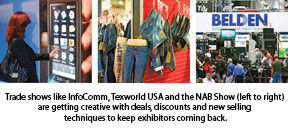 Like so many other industries, the world of trade shows has been rocked by the ongoing economic morass. According to data collected by the Dallas-based Center for Exhibition Industry Research, the number of exhibiting companies at trade shows and conferences fell by 12.8 percent in the second quarter of 2009 vs. the same period in 2008. Shows that have been hit hardest are in industries most adversely affected by the recession, including construction and automobiles.
Yet some trade show experts already are pointing to eventual light at the end of the tunnel. "We've been analyzing the behavior of exhibitions through recessions since the end of World War II," notes Steven Hacker, CAE, president of the Dallas-based International Association of Exhibitions and Events, "and we know that when the economy rebounds, many exhibitors who dropped out will return."
Others are not so sanguine and see the need for a more fundamental change in the industry. "Unless we build our events richly enough, then we're in trouble," warned Rick McConnell, president of Irving, Texas-based Hanley Wood Exhibitions, during a panel discussion this past August at the Society of Independent Show Organizers Executive Conference in New York City. Many show managers are heeding that caution and taking proactive measures to build exhibitor loyalty.
Priced right
Something had to change for the National Association of Home Builders' annual International Builders' Show, which drew 1,200 exhibitors this past January in Las Vegas, down from 1,800 the year before. So the association developed a "stimulus plan" for 2010. The Washington, D.C.-based NAHB offered discounts of up to 14.5 percent off the price of booth space if exhibitors signed up by a certain time and maintained their footprint from last year. Those who reduced their footprint were still eligible to receive an 8 percent discount.
NAHB also liberalized its payment terms. "Exhibitors still have to be paid in full before they set up, but we have allowed them to spread out payments," says Mark Pursell, senior vice president of exhibitions, marketing and sales. "And we are seeing some benefit from that. We saw a big bump after the third quarter of 2009 for the 2010 show."
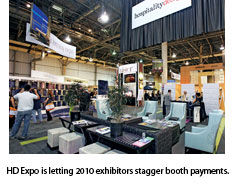 Similarly, San Antonio-based Hospitality Design Group is easing the payment rules for its 2010 HD Expo in Las Vegas. The show, held each May, had 904 exhibitors in 2009, down from 1,130 the year before. HD Expo previously required 50 percent of the payment for booth space up front, with the remainder due in January, according to Liz Sommerville, HDG's Atlanta-based show director. "Now we are breaking this up as a 25 percent down payment, another 25 percent due later on and the final 50 percent after that," she notes.
HDG also is delaying invoicing for its HD Boutique, to be held in Miami Beach, Sept. 13-14, 2010, until January, so exhibitors can count deposits as part of their 2010 budgets. In addition, booth space rates for HD Expo 2010 will be frozen at 2009 rates, an unprecedented move, according to Sommerville.
At Chicago-based Corcoran Expositions, a trade show management company that puts on roughly 40 shows annually for different industries, group show director Noreen Burke says her sales staff's mission is "to educate exhibitors about the industry and the show that we're selling, to convince them that it's in their best interest to stay in the show."
This approach has its limits, Burke acknowledges, but keeping exhibitors in the show is paramount, even if it's at a downsized presence. An exhibitor can downsize to a 20 by 10 or even a 10 by 10 booth, she notes, "but a 10 by 10 can't go any smaller."
Luring Your Best Prospects
Atlanta-based Messe Frankfurt USA, a branch of the global trade show company, goes the extra mile to help clients succeed. For Texworld USA, a semiannual event for the apparel textile industry, loyalty is fostered by engaging each first-time exhibitor in a "matchmaking program" executed by Messe Frankfurt's marketing division. The team's task is to learn the top five companies the exhibitor would most like to meet, and then reach out to buyers at those companies and entice them to attend.
Illustration: ©iStockphoto.com/Gollykim
Beyond the booth
There are other areas
where show organizers help exhibitors reduce costs besides booths,
which represent "only 25 to 35 percent of the cost of being at a show,"
according to NAHB's Mark Pursell.
NAHB, for example, worked with
Dallas-based show producer Freeman, general services contractor for the
International Builders' Show, to reduce exhibitor set-up and tear-down
costs.
A major cost component, especially for shows at which
companies exhibit equipment, machinery and other heavy products, is
freight. Jason McGraw, senior vice president of expositions for
InfoComm, an annual commercial audiovisual-services show that
alternates between Orlando and Las Vegas, has witnessed companies large
and small struggling with freight fees and having to cut back on the
equipment they display in their exhibits.
In response, McGraw
negotiated a "blended" freight rate to help ease the burden. Instead of
the typical 8 a.m. to 4 p.m. rate base, with overtime charged for
deliveries or pickups made outside of that period, InfoComm secured a
fixed freight rate per 100 pounds. "That way there are no overtime
charges for the exhibitors," McGraw says.
He also negotiated
with his 2010 headquarters hotel to lower move-in room rates for
exhibitors. "Cutting $30 to $40 per night on room rates for an
exhibitor's set-up crew represents significant savings," notes McGraw.
The
Reston, Va.-based Graphic Arts Show Co., which sponsors the quadrennial
global graphics and commercial printing expo called Print, worked with
sponsoring partners to absorb labor costs for the handling of heavy
machinery at the 2009 show, held in September at McCormick Place in
Chicago. This covered unloading machinery from delivering carriers,
transporting it to the booths and vice versa once the show ended. It
was a big help, because equipment is a top draw for attendees, yet it's
also one of the first things cut by exhibitors under budgetary
constraints, according to GASC vice president Chris Price.
Some
organizers caution against such discount schemes. "I don't want to set
a precedent and then have to do it every year," says Bob Hughes, vice
president of supplier relations and exhibitions for the Alexandria,
Va.-based National Association of Convenience Stores, which puts on the
annual NACS Show.
Following market trends
Show
organizers must pay attention to their market and be willing to change
along with it, says Alexandra d'Archangelo, marketing manager for
Texworld USA, a semiannual event for the apparel textile industry. For
example, her planning team noted the growing trend in recent years
toward premium denim. At the 2009 show, held in July at the Javits
Convention Center in New York City, denim exhibitors were for the first
time separated out into their own product category on the show floor.
"The year before, 64 percent of attendees surveyed said they would
prefer this arrangement," d'Archangelo says, "so we tried to create
more of a destination to retain our denim exhibitors." The move proved
popular with both exhibitors and attendees, and it will be repeated in
2010.
The BIO International Convention also has, over the past
four years, created a number of "product focus zones" on the show
floor, explains Robbi Lycett, vice president of conventions and
conferences for the sponsoring Washington, D.C.-based Biotechnology
Industry Organization. This happened after some companies exhibiting in
country-specific pavilions felt they were too hard to find and wanted
to be out on their own. Once they were gathered in an "emerging
technologies" zone, attendee traffic -- and exhibitor mood -- improved.
Now, notes Lycett, "We want to create a new zone or grow an existing
one every year."
Consultative selling
Sometimes
keeping an exhibitor simply means reaching out and asking what it would
take to do so. David Dziedzic, senior vice president of business
development for the Washington, D.C.-based National Association of
Broadcasters, which holds its annual show in Las Vegas, says that in
these tough times, "We are spending a lot more time on the phone with
our customers, trying to learn more about how they use the show."
In
a good economy, selling space can end up being "more of an order-taking
function," Dziedzic says. But in the current climate, it's more about
understanding what the exhibitor requires and expects from a
face-to-face event.
Adds Margit Weisgal, CME, president and CEO
of the Chicago-based Trade Show Exhibitors Association, "Price has
never really been a major component of whether people exhibit. The
relationship has always been most important."