What began as a simple music festival in Austin, Texas, in 1987 has become one of the most influential events in the United States. South By Southwest -- also called SXSW or simply South By -- now includes film and technology components, and it's a mecca for music junkies, cinema buffs and cutting-edge social technologies looking to become the next big thing (both Twitter and Foursquare got their start here).
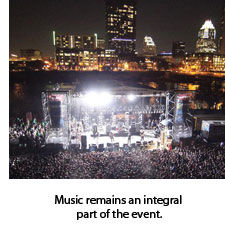 The music program, which drew 700 registrants in its first year, had some 17,000 this year (March 9-18), while SXSW Film and SXSW Interactive brought in about 16,000 and 24,500 people, respectively, to the Austin Convention Center. But thousands upon thousands of unregistered groupies also travel to Austin, seeking the plethora of after-parties and independently ticketed events, hoping to mingle, party, and score some free food and drink. While it's impossible to officially tally everyone that comes through town during the 10-day event, some insiders estimate the 2012 event drew as many as 300,000 people to Austin.
To delve deeper into the conference's appeal, M&C went to this year's gathering and picked the brains of Mike Shea, executive director of SXSW; Steven Stout, director of meetings and events for Hospitality Financial and Technology Professionals and an Austin resident; and Jason Preston, vice president of strategy and product with the Redmond, Wash.-based events production company Parnassus Group, who was one of many speakers on the show's jam-packed agenda. Following are key takeaways that can be applied to any event.
Create lots of lounging space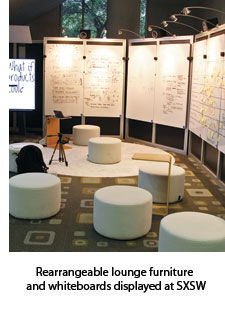 Planners pay for every square foot of a venue, so why not use it? At SXSW, "There wasn't a corner in the convention center that didn't have some interactive lounge or activity for attendees to experience," says Stout. "There's this imperative that we want attendees to spend their time in the sessions and not in the common areas, but if someone wants to go network in a lounge instead of head to a lecture, that's still a win. You're still providing valuable education, because networking is one of the main reasons why people come to face-to-face events."
For the entirety of the show, the convention center's floors, corridors and corners were dotted with sofa-stocked lounges, whiteboards and cell-phone charging stations, many of which were sponsored, and all of which were constantly trafficked by attendees from morning to night. "Everywhere you turned there was a place to sit," Stout notes. "It makes interactions so informal and organic."
Crowdsource education This year's SXSW
featured 1,033 panelist sessions that ranged from technology trends in
education to "Sex on the Web: The Sabotage of Relationships?" Part of
what makes SXSW's educational program unique is that "anyone, anywhere
can submit an idea for a panel," says Mike Shea. "We were crowdsourcing
our speakers before crowdsourcing was popular, and it's probably the
best thing we ever did."
 Hopeful speakers submit their concepts through the SXSW PanelPicker,
which is open to voting by the public, after which a jury of SXSW
organizers picks from the finalists and determines the educational
offerings for the year.
Hopeful speakers submit their concepts through the SXSW PanelPicker,
which is open to voting by the public, after which a jury of SXSW
organizers picks from the finalists and determines the educational
offerings for the year.
Last year, 3,231 session ideas were
submitted, so the initial public voting serves as a screening process
before organizers even see proposals. It also "gives the SXSW staff a
built-in sense of demand for the sessions -- a better sense of which
room they should use, how many seats and what kind of space," says
Preston, who is working on a project to offer a similar crowdsourcing
platform called SessionPicker,
which will allow any planner anywhere to create a similar process for a
fee. (Preston's project still is in the development stage but is ready
to use.) "Simply by getting the public involved, it generates a lot of
discussion online and becomes an effective mechanism for keeping the
conversation alive year-round," he says.
While the crowdsourcing
process allows almost anyone to be a speaker, that also means that
panelists' experience levels can vary drastically. To ensure that
sessions consistently deliver the quality content SXSW is known for,
organizers set up speakers with an online account, complete with
checklists, presentation tips and deadlines for them to follow. In
addition, SXSW speaker liaisons help panelists by walking them through
the preconference process, ensuring they are well prepared for the big
day. "It's interactive for a speaker to go online, log in and see his or
her progress against the digital checklist SXSW provides, and get
instructions and messages from a centralized system," says Preston.
"They have made the process of prepping speakers a scalable thing, which
isn't an easy task."
Encourage roommates SXSW
has more than 70 hotel partners around Austin, though properties keep
filling up and many registrants end up on waiting lists. In response,
event organizers encourage single occupants who have two beds to swap
out their room for accommodations with a single bed. This allows
attendees who might have a colleague or friend on the waitlist to pair
up and make the most of available digs. Registrants interested in
proffering their rooms simply e-mail SXSW's housing bureau, which
handles the logistics.
SXSW
has more than 70 hotel partners around Austin, though properties keep
filling up and many registrants end up on waiting lists. In response,
event organizers encourage single occupants who have two beds to swap
out their room for accommodations with a single bed. This allows
attendees who might have a colleague or friend on the waitlist to pair
up and make the most of available digs. Registrants interested in
proffering their rooms simply e-mail SXSW's housing bureau, which
handles the logistics.
Think beyond the shuttle While
traditional shuttle buses are a consistent and reliable way to get
around campus at SXSW, they are only one of many options. This year, the
event pioneered a bike-share program called SXCycles, which allowed
attendees to check out bicycles, helmets, locks and lights for nighttime
riding. The program, which was complimentary for registrants, paired
well with the bike-friendly and eco-conscious city of Austin and allowed
delegates to get in a little exercise between sessions.
Those
who preferred four wheels to two could flag down one of the many
Chevrolet Cruzes circulating around the SXSW campus, picking up
badge-holding participants and whisking them off to their destinations
at no charge. The program, sponsored by Chevrolet and branded Catch A
Chevy, was wildly popular.