 If the hotel industry could speak in one collective voice, it likely would be chanting "China!" In a modern business-world equivalent of the Oklahoma Land Rush, U.S. hotel companies are engaged in a fierce expansion race eastward to plant their individual chain flags. The prize? The attention and, ultimately, guest loyalty of a new and growing contingent of deep-pocketed Chinese customers.
And arguably no hospitality company is more focused on gaining the high ground than White Plains, N.Y.-based Starwood Hotels & Resorts Worldwide. This past June the chain, in an unprecedented move, relocated its entire eight-member leadership team to China for five weeks. It was a strategy that immediately set competitors speculating and the media humming. But for Starwood's chief executive officer, Frits van Paasschen, the relocation made perfect sense. "I didn't go to China to have some kind of epiphany or close a big deal. It wasn't some kind of watershed moment," van Paasschen says. "Our team went to make sure that we are supporting our local teams there in every reasonable way that we can."
 During the five-week effort, M&C shadowed the Starwood team's progress through a series of early morning phone interviews, as members crisscrossed the country from Shanghai to Chengdu in the west, and Beijing to Guangzhou in the south. Among detours along the way, they met with their 26-member Asia Pacific advisory board at the W Taipei; attended a divisional conference at the Royal Orchard in Bangkok, Thailand, with some 700 general mangers, directors of sales and others; and attended a board of directors meeting in Shanghai.
"It was," reflects van Paasschen, "the most intense five weeks of my life."
Starwood's China Timeline

1985 The 827-room Great Wall Sheraton Hotel Beijing (above) opens, becoming Starwood's first property in China.
1999 Starwood's first St. Regis in China, the 258-room St. Regis, Beijing, opens.
2002 During the year, 14 Starwood properties open in China.
2005 The 278-room Four Points by Sheraton Shenzhen opens, becoming Starwood's first Four Points in China.
2007 Starwood opens 40 hotels in the country.
Eastward to China Exactly
how dominant a player has Starwood become in the China market? In 2010
the company opened more hotels there than any other chain, comprising
its second largest market outside of the United States. At press time,
Starwood had 75 hotels in the country, with another 100 in the pipeline
and set to debut by 2013.
Exactly
how dominant a player has Starwood become in the China market? In 2010
the company opened more hotels there than any other chain, comprising
its second largest market outside of the United States. At press time,
Starwood had 75 hotels in the country, with another 100 in the pipeline
and set to debut by 2013.
By comparison, here's what other major hotel companies have going in the world's most populous country:
• Marriott International has 57 hotels (10 of them in Beijing) now open in China, with plans to add another 27 by 2014.
•
Hilton Worldwide, which has 18 Chinese properties (including nine
Hilton Hotels & Resorts), plans to grow its portfolio to 100 within
the next five years. Just last month, the company appointed veteran
hospitality executive Edmond Ip to the new role of chairman for Greater
China, charged with overseeing Hilton's operational interests in the
country.
• Best Western has 31 properties in China, with 41 more in the pipeline.
•
The only hotel companies with larger portfolios than Starwood in China
are Wyndham, with 324 properties, and InterContinental Hotels Group,
which currently has 150 and is on track to double that number by 2015.
However, most of the product for these two chains is in the budget and
limited-service sectors.
Driving the robust international hotel
development engine is China's booming multibillion-dollar tourism
sector. According to the United Nations World Tourism Organization,
China beat out Spain in 2010 as the third most visited country in the
world, right behind France and the U.S., with the number of
international arrivals reaching 55.66 million -- and it is predicted to
snag the top spot by 2020.
Meanwhile, the number of outbound
Chinese travelers reached close to 57.4 million in 2010, up 20.4 percent
from the year before. But it is the Chinese domestic traveler who
clearly is the front-runner. According to China's National Tourism
Administration, this segment made 2.1 billion trips in 2010, an 11
percent jump over 2009. And as China's economy continues to percolate,
the volume of Chinese traveling for business and vacation within their
homeland is predicted to swell.
Starwood has this new domestic
traveler squarely in its crosshairs. "This sector has grown
exponentially for us," says Alison Taylor, vice president of sales, Asia
Pacific, speaking from Shanghai, where she and relocated team leader
Christie Hicks, senior vice president of global sales, have made their
way after spending several days at the Westin Beijing. Based in
Singapore, Taylor is a 23-year Starwood veteran, with 15 of those years
spent in the Asia Pacific region. "Five years ago, Chinese travelers
represented about 15 to 20 percent of our business," she notes. "Today,
58 percent of our business is from them, and 10 percent of that is from
same-day bookings."
In Beijing, Hicks' top priority was scoring a
sit-down meeting with Guangfu Cui, the CEO of eLong, and his senior
team. Owned by Expedia Inc., Beijing-based eLong represents 20,000
hotels in more than 700 Chinese cities (Starwood's portfolio included)
and more than 135,000 hotels in some 100 countries overall. Besides
being a major partner for Starwood, eLong is widely considered the
country's fastest growing online travel service provider. In 2010, the
company booked 6.4 million room nights, an increase of 49 percent over
2009.
The meeting with eLong's management, Hicks says,
represented an opportunity to affirm their importance to Starwood. "In
the U.S., it's normal to conduct business by e-mail and phone and never
lay eyes on the customer," she notes. "In China, face-to-face meetings
are very important. They are a sign of respect. I wanted eLong to take
away from that meeting that Starwood is taking the Chinese market very
seriously, and that we respect their company and appreciate the work
they are doing."
Starwood's China Timeline continued
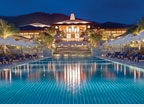
2008 Starwood's first Aloft and Le Méridien properties open -- the 186-room Aloft Beijing and 275-room Le Méridien Shimel Bay Beach Resort & Spa, Wanning City, Hainan Island (above).
2009 Starwood's first Chinese Customer Contact Center opens in Guangzhou.
2010 The First Luxury Collection hotel, the 152-room the Astor Hotel, Tianjin, opens.
2011 Total number of Starwood employees in China reaches 30,000 (to increase to 90,000 by 2015).
2011 Total number of Starwood hotels open in China reaches 75 (as of Aug. 1); in the pipeline: 100.
2013 Scheduled to open is the 4,000-room Sheraton Macao Hotel, with 53,000 square feet of meeting space.
Forging ahead Three
weeks into the trip, van Paasschen is in Shanghai readying for the
company's board of directors meeting. He says he can't wait to take
board members around the market in Shanghai, so they can experience the
excitement he has been witnessing.
Three
weeks into the trip, van Paasschen is in Shanghai readying for the
company's board of directors meeting. He says he can't wait to take
board members around the market in Shanghai, so they can experience the
excitement he has been witnessing.
"This is an economy making a
shift to consumption. There is a real sense of urgency everywhere you
go," he says. "It used to be that hotels were built as outposts for
Western travelers inbound to China, but that has completely shifted.
Today, the majority of our guests are Chinese nationals. And as we start
to build in second- and third-tier cities, that number will only go
up."
In 1985, Starwood became the first global hotel operator to
enter the Chinese market when it opened the 827-room Great Wall
Sheraton in Beijing. While all nine of its brands have since established
a presence there, it is Sheraton that continues to lead the company's
growth in the region by aggressively leveraging its first-in advantage.
Currently, the Sheraton portfolio stands at 35, with another 40 in the
pipeline. Not only will the brand increase the number of its properties
in big cities like Beijing, where it will add a second property, and in
Shanghai a fourth, it is moving into rapidly developing urban centers
such as Chongqing and Huzhou.
To capture the legions of newly
minted Chinese road warriors and leisure travelers, van Paasschen
acknowledges that Starwood must adapt to cultural nuances to stay
competitive. And the first priority, he says, is language accessibility.
As such, in March, after plowing a significant amount of investment
into its technology infrastructure, Starwood added online booking
capability in Chinese to all of its branded websites, including SPG.com,
the Starwood Preferred Guest loyalty program site. In addition, the
company has expanded its Customer Contact Center in Guangzhou, which
employs more than 160 associates to support Chinese-speaking customers.
Hot on those heels, Marriott International in June opened its first
dedicated China reservation center in the same city, with 45 associates.
Hotel
companies have good reason to chase down the Chinese traveler.
According to the U.S. Department of Commerce, a Chinese tourist spends
an average of US$6,000 per person, per visit, in the U.S. And that
represents just the outbound traveler. At home, China's appetite for
luxury goods is growing faster than any in other country and is expected
to surpass the U.S. by 2012, according to the 2010-2011 World Luxury
Association Annual Report, released in June. "Some 200 million
well-heeled consumers are increasing consumption by at least 15 percent
annually," Michael Ouyang, chief executive of WLA China, noted in the
report.
Meetings, Chinese-style Starwood
plans to equip its new Chinese properties with state-of-the-art meeting
facilities, which might help offset some of the hectic nature of
organizing events here. For example, the average window for booking
meetings requiring 20 to 150 rooms at Starwood's properties, where
overall meetings represent 20 percent of business (40 percent at
Sheraton), is just 13 days. That means response times to requests have
to be trigger-finger sharp, leaving scant opportunity for the massaging
of 25-page contracts.
"It's a little like the Wild West," admits
Alison Taylor. "A good portion of our banquet and business meeting
accommodations are booked on the same day. We can't afford to be as
contractually anal. Sometimes we don't have a contract at all, and there
are not a lot of deposit and attrition requirements."
 "The
number-one differentiator to closing meetings business in China is
response time, not rate," says Hicks. "They want space and availability,
and they don't have a lot of time to shop." After that, she says, the
next negotiated point is a flexible payment schedule. And if that's what
it takes to grow Starwood's share of the meetings market, adds Hicks,
she and her team have no problem adapting. Currently under
consideration, as a way of shortening the response time for group
business, is creating clusters of sales associates who work on a "follow
the sun" strategy. "That doesn't mean we are going to have 75 people
working the graveyard shift," notes Hicks. "But with today's technology,
and the requests from our employees for flexibility in lifestyles, the
possibility of shifts from 11 a.m. to 7 p.m. is very real."
"The
number-one differentiator to closing meetings business in China is
response time, not rate," says Hicks. "They want space and availability,
and they don't have a lot of time to shop." After that, she says, the
next negotiated point is a flexible payment schedule. And if that's what
it takes to grow Starwood's share of the meetings market, adds Hicks,
she and her team have no problem adapting. Currently under
consideration, as a way of shortening the response time for group
business, is creating clusters of sales associates who work on a "follow
the sun" strategy. "That doesn't mean we are going to have 75 people
working the graveyard shift," notes Hicks. "But with today's technology,
and the requests from our employees for flexibility in lifestyles, the
possibility of shifts from 11 a.m. to 7 p.m. is very real."
To
delve into the mind of the Asia Pacific meeting buyer, Starwood recently
hosted its top 35 buyers at the W Taipei in Taiwan for a day of
meetings and a showcase of the chain's hotels. None of the clients, says
Taylor, had ever met the CEO of a hotel company before, and many
remarked how unusual and exciting it was to have Frits van Paasschen
addressing them in a meeting. "Honor is very important in Asia, and that
just took our relationship with our clients to an even greater level,"
says Taylor.
Online Extra

For a Q&A with Qian Jin, Shanghai-based senior vice president of operations for Starwood, go to mcmag.com/webexclusives.
Growing pains While
China's hotel building boom continues its frenzied pace, industry
watchers predict that an oversupply in markets will lead to price
discounting, as demand lags. Horwath HTL's Annual China Hotel Industry
Study 2011, released in July at the China Hotels Development Conference
held in Hangzhou, pointed out that a drop in foreign demand, coupled
with the increase in the supply of international hotels, was leading to
oversupply and keeping the average daily rate down.
In its 2011
Spring Asia-Pacific Lodging Real Estate report, Portsmouth, N.H.-based
Lodging Econometrics said China had 1,260 projects, representing 353,252
rooms, in the pipeline -- 62 percent of the total Asia Pacific
pipeline. Van Paasschen acknowledges the burst of supply has led to
saturation in some cities, but he is confident that demand eventually
will catch up. "The economy is developing so quickly now, there will be
places where supply and demand is out of kilter," he says, "but with 300
million people eventually on the move, a little extra capacity today
will quickly meet that."
Of a more immediate concern, he insists,
is ensuring Starwood's properties are staffed to the correct levels,
because Chinese travelers are far more demanding when it comes to
service expectations. "We are focusing on selecting, training and
promoting people who understand how to deliver the brand experience,"
says van Paasschen -- and it's shaping up as quite a job, considering
that Starwood currently has close to 30,000 associates in China alone
and plans to triple that number in the next several years.
The
sheer magnitude of the task is daunting, admits van Paasschen, who has
been on the road visiting hotels across the portfolio, meeting with
management teams and sizing up each property's fidelity to the brand. To
help keep standards in line, each new hotel is used as a stepping stone
to the next in development, with trainee employees on every level
shadowing their more experienced counterparts, before going on to take
over that role when the new property opens. "You can't open 90 hotels
from a standing start. This is the only way to get the job done," says
the CEO.
One eye on the competition
Earlier this year, the InterContinental Hotels Group announced plans to
launch in 2013 an "upscale, made-for-China" brand that will cater
specifically to the Chinese domestic business traveler. IHG expects that
one in four hotel rooms the company opens in the foreseeable future
will be in China.
Not to be outdone, Marriott International said
in July it was working on a Courtyard by Marriott prototype for China
but did not offer details on how it would differ from existing
Courtyards.
At present, Starwood has no plans to develop a brand
specifically for the China market, says van Paasschen. Instead, to meet
the needs of the lower price-point traveler, the company will focus on
expanding its Four Points by Sheraton, Element and Aloft brands.
Meanwhile,
now back at their U.S. headquarters, the Starwood team says they are
more keenly aware of local needs after their sojourn. Stay tuned, they
say, because in the next several months they will launch even more
initiatives aimed at capturing this dynamic travel market.
"The
Chinese are used to cutting-edge hotels," says Hicks. "The exciting part
now is making sure we capture them as they travel outside their
country. That's what we will be focusing on now."