Beyond Our Borders
Though some perception-conscious companies have put international destinations on the back burner for their 2009 and 2010 programs, an array of alluring dollar-friendly places are catching planners' interest.
- Europe. Given currency fluctuations and the world economy, places like London, Scotland and Paris are now more affordable.
- North and south of the border. Canada and Mexico offer great bargains, too. Groups are eyeing the Riviera Maya and Montréal.
- Croatia. Dubrovnik has been popular for several years, says Pat Durocher, CEO of Scottsdale, Ariz.-based site-selection firm Global Cynergies. But other areas, such as Hvar, Istria and Korcula are now ready for groups.
- Montenegro. "The infrastructure is now being developed, particularly in Budva and Kotor Bay," Durocher notes.
- Turkey. The Mediterranean Coast, especially Belek and Bodrum, offer a number of new incentive-level hotels.
 Historically, when the economy has shown signs of decline, reward trips have been easy targets for corporate cost-cutters. But the challenges incentives have been facing since last fall are unprecedented. Virtually no area of the industry has been untouched by the recession, as well as public and political outrage over perceived excesses. As Christine Duffy, president and CEO of Fenton, Mo.-based motivation-services firm Maritz puts it, "our world has changed, and it won't go back to the way it was."
Yet, the need for incentives to help drive American business remains strong, as M&C found in talking with top industry experts and planners, and companies are adjusting their programs to reflect current realities as well as the eventual post-recession landscape.
How firms' incentive programs are faring this year and for 2010 is highly individualized. A number of industry experts have begun to express cautious optimism about the future of rewards. "We have started to turn the corner on people being afraid of running programs. The rate of cancellations for 2009 has stopped," says Fay Beauchine, president, engagement and events at Minneapolis-based Carlson Marketing.
Beauchine and other insiders attribute the apparent shift, in part, to vigorous efforts by the U.S. Travel Association and meetings industry coalitions to educate Congress and other government bodies on the distinction between performance-based incentives and CEO bonuses. They also cite increasing attention by the press to the good that incentive programs can provide businesses, and the fact that well-structured programs are designed to pay for themselves (see "The Case for Incentives," May).
| For an inside look at how Nationwide Financial Services recently reworked its incentive program, click here. |
Steve O'Malley, vice president, strategy, practice and industry relations, for Maritz, told M&C in late April, "In the past three weeks, I have heard more hope and positive news from hotels and destinations [about incentive business] than I have in the in past six months."
O'Malley does, however, believe companies will continue to be conservative with programs and budgets for the next few years, because the pain of the downturn still will be fresh.
Adding and subtracting Getting companies to "put their oar in the water again," as Fay Beauchine puts it, and reinstate incentives going forward is one aspect of the new reality the industry is now facing. And programs are evolving to ease the process in a number of ways.
• Adding a charitable component. Whether it's helping to build a home via Habitat for Humanity or collecting donations for the American Red Cross, experts say volunteer activities increasingly will become a part of incentives, for two reasons.
First, participants find them very motivating, particularly when they can see how their efforts help individuals. Second, more and more companies are being very careful about their public image; if their rewards programs get publicity, they want it to be for positive reasons, such as the implementation of give-back projects.
• Closely monitoring results. Measuring the outcomes of programs -- and sharing them with the company's stakeholders and board -- is more crucial than ever.
"What will come from this time is that our industry will now do a much better job of calculating return on investment of their programs," says Mary Bussoni, senior vice president, ITA Group, an incentive firm based in West Des Moines, Iowa. "We've all paid lip-service to it for some time, but it has taken on new meaning now."
• Consolidating rewards. Some companies that used to run numerous programs are now condensing them into a few to save on costs, says Carlson's Beauchine.
• Creating trips for two. Presenting winners with vouchers for trips for themselves and a guest were popular about 10 years ago but lost steam when companies began to miss the opportunities to conduct business that group trips could provide. But pros say individual travel rewards are making a comeback with firms that want to keep their programs under the radar.
Carol Ann Payne-Johnson, president of the Travel Corner, a meeting and incentive firm based in Smyrna, Ga., is planning individual travel rewards for winners of an insurance firm that was originally going to hold a group program in Bali this summer.
• Emphasizing engagement and retention. Experts say smart firms believe in the need to take care of their best people even in down times. "It's a huge mistake to think your employees have nowhere else to go," says Steve O'Malley of Maritz. "That's not true; your best employees always have options. Keeping them engaged and giving them thank-yous and rewards are instrumental in keeping them."
• Quieting the bells and whistles. Companies are looking to trim budgets in ways that won't diminish the reward or negatively impact the overall program. They are offering fewer sponsored activities (tours, sports, group meals), dropping top-name entertainment and contracting fewer speakers -- often using the firm's top executives as motivational presenters.
• Staying closer to home. While some companies will continue to hold their programs in long-haul destinations (Asia, Europe, etc.), many incentive professionals say the majority of their clients are selecting destinations closer to home for budget reasons (for some newly popular destinations, see "Low-Profile"), while others are doing so expressly to stimulate the U.S. economy.
Low-Profile Luxe
 For many firms today,
 tropical playgrounds, luxury resorts, expensive cities and/or international destinations are off the current radar as incentive destinations. "Industries that are feeling the pressure to clearly demonstrate all events have a business purpose are steering clear of resort properties," says Pat Durocher, CEO of Scottsdale, Ariz.-based site-selection firm Global Cynergies. "The perception of a resort, even if it may be better value right now, is not the message they want to send to stakeholders."
Due to the shift, a number of "new" destinations are piquing the interest of incentive planners. "Some second- or even third-tier cities could be great for incentives," Durocher notes. "They are unlikely to have had any negative publicity through the past several months and may be perceived as an easier sell to upper-level management."
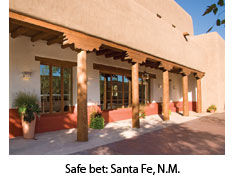
Durocher's clients are taking a close look at destinations such as Sedona and Tucson, both in Arizona; Santa Barbara, Calif.; Savannah, Ga.; Santa Fe, N.M.; Charleston and Hilton Head, both in South Carolina; Nashville; and Jackson Hole, Wyo.
Fay Beauchine, president, engagement and events, at Carlson Marketing, sees a similar pattern. "Several incentive programs have changed their focus to include more meeting elements and are choosing destinations, such as Atlanta, that better fit that focus."
A Meaningful Agenda
One firm that's committed to running programs through thick and thin is Fort Lauderdale-based Spherion, which provides recruiting and staffing services. Here, incentives are considered the primary driver of performance and, even in a tough market, a way to grow market share. Increasingly, Spherion's incentives have become an effective tool in retaining top talent and reducing employee turnover (hiring and training expenses for new staff cost the firm about $60,000 per position). In light of those factors, and despite some fallout from the weakened economy, Spherion went forth with its 2009 program.
The event rewarded the top 10 percent of sales and operations professionals and was held in March at the Loews Coronado Bay Resort in San Diego. There was some fine-tuning made from last year's outing, according to Dahlton Bennington, CMP, CMM, director, business meeting services. Specifically:
• Less cost; more business. The company reduced overall spend, scaling back on items such as food and beverage, and group size was trimmed to 325 from 350. Also, while meetings are always part of the agenda for Spherion's incentive programs, they were increased this year to three half-day sessions.
• Employees only. As always, spouses/guests were not included, because, says Bennington, "our program is a business meeting and we want participants to network and work, as well as have fun. People more actively engage others in business talk when without their spouses." Top executives attended and spent significant face time with the group.
• Forum for feedback. Winners serve as a brain trust for management. During the program, they're asked to share their views on a particular topic of interest to the company. This year, participants were asked to discuss why people are emotionally committed to the firm, and what Spherion can do to drive that commitment. After the trip, the findings were forwarded to a task force, which will make recommendations to management. "It's not a one-time meeting that ends," says Bennington. "The momentum continues on."
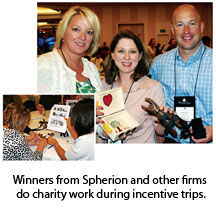
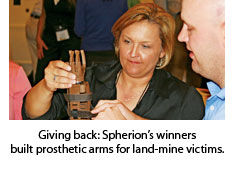
• Charitable team-building. Two years ago, the company added philanthropic activities to its programs. This year, teams of participants made 100 prosthetic arms for victims of land-mine accidents. The effort inspired one winner to say, "In a time where it is easy to lose motivation, I am inspired and energized and rewarded to have participated in this activity."
The company plans to reward top performers next year with a trip to the Atlantis Resort & Casino in the Bahamas. Bennington also is looking at other international destinations for future programs.