Model for Recovery?
Analysis of the Ixtoc oil spill (140 million gallons, comparable to this year's Gulf Coast spill) off Mexico's coast in 1979 suggests that affected beaches could return to pre-spill conditions within about three years. However, tar balls and patties could wash ashore for longer. Some mangrove swamps in the Yucatan Peninsula, an ecosystem similar to the one found off the Louisiana Gulf Coast, currently are 80 percent recovered from that spill; tar still can be found in some areas.
Source: "The Potential Impact of the Gulf Oil Spill on Tourism," a study by the U.S. Travel Association
It's been six months since BP's Deepwater Horizon well exploded in the Gulf of Mexico, causing the largest offshore spill in U.S. history, and more than two months since the leak was capped. By mid-September, all remnants of surface oil slicks, which at one point covered 2,500 square miles of the Gulf, were gone; fishing, an industry that netted $4 billion in 2008, had been declared safe by the federal government in nearly the entire region; and beaches affected by the spill were open and declared safe by their respective state health departments.
Coupled with a $70 million emergency tourism marketing grant BP gave this summer to the four states affected by the spill -- Alabama, Florida, Louisiana and Mississippi -- the Gulf Coast tourism industry is positioned for a comeback.
But are these positive signs enough to make the public forget the televised images of oil-coated birds, out-of-work fisherman and eerily deserted beaches, and lure visitors back to the region?
A U.S. Travel Association study (bit.ly/aspmC0) projects tourism losses in the area could reach a staggering $22.7 billion. The report, conducted by Oxford Economics, considered how the spill had already impacted the behavior of tourists and visitors; it also assessed the duration and magnitude of the disaster on the Gulf's image and travel prospects in a comparison with similar data from earlier disasters, such as the 1989 Exxon Valdez oil spill and Hurricane Katrina.
Among the keys to tourism recovery, according to the study, will be to alter travelers' perceptions. As Richard Forester, executive director of the Mississippi Gulf Coast Convention & Visitors Bureau, says, "The single greatest problem we have is perception; we had oil on the beach once, and we got calls from people who wanted to know if they had to wear gas masks or if the finish on their cars would be safe."
However outsiders view the oil spill, "This has been a different type of crisis; it's affected each of the four states in different ways," says Chris Thompson, president and CEO of Visit Florida, that state's official tourism marketing body. Following is a look at the challenges the spill presents to the affected states, and how they've responded to date.
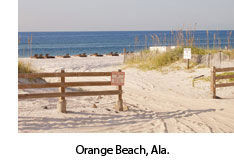 Alabama:
Picking up the pieces The beach resorts of Gulf Shores/Orange Beach in Baldwin County, Ala., took the brunt of the spill. In 2009, the area, which accounts for 25 percent of the state's tourism revenues, had 4.6 million visitors who spent $2.3 billion and sustained 40,000 tourism-related jobs. Beginning May 1, less than two weeks after the Deepwater Horizon well exploded, group cancellations started rolling into the Alabama Gulf Shores Convention & Visitors Bureau. By Aug. 6, a total of 37 meetings and events -- representing 2,300 group room nights, an estimated $410,000 in room revenues and $460,000 in additional spending -- were lost.
And it wasn't just meetings that were affected; lodging revenue was down 53 percent in July from 2009 figures, according to Beth Gendler, the Gulf Shores CVB's director of sales. Based on the bureau's projections through 2012, the destination stands to lose some 9,400 group room nights.
To quickly counteract tourism losses, the CVB used funds from the initial BP Gulf grant for tools to help planners boost attendance, including electronic postcards and giveaways for free stays. The bureau also launched daily video beach updates and information about attractions in the region.
In Mobile, a spokesperson for the Alabama Tourism Department says the city was a command center for BP clean-up operations, so "hotels were booked, but not with tourists." What did suffer losses, she says, were tourist attractions like the Mobile Mardi Gras Museum.
By the Numbers
• Visitors to the Gulf Coast spent in excess of $34 billion in 2008, sustaining 400,000 jobs.
• The potential impact of the Deepwater Horizon oil spill could cost the U.S. coastal economies $22.7 billion over a period of three years.
• The economic toll could be could be cut by one-third ($7.5 billion) with the establishment of a $500 million emergency marketing fund to counter misperceptions and encourage travel to the affected region.
Source: U.S. Travel Association, "The Potential Impact of the Gulf Oil Spill on Tourism"
 Florida:
Facing statewide losses
"With 825 miles of beach and 1,260 miles of coast, we had the most at
stake," says Visit Florida's Chris Thompson. "Even the experts couldn't
know what the impact would be when the leak started. We saw models that
showed the current bringing the spill around the peninsula -- it could
have affected our entire coast."
While that didn't come to pass,
the spill did reach seven northwest coastal counties in the Florida
Panhandle. "We didn't have the first oil impact until June 4," Thompson
says. "Immediately, we had challenges with tourist cancellations. And
then the phones stopped ringing altogether."
 For
the month of July, hotel tax revenues in key Panhandle destinations
were down: Panama City Beach had a drop of 15 percent from July 2009
numbers; Fort Walton Beach's numbers were down 20 percent, and
Ocaloosa's and Pensacola's were off 30 percent.
For
the month of July, hotel tax revenues in key Panhandle destinations
were down: Panama City Beach had a drop of 15 percent from July 2009
numbers; Fort Walton Beach's numbers were down 20 percent, and
Ocaloosa's and Pensacola's were off 30 percent.
Thompson says
there are no statewide figures yet to determine the loss of tourism (or
meetings) dollars due to the spill, but, he adds, "Tourism is a $60
billion industry in Florida; even 1 percent down is a loss of $6
million." He also notes that in polls the state conducted after the
spill, 4 to 6 percent of travelers canceled plans to vacation in the
state in July and August, mainly due to the spill.
In describing
how Florida will move forward from the crisis, Thompson says, "Our goal
now is to gain back the market share we've lost by correcting
misperceptions and influencing intent to travel."
Among steps
Visit Florida has taken is to create a real-time website at
visitflorida.com; locals and visitors are encouraged to upload photos to
help counter false impressions. The site also offers beach advisories,
daily fishing reports, an interactive map with links to live web cams
around the state and more.
 On
a more local level, Dan Rowe, president and CEO of the Panama City
Beach Convention & Visitors Bureau, says one way he plans to move
forward is to diversify the destination's tourism economy. "We are
focusing on golf for the first time, and not just beaches." He adds that
the area will attempt to capitalize on the opening of Northwest Florida
Beaches Airport with daily nonstop service from six gateway cities,
which will boost the lure for corporate meetings and incentives.
On
a more local level, Dan Rowe, president and CEO of the Panama City
Beach Convention & Visitors Bureau, says one way he plans to move
forward is to diversify the destination's tourism economy. "We are
focusing on golf for the first time, and not just beaches." He adds that
the area will attempt to capitalize on the opening of Northwest Florida
Beaches Airport with daily nonstop service from six gateway cities,
which will boost the lure for corporate meetings and incentives.
Fighting the Perception Battle
Last month, M&C spoke with Jim Hutchinson, assistant secretary of the Louisiana Office of Tourism, shortly after the five-year anniversary of Hurricane Katrina. Following are his thoughts on the state's most recent disaster.
• How was the state affected by the spill? Louisiana has more than 7,000 miles of tidal coastline. The oil only reached about 400 miles of coastline, so a relativity small area in the southeast region has been directly affected by the oil spill.
Rather than beaches, our shores mostly consist of picturesque wetlands and swamps. Though most of these areas were unaffected by the spill, we recognize there were some isolated portions of the southeast coast that have been directly affected.
Travelers can put their minds at ease knowing that we are open for business. Our outdoors are ready to be enjoyed, from swamp tours and bike trails to bird-watching and fishing. In fact, 100 percent of Louisiana's coast is now open to fishing.
• What was the most damaging aspect of the oil spill for the state?Most damaging is that the spill has created a number of false perceptions. Tourism is a perception-driven industry, and perception is key to decisions about where people choose to hold conventions and meetings. Lingering fear and misinformation kept travelers away for years in the aftermath of Hurricane Katrina. We don't want that to happen again.
• What about perceptions of the safety of eating Gulf seafood?The misperception surrounding seafood it is a significant threat to our tourism industry. More than 27,000 tests have been conducted on our seafood, and each one has shown it to be safe. Currently, Gulf seafood is the most heavily scrutinized and tested food available.
• How much of the state's revenue typically is derived from tourism, and how much has the spill cost that sector?Each year, the state hosts 24.1 million visitors who create a $9.4 billion tourism industry. Louisiana generates $864 million in tax revenues and directly or indirectly employs 200,000 Louisianians. Our most current research shows that 29 percent of visitors nationally have canceled or postponed trips to Louisiana because of the oil spill. The effects may be worse, because it is difficult to calculate missed opportunity.
• What efforts to recoup business has the state launched so far? We have launched an advertising campaign in key drive-in markets. We have brought journalists down to experience our incredible food, music and scenery. We have overhauled elements of our website, LouisianaTravel.com, to provide a one-stop shop to journalists covering the issue, and we created an update page to keep potential visitors aware of the recovery conditions across the state.
We also have implemented social media campaigns, and we are developing an online site called MyReports that will collect user-generated videos and photographs to quickly illustrate Louisiana's recovery.
Louisiana:
Surviving another disaster
Unlike the other three affected Gulf states, Louisiana's coast does not
feature white, sandy beaches. The areas affected by the spill are on
the state's far southeastern coast, encompassing 400 miles of mostly
marshland. The most high-profile damage here was to the wildlife, as
news reports presented hard-to-watch views of pelicans and other coastal
birds covered by oil, as well as to the fishing and seafood industries.
As
it turns out, the damage to wildlife isn't as bad as feared; the
Audubon Louisiana Coastal Initiative estimates the total number of bird
casualties will be in the thousands, but that is a small fraction of the
250,000 birds estimated to have perished from the Exxon Valdez spill.
Fishing has resumed and seafood, at press time, continues to pass
federal safety tests. Yet the battle to convince visitors that all is
well is just beginning.
"People come here for the music, the
culture and food. We need to overcome how they look at our seafood;
right now, it goes through five stages of testing -- more than seafood
imported from overseas," notes Marion Fox, executive director of
Jefferson Davis Parish.
Adding to Louisiana's woes is the
perception that the state, which was the closest geographically to the
Deepwater Well, was ground zero for the disaster.
"Every time you
turned on TV for 100 days, you would see nothing but the story of oil
in the Gulf, with all the reporting done from our state," says Jim
Hutchinson, assistant secretary at the Louisiana Office of Tourism. "It
soon became not the Gulf oil spill, but the Louisiana oil spill."
To
determine the scope of the damage to tourism and other businesses, the
state has conducted several studies. According to the most recent
survey, 29 percent of would-be visitors canceled or postponed a trip to
all of Louisiana, not just the Gulf, because of the spill.
As
for meetings, Hutchinson says he has not heard to date of any sizeable
cancellations, but he stresses that the state's meetings industry still
is on the rebound from Katrina, which struck in late August 2005. "Our
convention business in New Orleans is still not what it should be," he
says, noting that post-Katrina, some 4.6 million cumulative room
nights were canceled, extending to 2025. (For Hutchinson's and the
state's efforts to bring back visitors, see "Fighting the Perception
Battle", left)
Mississippi:
Getting the word out
While the Mississippi Gulf Coast has just 26 miles of beaches, and they
were indeed affected by the oil spill, "they are not the region's main
attraction," according to Rip Daniels, vice president of the Harrison
County Tourism Commission. The top draw for tourists and groups, he
says, is the area's seafood, which, like neighboring Louisiana, suffers
from a bad rap despite being found to be uncontaminated by oil.
"Seafood
restaurants had problems because the perception was that the seafood
wasn't safe and we had to get it from someplace else," says Richard
Forester of the Mississippi Gulf Coast Convention & Visitors Bureau.
But the problem, he adds, "will take care of itself if government
testing continues to be positive."
Three of the state's coastal
counties were impacted by the spill: Baldwin, Jackson and Harrison,
which includes the city of Biloxi, a major tourism destination thanks to
its casinos. According to Forester, occupancy rates are strong at the
11 gaming properties in the region, averaging 85 percent during the
summer. "But the beachfront properties had problems, as did water-based
attractions, like charter fishing boats," he says.
The
Mississippi Division of Tourism has used some of the BP marketing grant
to create videos touting the state's Gulf Coast tourism attractions that
were up and running during the summer, such as gaming and golf, and
post them on the web at visitmscoast.org and on social media sites such
as YouTube and Facebook.
For his part, Daniels says Harrison
County has had very few cancellations of meeting and convention business
(exact figures were unavailable). "But we had a tremendous drop-off in
inquiries, by as much 40 percent," he notes. "This is hard to quantify.
We need to compare those numbers with past inquiries that resulted in
business in a banner year, in order to get a real dollar value."
Going forward
The $70 million marketing grant that BP gave to the four affected
states -- Florida received $25 million; the other three got $15 million
each -- is nearly gone, spent mostly on marketing efforts to salvage the
summer season. Plus, the grant stipulates that the remainder has to be
used by year's end.
Yet, as tourism officials repeatedly stressed to M&C, the effects of this crisis will last far longer than 2010.
"We
know from our research that the oil spill will have long-term effects
on businesses and jobs in the Gulf Coast region unless we counteract the
usual course of events with an unprecedented response," says Roger Dow,
president and CEO of the U.S. Travel Association (ustravel.org).
The
"unprecedented response" U.S. Travel is calling for is the creation of a
new $500 million marketing program, funded by BP, to share accurate
information on the oil spill and attract visitors to the region. The
measure is one of the key elements of the association's Roadmap to
Recovery (bit.ly/ahWnvE), a 10-point plan for government to help
communities in crisis by implementing specific action steps that inform
public perceptions, incentivize travel to an affected area and make
impacted businesses whole.
According to Dow, the $500 million in
marketing would generate $7.5 billion in tourism spending in the regions
affected by the spill, which would offset about a third of projected
losses. "If BP steps forward, business will come back faster," Dow says.
Among
other initiatives the Roadmap to Recovery calls for is the development
of a "one-stop shop" online portal where consumers can obtain
up-to-the-minute information about which areas are safe and open for
travel and business during a spill-like disaster. A prototype of sorts
is the site Gulftravelupdate.org, launched by the U.S. Travel this past
summer.
Meanwhile, Roger Dow and tourism officials from the
region are working with attorney Kenneth Feinberg, administrator of the
Gulf Coast Claims Facility, and members of the U.S. Congress (most
notably Rep. Bobby Rush, chairman of the Energy and Commerce Committee
Subcommittee on Commerce, Trade and Consumer Protection) to raise
awareness of the Gulf's tourism losses. They also intend to spearhead a
movement to pressure BP to consider the $500 million proposal, in
addition to other tourism claims.
At press time, a spokesperson
for Rush told M&C the congressman had drafted a resolution backing
U.S. Travel's plan but still needed to get signatures from other
congressional representatives before it could be introduced.
Not
surprisingly, the most difficult aspect for government and BP to
quantify is money lost due to perception. Says Dow, "Perception-related
damage is damage. If it causes you to lose a customer for one Saturday
night, it may cost you the rest of Saturday nights." At press time, he
was still trying to set a date with BP CEO Bob Dudley for a face-to-face
meeting.
The Mississippi Gulf Coast's Rip Daniels, in stating
what he hopes will come from these talks, doesn't mince words: "BP is
spending far more money advertising themselves, trying to rectify their
image, than they are giving us to do the same. We hope they get our
message."