Ones to Watch
Several new compact system cameras have been released in the past month, with more hitting the shelves in the next month or two. Camera makers are appealing to the mass consumer market -- not just photo enthusiasts -- with new interchangeable-
lens models that are more novice-friendly. Among the new offerings:
Olympus
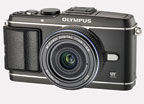
Olympus is most clearly taking a more tiered approach with its latest PEN family cameras. The flagship E-P3, the priciest of the new group, was scheduled to hit stores last month. The retro-looking camera will offer a new sensor, along with a faster autofocus. Full HD video capabilities will be complemented by stereo audio recording. And the camera's 3-inch LCD display will be a high-resolution touchscreen, meaning some controls can be adjusted by touching the screen, smartphone-style. The E-P3, which includes a built-in flash, is available in two configurations for $899.99 -- with a zoom lens (14-42mm/equivalent to 28-84mm) or a fast 17mm (34mm equivalent) f/2.8 lens.
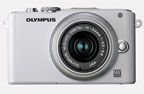
The E-PL3, meanwhile, is the "lite" version, due to hit shelves this month. The camera also offers the new sensor and autofocus system, as well as the full HD video with stereo audio. Instead of the touchscreen offered by its big brother, the E-PL3 has an LCD display that tilts and flips out. This camera has no built-in flash, but does ship with an external flash that clips on. The E-PL3 willl be sold with either the 14-42mm zoom lens or the 17mm lens, for $699.99.
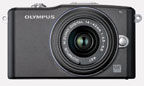
The E-PM1 is designed to be the least intimidating of the group for people considering the step up from point-and-shoot cameras. It's the smallest and lightest of the PEN line and, ostensibly, the easiest to use. The camera sports a simplified user interface and a more whimsical color selection: purple, pink, brown, white, silver or black. The LCD display will be fixed (and not a touchscreen), but the camera will have the same new sensor, autofocus, image processing and HD video capabilities as the other models. As of press time availability and price hadn't been finalized.
Most event organizers hire a professional to photograph their major meetings -- and there's no better way to capture and preserve an event's image. But even when a photographer isn't in the budget, planners can benefit from having documented their events with photos or video. For smaller or more impromptu gatherings, site inspections and other purposes, having a good camera at the ready could mean the difference between throwaway cell-phone snapshots and images crisp enough to be used in marketing collateral.
For that reason, M&C decided to take a closer look at a relatively new breed of travel-friendly cameras, known as compact system cameras (or the more descriptive "mirrorless interchangeable-lens cameras," or the more provocative "EVIL" -- electronic viewfinder with interchangeable lens). Produced by a growing list of manufacturers, they are smaller and lighter than digital single-lens reflex (DSLR) cameras but generally deliver image quality approaching that of their larger brethren. Read on for an explanation of the differences and how these cameras might be useful for meetings.
Format overview Until a few years ago, buying a digital camera -- and not just snapping photos with your cell phone -- meant an investment in either a compact point-and-shoot or a DSLR. The former category, which makes up the vast majority of the market, essentially means a camera with a nonremovable lens. A digital single-lens reflex camera, on the other hand, is what those of a certain age call "real cameras." The mechanics of these mimic the 35mm film SLR cameras of days gone by, with an image captured by a sensor rather than a film negative. The photographer can look through an optical viewfinder to compose the image and select different lenses for different purposes.
The compact system cameras we're looking at here bridge the gap between those two types. By eliminating the mirror that sits behind the shutters of SLR cameras, manufacturers can make the camera bodies much smaller. Lenses can be smaller and lighter as well. The lack of a mirror means these cameras can't offer an optical viewfinder, so on most models you compose the picture using the LCD display -- but nearly all offer viewfinder accessories you can attach, should you prefer to put your eye up to the camera.
Four manufacturers have been selling the bulk of these cameras -- Olympus, Panasonic, Samsung and Sony -- and more are on the way. According to one industry insider, Nikon will release a version by year's end, and Canon likely will have a model out by January 2012. Leica will join that list too, per recent reports.
Sensor science What makes these compact system cameras compelling in terms of image quality is the size of the sensor inside -- and size matters. Even entry-level DSLRs use sensors that are typically 15 times the size of the average sensor in most compact point-and-shoots (and at least 50 times what you might find in a cell-phone camera). Cameras with bigger sensors can theoretically provide cleaner photos, with more gradations of light and color and less "noise," or graininess. The sensors in compact system cameras from Sony and Samsung are the same size as those found in many beginner DSLRs; those in competing cameras from Panasonic and Olympus cameras are slightly smaller, but still nine times larger than the sensors in point-and-shoots.
Many other factors determine image quality, but the size of the sensor is a more telling figure than the commonly referenced megapixel count, which merely refers to the number of light-capturing pixels on the sensor.
What it means to you: It all depends on how you'll use the photos. If they'll be viewed at a relatively small size on a website, the image quality attributable to a larger sensor matters less. But if the photos will be displayed more prominently online, used in print collateral or shared with the media for publicity, the finer quality is important.
Sense of style A number of these compact
system cameras sport slim camera bodies with a retro style, evocative of
rangefinder cameras favored by street photographers 50 to 60 years ago.
The most obvious example is the Olympus PEN series, named and styled
after Olympus' light, portable film cameras that became popular in the
1960s. That's one reason this camera type has cultivated a following
among photographers -- when used with smaller lenses, these cameras
present a handy alternative to DSLRs. Most offer the manual
adjustability found in DSLRs, in the portable convenience of a camera
body around the same size as the larger compact point-and-shoot models.
What it means to you:
These cameras are stylish, light, easy to carry and less likely to draw
attention when you're trying to take candid photos. A DSLR will
probably produce better-quality images. But if that extra bulk means
you're more likely to leave the camera in your room when you're on-site,
the better photo quality won't matter much.
Moving pictures
While retro on the outside, the cameras still provide most perks of the
present, notably high-definition video. Most digital cameras these days
have added video to their feature lists; in the case of the compact
system cameras, the relatively big sensors and the selection of
different lenses can mean better quality output and more flexibility in
different shooting situations than you'd get with a point-and-shoot.
Several models can shoot full-size HD video (the newest Olympus PEN
cameras, Panasonic Lumix DMC-GF3), while others offer what's called 720p
HD video (Sony NEX-C3, Samsung NX100, Olympus PEN E-PL2) -- still
high-definition video, but with fewer lines of resolution. Some even
have a separate shutter button for shooting video -- a nice convenience,
because you can begin shooting immediately without first selecting a
movie mode.
What it means to you: In this age of YouTube,
using video to promote an event can be a great way to build buzz.
Whether you're responsible for the final product or you're handing off
your video clips to someone else to edit, good-looking footage makes a
bigger impact.
Ones to Watch continued
Panasonic
The Panasonic Lumix
DMC-GF3 was released last month and, like the Olympus E-P3 (and the
Panasonic GF2 before it), it features a 3-inch touchscreen interface.
It's quite small, and some of the external dials and controls have been
removed from previous versions as a result. That, along with the
touchscreen, gives it a style more modern than retro. The camera records
full HD video and has a built-in flash, although it lacks the hot shoe
port of its predecessors -- meaning it isn't compatible with external
flash or electronic viewfinder units. The GF3 sells for about $699 with a
14mm (28mm equivalent) f/2.5 lens or $599 with a zoom lens
(14-42mm/equivalent to 28-84mm).
Sony
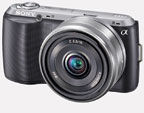
The
Sony NEX-C3, another very compact camera released last month, manages
to pack in a larger sensor, equivalent to those found in many DSLRs. An
external flash is supplied but not built-in, and the camera shoots 720p
HD video. A new "Photo Creativity" interface removes photo jargon from
the settings, replacing technical terms like "aperture," "exposure
value" and "white balance" with the simplified "background defocus,"
"brightness" and "color." The camera retails for about $650 with a zoom
lens (18-55mm/equivalent to 27-82mm) or $600 with a wide 16mm
(equivalent to 24mm) f/2.8 lens.
In the raw Another
feature common to these cameras, which is absolutely essential to
photographers, is the ability to shoot in the RAW file format. For
anyone who used to shoot on film, shooting RAW is like magic; the format
preserves all of the raw data captured by the sensor, meaning you can
actually change the camera settings after you've taken the picture. You
shot with the wrong white balance setting? Change it after you've
downloaded the image to your computer. The exposure was off by a stop?
You can adjust that too, and without the degradation to picture quality
that comes with manipulating a photo shot as a JPEG.
Of course,
there's post-processing work associated with shooting in RAW (which
requires either software that comes with the camera or programs such as
Lightroom or Photoshop from Adobe, or Apple's Aperture or iPhoto), and
not everyone wants to bother. For that reason you also can shoot JPEG
files with any of these cameras.
What it means to you: Is
there any chance you'll be passing your photos on to an art director or
designer for use down the road? You can shoot RAW and JPEG files
simultaneously. That way you can get the immediate gratification of the
JPEG file, and still save the infinitely more editable RAW files for the
art team.
Creative control Another
benefit of compact system cameras is photographic control. Neophytes
needn't fear -- each camera also has fully automatic shooting options --
but for those with some know-how or interest, these cameras offer a lot
of possibilities. The ability to select lenses, add a flash, and adjust
aperture and ISO settings, among many other options, can be helpful.
Consider these real-world examples.
Dim lighting. We all
know not every meeting room has sunlight pouring in through the windows,
bathing all that we see before us flattering light. Because the
built-in flashes on point-and-shoots (and some of these cameras, too)
generally are too weak to shed light that's either sufficient or
flattering, you need options. A "fast" lens can be incredibly useful --
that's a lens with a wide maximum aperture, meaning it lets in a lot of
light, making the most of what's in the scene. Consider a lens of f/2.8
or wider (meaning smaller numbers) for low-light shooting without a
flash. Having flexibility in lens selection is a huge help.
You
also can bump up the camera's ISO setting, meaning its sensitivity to
light. Some of the new compact system cameras can be set to very high
settings. While a higher ISO setting typically means grainier photos,
the larger sensors in these cameras offer an advantage in managing that
unwanted graininess.
Speaker shots. If you're shooting a
speaker with stage lighting, a fast lens without a flash can be
sufficient (depending on the lighting, of course). The wide-aperture
lens also provides the benefit of blurring out the background, drawing
more attention to the speaker. (This is actually another advantage of
the larger sensor size, too -- it's easier to obtain this
out-of-focus-background effect, or bokeh, with a large sensor.)
For
a speaker in a conference room, a flash usually is required. A number
of compact system cameras allow for the use of external flash units
(Olympus PEN family, Samsung NX100, Sony NEX-C3), which typically are
more powerful than built-in flashes, and more adjustable in terms of
that power and light direction.
Conveying the space. If
you like to document what you see on a site inspection, a wide-angle
lens often is ideal for providing the perspective needed to convey the
size of a room or space.
> See Field Notes for Travel-Friendly Cameras
Field Notes
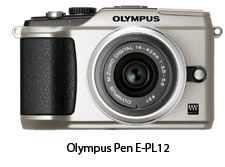 While waiting for the new cameras to be released, I was able to put an Olympus PEN E-PL2 through its paces. Shooting with this camera was a fun, rewarding experience, and its size and weight, as well as the photographic control it provides, make it an excellent travel companion. Compared to DSLRs, such a camera is a lot easier to carry to hotel openings, site visits and events without being cumbersome.
I evaluated the Double Zoom Kit, which has two lenses: a 14-42mm f/3.5-5.6 zoom and a 40-150mm f/4.0-5.6 zoom. In terms of traditional 35mm photography, those lenses are equivalent to a 28-84mm field of view and an 80-300mm field of view. The lenses are very light and are designed to collapse a bit when not in use, making the camera slimmer for travel.
The lens quality was good, but neither made me nearly as happy as shooting with the Panasonic 20mm f/1.7 lens, which I also tried with the E-PL2. (Olympus and Panasonic adhere to the same Micro Four Thirds standard specs.) This lens doesn't have the range of a zoom (it's equivalent to a 40mm lens in 35mm photography terms); but it's a beautiful sharp lens, and its wide aperture is fantastically useful in dimly lit situations and for creating a shallow focus. Plus, attaching such a small, flat lens to one of these cameras makes them less conspicuous and that much easier to tote.
The E-PL2's autofocusing was slightly sluggish, and that seemed more pronounced with the kit zoom lenses. While not a deal-breaker, that was my biggest quibble with the E-PL2. It isn't a factor when shooting an event space or the beautiful landscape of a meeting destination. It's a bit more noticeable when photographing a toddler on vacation.
The E-PL2 will be sold alongside the new Olympus models this fall, although the retail price has yet to be decided. Depending on the price difference between this one and the new $699.99 E-PL3 kit, the E-PL2 might be a good value -- especially if you'll use its built-in flash, which the new model lacks. But I'd hesitate to lay out the money for the E-PL2 before putting the updated version's new autofocus system to the test.
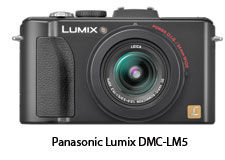 For comparison, I tested a high-end point-and-shoot, the Panasonic Lumix DMC-LX5 ($499 retail). This camera has a feature set comparable with the interchangeable-lens models. It has an excellent built-in Leica zoom lens with a wide field of view (equivalent to 24mm) and aperture (f/2.0 when zoomed all the way out). It's a good low-light performer, although such images are a bit noisier than what I've seen from compact system cameras in similar conditions.
The LX5 shoots HD video (720p) and offers a dedicated button for shooting video. Image quality is a tad below what I've seen from CSCs, but the LX5 makes very pleasing photos and is more pocketable than the those larger-sensor cameras. That size differential is shrinking, though: Panasonic's new compact system camera, the GF3, is nearly the same size as this one. I prefer the flexibility and end results of the compact system cameras, but this LX5, at $200 less than the new GF3, is a very appealing alternative.
> For video reviews of these models, go to mcmag.com/webexclusives.