Social media activity at one of the world's largest trade shows skyrocketed this year: Ten times more people contributed information and commentary through the handful of active platforms than did at the previous event. Was it a show known for its youthful crowd or cutting-edge consumer gadgetry? Not at all: It was September's International Manufacturing Technology Show.
"Traditionally, manufacturing has been an older crowd that was slow to adopt social media," admits Monica Haley, marketing communications manager for the Chicago-based Association for Manufacturing Technology, which owns the trade show. But this year, according to Haley and co-worker Lee Anne Orange, special projects manager for exhibitions, something changed. Watching the discussion unfold on Twitter, in particular, caused many to reassess their perception of these forums. Social media went from "things their kids did" to effective business and marketing communications tools.
Haley has worked with AMT's social media initiative since its inception in 2006 and helped to debut several platforms at the 2008 IMTS (the show is biennial.) She didn't think the association should be limited by the increasingly outdated notion that social media only caters to a younger demographic. "That inevitably would change, as we knew it would. And we wanted to get out ahead of the curve," she explains, adding that this year's success in large part was driven by the proliferation of mobile technology.
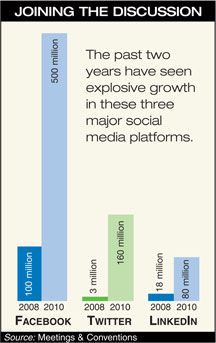 "More people are walking around with smartphones and iPads and using them at the show," Haley points out. Plus, there's the popularity of the platforms themselves: Facebook grew from 100 million users in 2008 to more than 500 million in just two years -- while increasingly gaining users a good deal older than the college crowd for which it was originally created. Twitter's community exploded from about three million just two years ago to more than 160 million in 2010. LinkedIn grew nearly 350 percent in the same period and now has more than 80 million users.
Clearly, the masses have embraced social media; for trade show organizers, it's just a matter of learning how best to use it.
Running a Social media campaign
The December 2009 Expo! Expo! show, held in Atlanta, gave the organizer, the International Association of Exhibitions and Events, experience in running a virtual social community. "The platform [which included a presence on Twitter, Facebook, LinkedIn and 3D Media's Collaborate] was brand new, so there was a learning curve for everyone coming in to use it," says Susan Brower, CMM, CCP, vice president of marketing and communications for the association's parent organization, The Center.
The lessons from last year are being applied at this year's Expo! Expo!, to be held in December in New Orleans. "We started early and have been communicating the process and brand of the site to increase awareness and familiarity for our new users," notes Brower. IAEE's efforts also resulted in the creation of a Social Media Task Force, whose agenda has included development of "Social Media Best Practices for Exhibitions and Events," released as a white paper in August (
iaee.com; free for members, $99 for nonmembers). The group offers the following checklist for executing an event-specific social media campaign.
> Six to 12 months prior • Set goals, objectives and strategies;
• Determine goals and audience needs;
• Design a strategy (Facebook pages, LinkedIn groups and subgroups, event collaboration sites, preshow communication regarding community network participation).
> Three to six months prior• Share social media opportunities with sponsors and exhibitors.
> Six weeks prior• Announce on-site contests;
• Begin discussions and daily posts (on dedicated website, Twitter, Facebook);
• Identify participating blogs;
• Send follow-up mailers;
• Start a picture contest.
> Two weeks prior• Distribute press release;
• Announce blog posts about webcasts, events, etc.;
• Begin Twitter community outreach.
> During event• Post/share the event's content in small quantities;
• Consider sharing an attendee's point of view through quotations, snapshots and location updates;
• Label promo items with social media addresses/profiles;
• Announce content-sharing sites in use (Flickr, YouTube);
• Invite local bloggers;
• Post engaging content;
• Engage attendees by starting conversations, promoting contests (that involve exhibitors and sponsors) and offering great customer service;
• Collect data nonintrusively by tying it in to on-site sign-ups and using existing social network strategies.
Post event• Continue engaging (send content to bloggers, track mentions online and offline, follow up with Facebook followers, request feedback, maintain Facebook and Twitter communication, keep event profiles updated, distribute photos and videos, announce contest winners, provide information about next event);
• Distribute event content, both written and visual;
• Extend the community life cycle (continue to post highlights, encourage attendees to post content, monitor and measure results).
Continued... Not for prime time only Don't rush into this
new technology without a strategy, cautions independent trade show
presenter Emilie Barta, who also worked with the IMTS event this year.
Barta, who is based in St. Louis ("but I live out of a suitcase"), helps
associations and exhibitors fine-tune their messaging; in her
experience, audiences will be quick to dismiss your efforts if you don't
take the task seriously.
A crucial point, says Barta, and one
that might be counterintuitive for many trade show organizers, is that
the best strategy is one that isn't built around the event itself.
Rather, it should be based on creating a year-round community. "Social
media is used to develop relationships and have conversations, not just
broadcast sales messages," she notes. "A trade show provides a
disservice to its audience members if it does not employ a 365-day
social media strategy. The shows that do that and have very
conversational approaches are the ones that succeed. The actual trade
show just becomes one of the things to talk about in a given moment."
Jordan
Schwartz, whose Seattle-based company, Pathable, provides custom social
media platforms for events, fully agrees with Barta and adds, "If you
regard any kind of trade show or conference as a two- or three-day
event, you are squandering an opportunity. The best value that an
exhibitor can get from a trade show is a long-term relationship with a
customer. You can try to start a long-term relationship with a
five-minute visit in a booth, but its really going to be most valuable
when trust and understanding and background knowledge are built over
time."
Working the platforms The
social media team that worked on this year's IMTS show devised a
strategy that relied on five social media platforms. Although the show
itself occurs only once every two years, the team maintains their
presence on four of the platforms year-round, and simply shifts focus
before and during the event, with the posts then becoming more timely
and information-based. That's a natural use of the platforms, Barta
explains, and is part of what differentiates one from another. "You have
to give the messaging to your audience in the way they want to receive
it," she says, noting that some people prefer Twitter, while others
prefer LinkedIn. "It's a different way to build communities, and those
communities may take on different personalities."
For IMTS, the team focused on the communities they have cultivated through the following media.
 Twitter.
AMT attempts to share information year-round on Twitter, according to
Monica Haley, but as the actual event approaches -- and then,
especially, during the event -- it becomes a primary means of
communication. "During the six-day show," she says, "posts are going to
be coming in as fast as they ever will." Think of Twitter like text
messaging: Its immediacy works particularly well when trying to reach
mobile attendees on the show floor.
Twitter.
AMT attempts to share information year-round on Twitter, according to
Monica Haley, but as the actual event approaches -- and then,
especially, during the event -- it becomes a primary means of
communication. "During the six-day show," she says, "posts are going to
be coming in as fast as they ever will." Think of Twitter like text
messaging: Its immediacy works particularly well when trying to reach
mobile attendees on the show floor.
"We did a lot of interaction
with the exhibitors," explains Barta, who tweeted from her own account
during the show. "If they were hosting something in their booths at a
particular time, we promoted that. If we stopped by a booth and saw
something cool, we took a picture and promoted it."
 Facebook.
This was another area of focus during the event itself. Facebook,
though, has the potential to address both immediate concerns and more
in-depth conversations, because people use it in different ways. On one
hand, especially for those with a lot of Facebook friends, the status
updates in the live feed can become buried relatively quickly. But it's
also easy to navigate directly to an event's page, to take a quick look
at what's been posted and see any conversations that have sprung up in
response.
Facebook.
This was another area of focus during the event itself. Facebook,
though, has the potential to address both immediate concerns and more
in-depth conversations, because people use it in different ways. On one
hand, especially for those with a lot of Facebook friends, the status
updates in the live feed can become buried relatively quickly. But it's
also easy to navigate directly to an event's page, to take a quick look
at what's been posted and see any conversations that have sprung up in
response.
"With Facebook, it's all about having a conversation,"
notes Barta. "It's about using the platform to get conversations going
among the audience. It's a great way to get information from the
audience -- to get people to comment and have people comment on each
other's comments. You also can have your audience members post pictures.
It kind of becomes a bulletin board."
 LinkedIn. This is an
important platform for the association in general, but during the event
AMT kept the activity here fairly low. "We decided we'd have a little
bit of conversation on LinkedIn," explains Haley, "because we always
have LinkedIn groups associated with manufacturing and the membership.
But it doesn't necessarily lend itself very well to a live discussion.
It works very well as a kind of static post that unfolds into a
discussion over a longer period of time."
LinkedIn. This is an
important platform for the association in general, but during the event
AMT kept the activity here fairly low. "We decided we'd have a little
bit of conversation on LinkedIn," explains Haley, "because we always
have LinkedIn groups associated with manufacturing and the membership.
But it doesn't necessarily lend itself very well to a live discussion.
It works very well as a kind of static post that unfolds into a
discussion over a longer period of time."
As with every platform,
though, it all depends on the nature of the group. "Most people look at
LinkedIn as their professional Rolodex," points out Barta, and there
could very well be opportunities through that platform for people to
connect at the show. (Note that many event-specific social media agents,
such as Pathable and CrowdVine, offer some integration with LinkedIn
contacts.) Plus, adds Barta, because LinkedIn has more of a corporate
following, "you might get an audience there that would never touch
Facebook."
 YouTube. The IMTS team made good use of YouTube as a
marketing channel before the show, and also used it as an outlet to post
reports during the event. In the months leading up to opening day, they
uploaded a lot of content to convey basic information about the show
and about Chicago. Attendees could watch informational videos (featuring
the association's vice president of communications) about navigating
the O'Hare and Midway airports, for example, and getting into the city.
The team also tapped the exhibitors for contributions.
YouTube. The IMTS team made good use of YouTube as a
marketing channel before the show, and also used it as an outlet to post
reports during the event. In the months leading up to opening day, they
uploaded a lot of content to convey basic information about the show
and about Chicago. Attendees could watch informational videos (featuring
the association's vice president of communications) about navigating
the O'Hare and Midway airports, for example, and getting into the city.
The team also tapped the exhibitors for contributions.
"We
solicited them to contribute on YouTube as well, by doing a program
where they could make their own 60-second videos to try to convince
people to visit their booths," Haley says. "They put them up, and people
got to vote on them. The one that won got to be featured on the home
page, and we gave it some other recognition as well."
During the
show, the social media team recorded people answering a question of the
day, which was edited and posted on YouTube daily. They also shot and
posted additional footage of various aspects of the show to reveal what
might be otherwise missed by many attendees at such a large event.
 SCVNGR.
This was the one platform where use was restricted to the event itself,
by necessity. SCVNGR is a geo-location game that can be played through
an app on mobile devices, or via text messaging for those without
smartphones. "Basically, we didn't want to leave out one important
social media component," says Haley of ATM's decision to experiment with
geo-location technology.
SCVNGR.
This was the one platform where use was restricted to the event itself,
by necessity. SCVNGR is a geo-location game that can be played through
an app on mobile devices, or via text messaging for those without
smartphones. "Basically, we didn't want to leave out one important
social media component," says Haley of ATM's decision to experiment with
geo-location technology.
SCVNGR provides a way to direct
attendees to predetermined locations to complete "treks." The
competitive aspect, as well as the opportunity to earn prizes by
completing these treks, can increase attendee engagement. There also are
potential sponsorship opportunities. In the case of this year's show,
the Chicago Convention and Tourism Bureau provided the platform. (For a
closer look at SCVNGR's use, see "Experimenting With Geo-Location") Continued...
Calculating spontaneity While
it's crucial to plan a year-round social media strategy to represent a
show brand, it's just as important for organizers to plan some of the
communication that will occur during the actual event. That's another
point that might seem counterintuitive, given the notion of a
micro-blogging medium like Twitter as a way to spontaneously convey news
and information, but it can help jump-start and grow the conversation
taking place on-site.
The team at IMTS did just that by creating
a number of posts in advance. Messages were worked around known
scheduling and program information, including information about speakers
and specific seminar issues. The team kept things organized by creating
an Excel spreadsheet, listing the times down one side and the social
media platforms across the top, so they could determine that
communications would be spaced appropriately.
About a week
before the event, Haley manually entered all of the posts into
HootSuite, a social media dashboard site that can be used to create a
schedule for Twitter and Facebook updates. "We wanted to have the
messages pushed strategically, so they didn't all appear at 10 a.m. on a
Tuesday," she explains. "Nor did we go quiet for two and a half hours
while we were all in a meeting. We had consistently planned
communications, with real-time posts about things like someone well
known in the industry turning up on the show floor."
Keeping it real The
nature of social media platforms is to foster authentic conversations
among participants. Every platform discourages sales pitches, and most
have strong anti-spam mechanisms in place. The trade show environment
should be no different, despite the fact that exhibitors are there to
market and sell their wares.
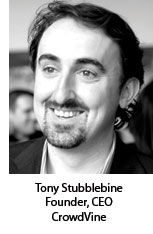 "The only way for an exhibitor in
an event community to connect with attendees is to be an interesting and
engaging person," explains Tony Stubblebine, founder and CEO of the
event community platform CrowdVine -- and the lead engineer on the team
that developed Twitter. "We've moved away from straight sales and
marketing to having an informed conversation. Exhibitors need to send
people who can have that conversation."
"The only way for an exhibitor in
an event community to connect with attendees is to be an interesting and
engaging person," explains Tony Stubblebine, founder and CEO of the
event community platform CrowdVine -- and the lead engineer on the team
that developed Twitter. "We've moved away from straight sales and
marketing to having an informed conversation. Exhibitors need to send
people who can have that conversation."
Social media can be a
huge benefit to exhibitors, adds Pathable's Jordan Schwartz. "Giving
exhibitors the opportunity to be participants in the community and to
engage with attendees as peers can help them establish the relationships
and the trust that can ultimately lead to the kind of business that
they're trying to develop," he notes.
Of course, show organizers
will be held to the same standards of authenticity. They should avoid
marketing heavily and do what they can to encourage, but not force, an
honest communication among attendees.
"Social media
communication cannot be contrived," says Emilie Barta, "because people
can see right through that. The conversation has to grow organically. If
the organizers are going to hire a group of, say, 20 people and pay
them per tweet, people are going to find out about that, and it isn't
going to be taken well."
Besides the schedule reminders and show observations brought up by the IMTS team, what information should organizers post?
"There's
a bunch of really easy ways for you to contribute," says Stubblebine.
"There's a huge stream of worthwhile content -- that which was generated
to put on the event, and the social media feeds of the speakers and
exhibitors. If organizers just mine that information, to retweet it or
blog about it, it ends up being a win-win, where the exhibitor and the
speaker feel like the conference is promoting them, and attendees who
otherwise are not in that particular loop are getting access to
interesting information." Continued...
Generating revenue
Because many shows are still in the experimental phase of their social
media initiatives, generating revenue still is just a goal in many
cases. Monica Haley of IMTS, for instance, says that at this year's show
she heard a lot of interest from exhibitors regarding sponsorship for
various parts of the association's social media program. "A lot of them
didn't realize how much it was going to be pushed at the show," she
reports. "So in the future, it's going to be an option."
Other
opportunities exist, particularly in event-specific community platforms.
Pathable, for instance, began offering revenue-generating features this
past May. With Pathable, all show attendees have the opportunity to
register and create their own show profile. Exhibitors and sponsors can
join the community as well and set up online trade show booths. The
virtual booths can include downloadable documents and pamphlets, and
even embedded videos. They might have exhibitor logos and additional
marketing materials, and they offer attendees the opportunity to
schedule one-on-one, in-person meetings.
Specifics are
determined by the client, but one suggested model is to offer every
exhibitor a free basic listing, and to charge a fee for an enhanced one.
The model comes directly from that of the traditional show program
directory and can be found in a number of different platforms, in
various iterations.
Not letting up
Perhaps the biggest challenge to social media practitioners is to
maintain communications when the show closes up shop and exhaustion sets
in. The team at IMTS, says Haley, is going to do its best. "We want to
keep them talking where they are," she says of the various social media
communities. "We'll come to them. It's just a matter of us getting our
act together and being reminded on a regular basis to look, to
contribute or to just thank someone for talking. Everyone needs
encouragement." Haley adds, "To have a real conversation of content, you
have to put some real quality time and effort behind it."