When it comes to trade shows, getting people to sign on is just one challenge — and probably not the toughest. Attendance at a wide range of shows is up this year by anywhere from 3 to 13 percent over 2011, according to the Trade Show News Network. But getting attendees to spend quality time on the trade show floor is something else entirely.
To draw them in and keep them there, show organizers are devising new exhibit floor layouts and incorporating cutting-edge ideas about foot traffic, education, networking and more, all in an effort to create buzz and foster greater attendee involvement. The key, says Dave Weil, vice president of event services for association management company SmithBucklin, is to “offer a mix of different activities to bring more traffic to the exhibitor hall and add value to the trade show.”
What follows is a closer look at some of the ways organizers are doing just that.
Show-floor “meetups” 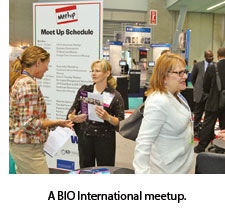 With a 20,000-member attendee base, the Washington, D.C.-based Biotechnology Industry Organization sought a way to help attendees network better at the 2012 BIO International Convention, held in Boston in June. “When you have that many people at a meeting, they need to feel a sense of community and connection,” says Margaret Core, BIO’s former managing director of sales and marketing and currently assistant vice president of strategic sales initiatives with the National Apartment Association in Arlington, Va.
Core found that a free online social gathering tool called Meetup.com was perfect for the task. “It’s an easy way to channel niche groups,” she notes. In advance of the show, she collected ideas for themed “meetups” (e.g., women in biotechnology) from various special-interest groups, suppliers and sponsors, a pool from which official hosts would be selected. Using Meetup.com’s online interface, Core was able create and post the various events for attendees to see, and members could then sign up, find out who else was planning to attend, post messages on an event board and directly contact each other, creating additional buzz and buy-in.
At the convention, show organizers gave meetup hosts tips on how to throw a successful gathering, but otherwise let them operate independently in dedicated areas on the show floor. Hosts supplied their own coffee or catering for the meetups, and because industry players drove the events, rather than show organizers, “the gatherings had a more informal and organic feel,” says Core.
Silent auctions For many years, in conjunction with its trade show, the Arlington, Va.-based National Community Pharmacists Association ran a silent auction during a party held before the show floor opened. At this year’s show, which took place last month in San Diego, organizers used it as a tool to drive traffic to the floor during exhibit hours.
The planners first enlisted the help of exhibitors, who donated items to be auctioned. (All funds went to the NCPA’s foundation, and exhibitors were able to write off their donations.) Auctioning something particularly enticing, like an iPad, stirred lots of interest. Participating suppliers kept the items in their booths, where attendees could write down their bids. The auction was held over two days, which meant serious bidders were compelled to frequently return to the floor and see if their offer had been one-upped, generating recurring traffic throughout the hall.
Exhibit-hall theater The
art of putting on special product demonstrations during a trade show
has come a long way. At the recent NCPA show, exhibitors got 30 minutes
to pitch their product or service (for a fee) on a stage set up in the
back of the hall and surrounded with Plexiglas to create a fishbowl
effect, drawing in passing attendees. “This has grown by leaps and
bounds,” says Nina Dadgar, the NCPA’s senior director of business
development. “Exhibitors are seeing the value in it because they have a
captive audience for a half hour.”
The
art of putting on special product demonstrations during a trade show
has come a long way. At the recent NCPA show, exhibitors got 30 minutes
to pitch their product or service (for a fee) on a stage set up in the
back of the hall and surrounded with Plexiglas to create a fishbowl
effect, drawing in passing attendees. “This has grown by leaps and
bounds,” says Nina Dadgar, the NCPA’s senior director of business
development. “Exhibitors are seeing the value in it because they have a
captive audience for a half hour.”
Such theaters can be set up
for different purposes. The Mid-America Horticultural Show uses multiple
stages to promote new segments of the industry, offer hands-on training
and more. “It connects the show floor to the education sessions, and
those who only purchase the trade show pass get a little something
extra,” notes Buffy Levy, SmithBucklin’s director of event services and
director of the horticultural show.
Central lounges
Organizers increasingly are moving lounge areas from the periphery
right onto the show floor to spur relaxation, casual networking and,
ultimately, more time spent at the show.
At the International
Avaya Users Group conference held in Boston in May, organizers stocked
the space with snacks and a pop-a-shot basketball game. For next year,
they’re creating themes like the “Charge and Recharge Lounge,” where
attendees can charge their devices and re-energize with massages and
smoothies before making another loop around the convention hall.
“Creating a brand for the lounge lets people know what to expect,” says
Alexa Newman, senior manager of event services with SmithBucklin and
senior manager of partner relations with IAUG. “Sometimes our attendees
just need to take a load off, so they’re really attracted to these
areas.”
Social media displays During
the 2012 International Consumer Electronics Show, held in January,
organizers crafted a “social media wall” in the lobby of the Las Vegas
Convention Center. The double-sided facade featured nine large screens
on either side that displayed the show’s Twitter feed. As attendees
inside the show floor were tweeting about their experience and posting
pictures of exhibitors and each other, attendees outside could see what
was happening and were compelled to come in and follow suit.
One-on-one kiosks
For attendees seeking personal attention, organizers of the Mid-America
Horticultural Show ask industry consultants and other experts to
volunteer to staff three kiosks for 20-minute themed time slots, based
on their field of expertise.
“This gives our attendees a chance
to connect with people who have knowledge in a specific area, like
irrigation,” says show director Buffy Levy. The sessions are reliably
popular, she notes. “Everyone who participates is very eager to do so,
and some of the consultants actually get business from it.”
As
SmithBucklin’s David Weil puts it, “Today, when everything comes
together on the trade show floor, it’s not just about finding something
to buy. It’s about finding solutions.”