Making the Case for DMOS

As a growing number of member bureaus grapple with budget cuts, the Destination Marketing Association International last year launched an Advocacy Committee jointly headed by Gary Sain, president of the Orlando/Orange County Convention & Visitors Bureau, and Richard Scharf, president and CEO of Visit Denver.
Among the committee's goals is to compile case studies and tools bureaus can use to educate government officials on what DMOs do and how they bring jobs and dollars to destinations.
Following are some of the resources that will be included in the online toolkit DMAI will launch this year.
• Tourism Pays (youtube.com/
watch?v=GPlGCYEIYBg). Created for Visit Denver last year, this video explains how destination marketing and visitor dollars impact a local community. It can be customized with the name of any destination at the beginning and end.
• Washington Travel Impacts, 1991-2009 (bit.ly/cM1Q98). This data documents the economic significance of the travel industry, including meetings, in Washington state.
• Pierce County Travel Impacts, 1991-2009 (bit.ly/9K4ddO). Like the survey above, this details the economic influence of travel and meetings in Pierce County, Wash.
Tourism Matters: A Case Study of Advocacy in Washington State (mcmag.com/
general_ektid34672.aspx). This report demonstrates how and why Washington's tourism stakeholders pulled together and created a public campaign to demonstrate the economic impact visitors have on the state.
It was familiar, if unwelcome, news for Jeff Eben. This past April, Mayor Ashley Swearengin of Fresno, Calif., proposed a cut to the city's funding of its convention and visitors bureau, which Eben helms. It was the third time in 18 months that, citing budget shortfalls, the city trimmed its outlay to the organization charged with attracting meetings and tourists to the state's fifth-largest city. "It's time to get out of government," says Eben, who's looking hard at alternative structures to fund his organization.
The Fresno bureau's funding woes are not singular. The Great Recession might technically be over, but its effect on states and municipalities continues to grow as budgets get tighter and cuts go deeper. Like so many other agencies, convention and visitor bureaus -- increasingly known as destination marketing organizations -- are acutely feeling the crunch.
DMOs are structured and funded in a variety of ways. They can operate as not-for-profit outfits (61 percent are structured this way, per the Washington, D.C.-based Destination Marketing Association International), government agencies of a city, county, state or authority (21 percent), and chambers of commerce (5 percent). Their funding comes from cities, states, member dues and hotel bed taxes. Typically, revenues come from a combination of two or more of these sources.
Given the precarious state of local economies, including a national average decline in revenue from hotel bed taxes of 14.5 percent in 2009, according to DMAI, with another drop of 1.5 to 2 percent expected this year, it's no surprise that many DMOs are in a vulnerable position. On the following pages, M&C explores the problems facing bureaus today and speaks with DMO executives spearheading a movement to help such organizations prove their worth and protect their budgets.
Revenue goes south According to DMAI, bureau budgets in the United States dropped an average of 2 percent in 2009 from the year before. And in 2010, the drop is far more significant for some.
• In Colorado, Experience Colorado Springs had $580,000 -- nearly 25 percent of its budget -- trimmed this year.
• Funding provided by the state to the Greater Hartford (Conn.) Convention & Visitors Bureau, which accounts for 65 percent of that organization's budget, was slashed from $2.4 million to $1.2 million in 2009, and "this year, it will be reduced further," says Michael Van Parys, acting president and CEO of the bureau.
• Perhaps most dire of all is the situation faced by the Fresno CVB. At press time, the city planned to slash its contribution from $1.3 million to $450,000 through December, and eliminate it entirely beginning in 2011.
Though DMAI does not have a figure on how many of its members are affected by budget cuts this year, the association's president and CEO, Michael Gehrisch, notes their revenue is "substantially less than it was." And Trisha Pugal, chair of the Council on Lodging Tax of the International Society of Hotel Association Executives and the American Hotel & Lodging Association, says she sees a minimum of five examples a day of DMO budget cuts just from researching the issue on the Internet.
Taxes get a hike Bed taxes (also known as hotel taxes, occupancy taxes and transient taxes) are one of the chief revenue streams for more than 50 percent of DMOs, according to DMAI, and one of the most controversial.
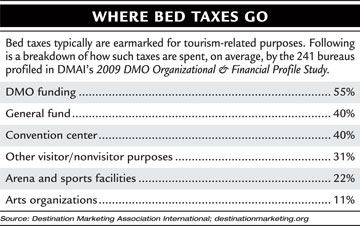
According to DMAI's 2009 DMO Organizational & Financial Profile Study, more than 10 percent of the 241 bureaus profiled reported a recent or anticipated change in their destination's hotel room/occupancy tax in 2009, with the average change being an increase of 1 to 2 percent. But the bureaus didn't necessarily benefit from the hikes. Bed taxes also are used to support entities such as cultural institutions, convention centers and sports facilities (see "Where Bed Taxes Go"). In addition, they may be used to finance the so-called general fund, which cities use for purposes such as fixing roads, collecting garbage and maintaining sewer systems.
According to the DMAI study, slightly more than half of the members profiled received or anticipated receiving a portion of revenues from the tax increase, but more than one-third found their municipalities keeping a significant percentage of the revenues (66 percent, on average) for their own purposes.
In Baltimore, which needs to close a $121 million budget gap, city stakeholders have been wrangling over proposed bed-tax increases. Freshman Mayor Stephanie Rawlings-Blake has turned back a move to enact a temporary "tourism district assessment" tax of 1.5 percent, favored by hoteliers because all those funds would go to tourism development and Visit Baltimore, the city's DMO, in favor of an outright bed-tax hike of 2.5 percent, which would put more of the revenue into the city's general fund. At press time, the issue had not been resolved, though the hike itself has drawn criticism, as it would lift the city's bed tax to 10 percent. Combined with Maryland's 6 percent sales tax, the total tax on hotel rooms in Baltimore would be 16 percent, putting the city in the "top six or seven cities in the country for lodging tax," according to Mary Jo McCullough, president and CEO of the Maryland Hotel & Lodging Association. Such a move could ultimately be self-defeating for a destination seeking to attract more visitors.
Phoenix case study
The DMAI Advocacy Committee's report on How the Visitor Industry Contributes to the Local Economy, conducted by the Greater Phoenix Convention & Visitors Bureau, shows how the average hotel guest room generated more than $6,300 in taxes during 2008. The result: a combined contribution to Phoenix coffers of $166 million from local hotels. View the full report at
bit.ly/aezC3L. Bureaus try to cope According to the
2009 DMAI report, DMOs typically spend nearly half (47 percent) of their
budget on sales and marketing efforts. The remainder is spent on
personnel (41 percent) and administrative costs (12 percent). When
budgets are slashed, all of these areas are ripe for cutbacks.
To
deal with the Greater Hartford CVB's severely depleted funding, acting
president and CEO Van Parys says the bureau's Washington, D.C., sales
office has been closed, direct-marketing mailings have been eliminated,
member fees will be slightly increased and some jobs will be combined.
"We're being more strategic about trade shows, too," he notes. "We're
downsizing or partnering in booths with groups such as New England
Society of Convention & Visitor Bureaus."
At the hard-pressed
Fresno CVB, officials are rethinking the bureau's entire structure to
ensure survival. President and CEO Jeff Eben's new funding plan calls
for a tourism development tax of $1 per hotel room, per night, which
will replace city contributions and provide the CVB with an estimated
$1.9 million budget next year. "I'm cautiously optimistic that it will
be supported by the local tourism community," Eben says.
 Advocacy gets strategic Several
savvy bureaus have developed strategies to help them make a strong case
for keeping their dollars -- or at least mitigating the cuts -- by
demonstrating the value they bring to cities.
Advocacy gets strategic Several
savvy bureaus have developed strategies to help them make a strong case
for keeping their dollars -- or at least mitigating the cuts -- by
demonstrating the value they bring to cities.
"We have found that
putting our message in language politicians understand, such as how
many local jobs will be generated by visitors to the area, is
effective," says Gary Sain, president of the Orlando/Orange County
Convention & Visitors Bureau, and co-chair of DMAI's Advocacy
Committee (see "Making the Case for DMOs"). Sain estimates
that every 85 visitors to his region translates to one job in the local
tourism sector.
Sain also has invited Orlando's political
leaders and commissioners on sales calls "to hear the pros and cons of
our destination directly from customers."
Colorado learned the
hard way how cuts in tourism funding could backfire, according to
Richard Scharf, CEO of Visit Denver and Sain's partner in helming the
DMAI committee. In 1992, Scharf says, residents voted to eliminate the
state's visitors tax; a follow-up report covering the impact of the cut
through 1997 found Colorado's market share of tourism and meetings had
dropped by 30 percent; in 1997 alone, the state lost approximately $2.4
billion in tourism revenues and $134 million in taxes.
In the
wake of such losses, tourism officials rallied together and made a pitch
to state lawmakers, using statistics such as how tourism-related
revenue saved the average Colorado household some $400 in taxes a year,
to reinstate funding. The effort paid off when the state voted to
include $19 million for tourism development in its budget, which
remained in place until this year, when 25 percent was trimmed because
of budget shortfalls.
"We wouldn't have gotten dollars restored
at all if we hadn't demonstrated our value," says Scharf. "For DMOs
today, telling what we do, what we bring to the community, is a way of
life."