This is the third in M&C's special three-part series on emerging meetings markets. Brazil's booming economy and heavy investments in infrastructure improvements have captured the attention of global investors, who watch with great interest as the country prepares to host major events in upcoming years.
The mystical allure of Brazil seems to have intensified of late, and not just as a leisure destination. The world's eighth largest economy now gets as much attention for its potential as an emerging market as for its soccer prowess and Ipanema bikinis. The fact that the country has scored two major sporting events -- the 2014 FIFA World Cup (to be played in 12 different cities) and the 2016 Olympic Games (which will be held in Rio de Janeiro) -- promises a boon to the travel and hospitality industries. Brazil is "the flavor of the month," as one convention and visitors bureau head put it.
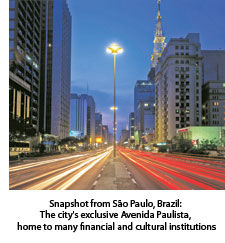 A handful of factors are driving Brazil's current success, according to Ricardo Souza Ferreira, executive vice president of corporate travel management company Grupo Alatur and the former president of the Brazil chapter of Meeting Professionals International. Ferreira touts the country's wealth of natural resources, newfound fiscal discipline (which has resulted in a national budget surplus) and the outgoing political administration, which strove to improve the country's infrastructure. (The hugely popular president, Luiz Inácio Lula da Silva, finished his second term in January. Dilma Rousseff, Lula's former chief of staff and now the country's first female president, succeeded him.) Brazilian corporations have prospered.
"For many, many years we've had big business," said Ferreira during a recent Association for Corporate Travel Executives webcast about Latin America, "but for the first time now we have multinational companies originating in Brazil, going all over Latin America."
The region was spared the worst of the worldwide economic recession. The effects surfaced later and were less severe than elsewhere, and most Latin American countries have bounced back relatively quickly. "In Brazil in particular, it's almost like the recession never happened," noted Barbara Blue, president of the Latin American division and North America Affiliate Program for BCD Travel, in the same webcast. "Business is booming," she added.
Building boom Hotel development has exploded accordingly. The construction pipeline is flourishing throughout South America, according to Portsmouth, N.H.-based Lodging Econometrics' 2011 Outlook for Latin America Lodging Real Estate Trends, thanks to the quick recovery of the South American economies and the rebounding hotel industry.
Brazil has 28,104 rooms in the pipeline, the report found -- a fraction of the development occurring in emerging-market leader China, but it accounts for 66 percent of all room development in South America. The number also represents a 33 percent year-over-year increase over room development at the end of 2009, and Lodging Econometrics expects that trend to continue its ascent.
"There are 177 projects in the pipeline right now in the country," notes Bruce Ward, senior vice president of Lodging Econometrics, "and I wouldn't be entirely surprised if at the end of next year we're sitting here talking about twice as many projects."
High Hotel Finance
Abig challenge faced by the international hotel companies, says São
Paulo CVB president Annie Morrissey, is that they have to put the money
up for developments. "In Brazil there isn't a lot of credit," she
explains, "and the credit that's here is very expensive. The interest
rates are very high. Government loans are difficult to get as well,
especially for a big international company."
Such challenges
could be mitigated as the World Cup approaches, posits Lodging
Econometrics' senior vice president, Bruce Ward. With the big games
looming, state and federal assistance might become more accessible. "The
government has to step up and say, ‘We're going to put the
infrastructure in place to make this work,'" says Ward. "I think with
the new administration, people might be sitting back and saying,
‘Nothing is really happening until 2014.' Remember that in Beijing, in
many cases hotels opened four or six weeks before the Olympics. In
Brazil, you have two events separated by two calendar years." The
potential growth is huge, he notes, but the plans are off to a
relatively slow start. – M.J.S.
Chains edging in Many international hotel companies would like a piece of that action.
• Starwood Hotels & Resorts announced
last month that its top executives were traveling to Latin America to
discuss future hotel development. "Of particular interest is Brazil,
where a flurry of development is expected," noted Osvaldo Librizzi,
president of Starwood's Latin American division, in a statement. But at
this point that boom really is more about expectations than signed deals
for North American hotel companies. Starwood currently operates six
properties in Brazil -- four Sheratons and two Four Points by Sheraton
hotels -- and hasn't yet announced any new projects.
The lack of
solid plans isn't limited to Starwood. "It is expected that many of the
global brands will come to the region," says Lodging Econometrics' Ward.
"With that being said, anybody who you talk to who's in the business of
trying to build hotels in Brazil says that there are some legal hurdles
dealing with the local government. It's not always as easy as it can be
in some countries. But after China, Brazil is probably number two or
three on the whiteboard of many major corporations -- it's a largely
under-branded country, as it relates to hotels."
Preliminary deals have been inked, but primarily with limited-service hotels.
• Marriott International signed
a partnership agreement last fall with Brazilian real estate company
PDG Realty and "identified the potential" to develop 50 Fairfield by
Marriott properties. However, according to a spokesperson, Marriott
currently has no plans to open any full-service hotels with meeting
space to complement the four Brazilian properties the company now runs.
• InterContinental Hotels Group, which operates 13 properties in Brazil, has four hotels in the pipeline -- all Holiday Inn Express hotels.
• Hyatt Hotels Corp.
announced last December that the company had purchased the land for a
408-room Grand Hyatt in Rio de Janeiro, which would be the company's
second hotel in Brazil.
• Hilton Worldwide has two properties in Brazil, and nothing new announced.
São Paulo squeeze
While São Paulo is one of the world's most populous metropolitan areas,
there aren't enough large-group venues to meet current demand. "There's
a lack of available meeting space here at the moment," admits Annie
Morrissey, president of the São Paulo Convention and Visitors Bureau.
"Our hotels are full from Monday to Thursday, which is a good problem to
have." The city hosts nearly 90,000 events per year, according to São
Paulo Turismo, and was ranked 18th by the International Congress &
Convention Association's 2009 report on the number of international
meetings.
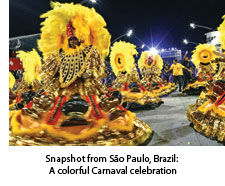 Seventy-five percent of Brazilian trade shows occur in
São Paulo, where "even some of the biggest meeting spaces have to turn
away business because they're full," says Morrissey. For example, the
three-hall, 781,000-square-foot Anhembi Park Exhibition Pavilion is 80
percent booked until 2016.
Seventy-five percent of Brazilian trade shows occur in
São Paulo, where "even some of the biggest meeting spaces have to turn
away business because they're full," says Morrissey. For example, the
three-hall, 781,000-square-foot Anhembi Park Exhibition Pavilion is 80
percent booked until 2016.
In December 2010, both the city and
state governments announced plans for Expo São Paulo, a major
convention district project in the Pirituba area, in the northwestern
part of the city. The
54 million-square-foot development will debut
in four phases. Phase 1 includes a 1.7 million-square-foot exhibition
park, a 646,000-square-foot convention center, a 452,000-square-foot
shopping center and two 540-room hotels. Subsequent phases will add two
more exhibition halls spanning at least 1 million square feet each, a
20,000-seat arena and a 560-room convention hotel.
The timeline
for Expo São Paulo will be determined after all approvals are received
for the project, but the plan is to begin debuting space in time for the
2014 World Cup events.
Fast track to Rio
During the Lula administration, an overhaul of the country's
transportation infrastructure was introduced. One high-profile endeavor
is a high-speed train that will link São Paulo to Rio de Janeiro. At the
end of this month, a builder should be selected for the project,
estimated to cost about US$19 billion.
Other projects in Rio de
Janeiro include a US$280 million makeover of the country's largest
airport, Tom Jobim/Galeão International Airport. Much of the city's
infrastructure is being overhauled as well, to the tune of more than
US$12 billion in projects, according to Washington, D.C.-based
development company CG/LA Infrastructure LLC.
Massive hotel
growth is anticipated: Rio should debut 40,000 new rooms n time for the
World Cup and 50,000 ahead of the Olympics, according to the Brazilian
Association of Hotels.
Picking up the pace
Throughout the country, there are concerns development isn't happening
fast enough to prepare for the World Cup. The Brazilian Audit Court, a
government watchdog group, released a report early last month that said
the pace of upgrades to airports, infrastructure and stadiums needs to
improve, and that it's crucial to begin major projects this year if they
are to be completed in time. In response, the federal government
promised that nearly US$20 billion would be invested in the nation's
infrastructure. The money is earmarked for "urban mobility"
transportation upgrades, stadium projects in all 12 host cities, new
hotels, and upgraded airports and ports.
The pressure of
improving the infrastructure is clearly an opportunity for future
growth, and to welcome international groups in greater numbers.
Morrissey points to a 40,000-attendee convention São Paulo signed for
2015, based on the client's assumption that the city would be more than
ready to handle the logistics following the World Cup. "Brazil is
definitely on the map now for international events," she says.