This is the first in M&C's special three-part series on Emerging Meetings Markets. With astronomical economic growth in China -- expected to increase by 346 percent through 2015, according to the U.S. Chamber of Commerce -- international meetings business should grow in tandem, and preparations are well under way to accommodate the influx. Watch for upcoming features on India in our March issue and Brazil in April.
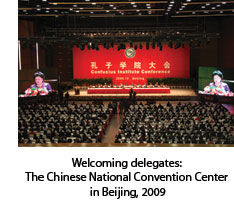 The world's most populous country is seeking -- and getting -- a lot of attention from meeting planners. And that's certainly no accident. "China has seen dramatic change in the last 10 years," says Haiying Liu, CEO of the China National Convention Center in Beijing. "In addition to political stability and increasingly fast economic development, the government has recently begun to realize the value of the meetings industry."
Not coincidentally, the number of international association meetings held in mainland China increased from 83 in 2000 to 245 in 2009, with Beijing alone hosting 96, according to the International Congress and Convention Association's Statistics Report. The influx of international interest was enough to boost China from number 19 on the list of countries drawing the most association meetings to number nine during that same period, noted the ICCA report.
Soon, more meeting planners will experience the destination firsthand. Two of the industry's major conventions -- Site's International Conference and the ICCA Congress -- are set for Beijing in 2012 and Shanghai in 2013, respectively.
"As with every country in Asia, China is interested in hosting more international conventions and attracting the economic impact that is generated," notes Liu. "Despite some rigorous regulatory requirements in China, we are seeing growth in the meetings industry, and this is only the beginning of a process long overdue."
A booming hotel sector One tangible sign of
an increased focus on attracting international visitors is the number of
new hotels being developed throughout China, with major efforts coming
from some of the world's biggest hotel chains.
• Last October, Hyatt Hotels Corp.
announced it would double the number of properties it plans to add in
China from 11 to 22, with four to open in 2011 and nine more in 2012.
• Starwood Hotels & Resorts plans
to add 86 new properties in the coming years to the 62 already in place
in China. This year alone, one third of all new Starwood hotels are
opening on Chinese soil.
• Both Marriott International and InterContinental Hotels Group plan
to double their hotel presence in China by 2016, to 120 and 280,
respectively. Most new properties will offer meeting space.
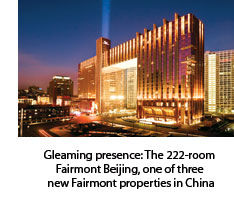 "China
presents a combination of significant investment opportunities, a hotel
market with space for growth, and active development partners," says
Mark Sergot, vice president of global sales for Fairmont Hotels. Though a
relatively small chain with about 60 properties worldwide, Fairmont has
three in China, all of which opened within the past 14 months; a
fourth, in the tropical beach town of Sanya, is set to debut in 2013.
"China
presents a combination of significant investment opportunities, a hotel
market with space for growth, and active development partners," says
Mark Sergot, vice president of global sales for Fairmont Hotels. Though a
relatively small chain with about 60 properties worldwide, Fairmont has
three in China, all of which opened within the past 14 months; a
fourth, in the tropical beach town of Sanya, is set to debut in 2013.
Even
with all the new hotels, "demand continues to outpace supply in China,
especially when you consider that the country has 171 cities with
populations of more than one million, most of which do not yet have a
major international branded hotel," says Wendy Huang, Starwood's
regional director of sales and marketing for Greater China. Huang says
2010 was a record-breaking year for the chain's Chinese properties,
which saw double-digit growth in revenue per available room in a number
of markets.
In addition to new facilities, brand recognition and
loyalty-program perks, international hotel chains bring with them an
added bonus for meeting planners: familiar business practices and a
Western standard of service.
"There's a distinct difference
between the Western brands and local hotels when it comes to
contracting, pricing and service issues," notes Chad Stark, senior
director of conventions and meetings for the Washington, D.C.-based
Optical Society of America, who courted both local and international
properties while planning a 2009 conference in Shanghai co-sponsored by
OSA.
Service levels have improved rapidly, out of necessity,
notes Alfons Westgeest, Beijing-based group vice president of the Kellen
Co., a global association management firm. "During the 2008 Olympics in
Beijing and World Expo in 2010 in Shanghai, many Chinese locals were
hired into the hospitality and convention industry without training in
the field," he says. "Staff, especially at five-star hotels, had to go
through a very steep learning curve, but they have since gotten better
about meeting international expectations, especially with the arrival of
international brands creating competition."
International
properties also are more likely to have staff members who speak English
and to offer amenities commonly found in the Western world, such as
24-hour room service, turndown service, hair dryers and Western food
options.
Expanding exhibit space In addition to a proliferation of hotels, China is seeing an array of new exhibition venues being built nationwide.
• The Guangzhou International Commodity Exhibition and Trade City began
construction in January 2009 to the tune of nearly US$2.2 billion. Upon
completion, the complex in the Panyu District of Guangzhou will span
more than 23 million square feet. For more information: gzietc.com/english/index.asp
• The 1.3 million-square-foot Fuzhou Strait International Conference & Exhibition Center opened
last May on the east coast. The US$377.3 million complex offers a
conference center, two exhibition halls and an entertainment district.
• The 2 million-square-foot Hangzhou International Expo Center broke ground in October 2009 in the Xiaoshan District, southwest of Shanghai.
• The Hong Kong Convention and Exhibition Center wrapped
up a US$180 million expansion of its atrium in April 2009, adding
208,819 square feet of exhibition space for a total rentable area of
990,936 square feet. For more information: hkcec.com.hk/front-page
• In China's northeast region, construction of the Shenyang Exhibition Center began in March 2009. The US$1.2 billion facility will include a 1.5 million-square-foot exhibition center.
• The US$303 million Wuhan International Expo Center
in central China broke ground in July 2009 and will include 12 halls
that can be connected to form a 4.9 million-square-foot venue.
Additional projects currently under way include exhibition facilities in the cities of Chongqing, Luoyang and Wuxi.
Daunting differences
Though Westernized service is becoming more prevalent within Chinese
institutions, many of the country's customs remain starkly different
from those in the United States. "It's not business as usual when you
head to China," says Chad Stark. "American rules, regulations and
legalities don't exist over there. It's a different sensibility and
different concept of what's best for business."
Key considerations include:
The time factor. One
of the biggest issues for foreign trade show organizers is the amount
of time it takes a show to develop in China. Holdups can stem from a
variety of sources, ranging from dealing with a complex bureaucracy to
the simple nuance of working in dramatically different time zones.
"For
a show that might take 16 months to organize in the U.S., I would take
24 months if I'm planning it in China," suggests Jim Hollan, president
and CEO of the Annapolis, Md.-based International Meetings Group LLC.
"Everything from promotions to registration forms needs to be sent out
several months earlier."
Guanxi. This Chinese term
stands for the concept of a deeper working relationship and is vital to
the success of a show. Business partnerships in China are not only about
finalizing a deal, but also creating a strong rapport between companies
and the people that run them.
"A lot of time is spent relationship building and making sure there is enough face time to build trust," says Stark.
Intellectual property laws. Since
its entrance into the World Trade Organization in 2001, China has
bolstered its legal framework to comply with WTO standards.
Nevertheless, "Companies [at trade shows] in China need to be clear
about how much intellectual property they're willing to sacrifice to get
their product into the marketplace," warns Megan Tanel, vice president
of exhibitions and events with the Milwaukee-based Association of
Equipment Manufacturers, which held CONEXPO Asia in 2009. "We had years
of hearing about manufacturers entering into joint ventures in China,
only to have the partnership dissolve and their ideas taken." It wasn't
uncommon for American companies to see those ideas show up at Chinese
trade shows later on, Tanel adds.
The U.S. Chamber of Commerce's
International Trade Administration offers a guide to intellectual
property rights in China, along with other resources: bit.ly/fcMrym.
Name registration.
"Planners can save a headache by clarifying exactly how Chinese
attendees would like their name to appear on their badge and
registration documents," says Merry Marwig, membership and event
administrator with Hotel Technology Next Generation in Schaumburg, Ill.
This is important because the Chinese can differ in the order of their
surname and given name, sometimes alternating which comes first
depending on with whom they are talking.
Additionally, many
Chinese have Western names that they substitute for their own to make
pronunciation easier for international attendees. "Having all of the
potential name permutations on hand, just in case, can prevent a
time-wasting mix-up at the registration counter," notes Marwig.
The partner principle
Finding reliable partners "on the ground" in China serves a twofold
purpose: They not only act as a shortcut to local contacts and
networking opportunities, but also as a guide through China's often
tangled red tape.
"Most foreign exhibition organizers are
required to apply for a license or permit to hold events," says Edward
Liu, chairman of the International Association of Exhibitions and
Events' Asia Exhibition Council. "This is best done with a local partner
who knows the Chinese authorities better and can secure the licenses or
permits much more easily."
Good ways to find a partner include
contacting a Chinese embassy, asking representatives of the hotel you're
working with or reaching out to one's own association members who have
worked with Chinese organizations in the past, advises Jim Hollan.
Another option: Hire a professional congress organizer, like
MCI or
Kellen,
with offices and connections on-site. That's what the Optical Society
of America did for its meeting in China in 2009. "They helped us
navigate in an area we weren't familiar with," says Chad Stark. "These
services cost money, but they were such a time saver and a real asset.
"Eventually
you might not need to use a PCO because your staff will get used to
working with the Chinese," Stark adds, "but it's a valuable investment
for first-timers in China."
For planners who already know what
city they want to meet in, tapping local tourism organizations can be a
good starting point, suggests Edward Liu. "Chinese provincial or
municipal tourism bureaus are all very keen to promote the MICE
[meetings, incentives, conferences and events] industry and may be able
to provide financial assistance or recommend local partners," he says.
M&C Web Exclusive: For information on issues relating to obtaining visas for China, go to
mcmag.com/webexclusives.