The experts in their respective fields who make up our collective crystal ball at M&C are optimistic about the coming year. It's a bruised and battered brand of optimism, to be sure, but we are, overall, looking ahead to better days in 2011. From the supplier perspective, airlines and hoteliers already have experienced huge improvements for the third quarter of 2010, and they likely will have the traction necessary to raise fares and rates in the new year. Meanwhile, the companies that are traveling and holding meetings and incentives appear ready to stretch their budgets a bit, based on survey results from the National Business Travel Association, Site and the Incentive Research Foundation, among others.
But don't expect any freewheeling spending to occur. Forecasts from American Express Business Travel and Carlson Wagonlit Travel both point to new meetings management efficiencies that will help to keep expenditures low. Likewise, the suppliers still are in recovery mode and will stick with current practices (as in ancillary fees from airlines and hotels) to boost revenues.
Plenty of wild-card variables remain, such as the state of the overall economy and the price of oil. But if all goes according to the experts' expectations, the meetings industry should see gradual improvement through next year and into 2012. Read on for a market-by-market overview.
Hotels Rebounding;
Room Rates on the Rise
Following a very tough couple of years, the U.S. hotel industry is now in the midst of a steady recovery. Third-quarter results from Smith Travel Research reveal particularly solid growth: The year-over-year increase in occupancy was the highest ever recorded by STR, and the revenue per available room increase was the highest in more than four years. Average daily rate actually increased for the third quarter -- the first year-over-year quarterly rate growth in two years. These and other signs point to some clear trends for next year.
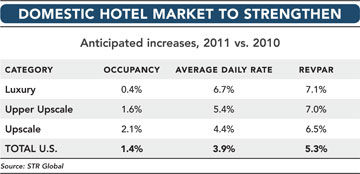
Room rates will rise. Raising room rates has posed a challenge to hoteliers thus far, but STR predicts that, at long last, the hikes will gain some momentum. As of September, the research company was forecasting a 3.9 percent rise in average daily rate across the U.S. for 2011 -- led by the luxury and upper-upscale chain segments, with increases of 6.7 percent and 5.4 percent, respectively.
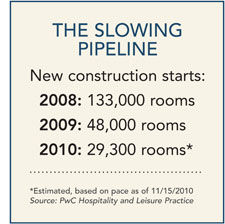 New hotel construction will continue its decline. Consulting firm PricewaterhouseCoopers predicts even greater rate gains in its forecast, which was updated last month. The reduction in new hotel supply has contributed to demand for rooms that exceeded PwC's previous expectations. In fact, for 2010 the firm says that demand should be only 0.1 percent lower than it was in 2007. That's due, in part, to the slowdown in new hotel construction (see "The Slowing Pipeline," right chart). Lodging supply is expected to increase by 2 percent this year, and only 0.4 percent in 2011. PwC forecasts 2011 gains of 5.7 percent in occupancy and 4.8 percent in average daily rate as a result.
Ancillary fees will have an impact. We likely will continue to see various methods of revenue-enhancement initiated by hoteliers before the recovery began, according to Carlson Wagonlit Travel's 2011 Travel Forecast. (CWT predicts a 6.4 to 7.4 percent overall increase in U.S. rates in 2011.) The practice of "unbundling" the total cost of components (as airlines do) in a stay is one that likely will stick, notes Mauricio Molina, director of hotel consulting for CWT Solutions. "Charging for improved and formerly complimentary amenities has been a vehicle to keep a hotel healthy in times of crisis," explains Molina, "and it will be a form of diversification in times of economic growth as well." CWT credits these ancillary fees as one way in which hoteliers have managed to increase revenue per available room even as rates continued to drop until earlier this year.
"Increased room-service charges and fees for luggage storage and items like the minibar and wireless Internet are some of the approaches used," notes Molina. "Overall, these charges account for an average of 33 percent of the total cost of stay, and we expect this proportion to remain steady next year -- meaning that new ancillary fees will increase along with room rates over the next 18 months."
Meetings will be light on amenities. Hotel meetings likely will continue to have relatively few amenities, as companies maintain a watch on meetings spend. According to the American Express Business Travel Global 2011 Forecast, companies will increase both the spending and frequency of their meetings next year, but an increased focus on sourcing and management will remain, leading to a lower expenditure per meeting, along with the growth of smaller, regional meetings. Meanwhile, the use of audiovisual services will rise, Amex expects, particularly the technology that adds virtual elements to face-to-face gatherings.
Lead times should increase. Steadily increasing demand coupled with a reduction in hotel construction also suggests that meeting lead times will begin to grow again. While most cities were beginning to approach pre-recession occupancy levels by the third quarter of this year, some, such as Chicago, Hong Kong, London and New York, already were in very high demand, per Advito's Category-Specific Trends and 2011 Forecast. The upshot: Increasingly, companies will find it more difficult to find hotel meeting space if they wait until the last minute to book.
By Michael J. Shapiro
Continued...
The Cost of Flying: Going Nowhere But Up
A combination of reduced capacity
and ancillary fees, in tandem with recovering travel demand, already
has equated to a strong recovery for carriers. In fact, the third
quarter of 2010 was the most profitable in history for the major
airlines as a whole. It was the first third quarter since 2007 that the
nine largest carriers all posted profits, points out industry consultant
Robert Herbst, and the first time since that same year that all nine
had two consecutive profitable quarters.
Fares will rise. While
the percentages vary slightly, nearly every travel management company
forecast agrees: Airfares will go up in 2011. The constrained capacity
and higher demand are likely to drive fares up and make corporate
negotiations more difficult, according to the 2011 Global Forecast released
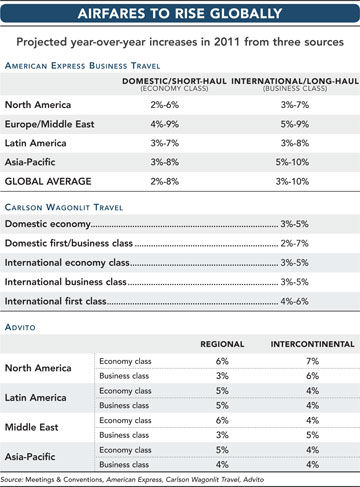
in October by American Express Business Travel. Amex predicts global
fare increases of from 2 to 8 percent for short-haul, economy-class
fares and from 3 to 10 percent for long-haul, business-class fares --
with the higher end of the spectrum occurring in the Asia-Pacific region
in both categories.
Supplier consolidation also could play a
role in the fare game, notes Christa Degnan Manning, director of
"eXpert" insights and research for American Express. Hard on the heels
of the Delta-Northwest merger, which was finalized earlier this year,
United and Continental sealed their merger agreement in October. At
about the same time, Southwest Airlines announced its intention to
acquire AirTran. While no one can say for certain what effect the
consolidation will have on fares, conventional wisdom dictates that
reduced competition should lead to higher prices. "Joint ventures
usually push prices up," says Manning. "That's why airlines make them."
Healthier airlines could mean happier passengers. While
ticket prices, at least in some markets, are likely to go up as a
result of consolidation, there may be an upside for flyers as well as
carriers. "In the long term," says consultant Herbst, "mergers are the
best thing that can happen for the overall economy and for consumers."
Carrier cost-cutting over the past 20 years has seriously affected the
traveler experience, he says, adding that "the level of customer service
has become embarrassing." But consolidated carriers should have the
leverage to charge higher fares and become less focused on cutting labor
costs. "We could see improved customer service as a result," notes
Herbst.
Unbundling will be the norm. Ancillary fees will
continue to affect actual prices paid, as the airlines have come to rely
on them as a significant revenue source. According to Carlson Wagonlit
Travel's 2011 Travel Forecast, ancillary fee revenue skyrocketed
by 42 percent between 2008 and 2009. "One of the only ways that we've
seen people be able to mitigate the impact of ancillary fees is through
frequent-flyer status matching," says American Express's Manning, adding
that Amex still is working with clients to determine the best way to
address these fees in travel policy.
Black gold is the wild card. The
biggest variable to consider when forecasting airfares, says Robert
Herbst, is the price of oil. About 30 percent of every fare goes to pay
for jet fuel; even with the record profits of the third quarter this
year, Herbst notes that the average profit margin was 7 percent. "That's
a pretty thin margin," he says. "The airline business model was
established when oil was $25 or $30 a barrel. They are only now
attempting to adjust so that they can account for $85 or $100 barrels."
Unexpected fluctuations could well drive the expected fare hikes even
higher.
By Michael J. Shapiro
Continued...
Trade Show Growth Encouraging
The
second quarter of 2010 marked the ninth consecutive decrease in major
trade show and exhibition industry metrics, year-over-year, and the same
was anticipated for the third quarter.
Surprise: Statistics
released in mid-November by the Center for Exhibition Industry Research
found attendance was up 6.6 percent, revenue rose by 5.6 percent, the
number of exhibitors climbed by 5.2 percent and net square footage was
up 5.2 percent over the same period in 2009. Overall, while
second-quarter numbers showed an industrywide decline of 1.4 percent
over 2009, the third-quarter was up by 5.5 percent.
"These are
encouraging figures," says Steven Hacker, president of the International
Association of Exhibitions and Events. "But it's not quite time to
start dancing in the streets. Exhibitions and trade shows are mirrors of
the industries they serve, so a sustained, robust resumption of growth
will not happen as long as unemployment stays as high as it is and
corporations remain reluctant to expand. We need the U.S. and world
economies to get back to full strength."
The next two quarters will be key. "How
the industry recovers could hinge on the fourth quarter of 2010, during
our strongest buying season, and the first quarter of next year, when
most of our consumer-goods shows take place," notes Doug Ducate,
president and CEO of CEIR. "But I believe retailers are committed to
making people spend money again, so I'm optimistic."
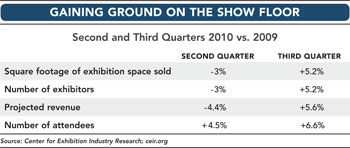
Attendance will lead rebound. One
of the few bright spots of quarter two 2010 was a 4.5 percent boost in
attendance, year-over-year, a trend that continued in quarter three.
"The stabilization and growth in attendance is by itself a reason to
hope we'll continue to see growth in the other metrics as well," says
Ducate.
In the meantime, both Ducate and Hacker are keeping their
fingers crossed that 2011 will truly mark a turning point for their
industry.
By Michael C. Lowe
Conference Center Business Lags
All sectors of
the hotel industry were hard hit in 2009, but one of the harshest blows
landed on conference centers, whose fiscal health depends on meetings
business.
 Since pricing for centers is based on the complete
meeting package model -- where the room rate includes the cost of the
meeting space, F&B and more -- revenue typically is measured by
dollars per occupied room (POR). According to Trends in the Conference Center Industry, a
report from Colliers PKF Consulting USA, centers reported a 9.2 percent
decline in total revenue from POR in 2009. Conference demand, which
accounted for 72.2 percent of the rooms occupied at conference centers
in 2008, fell to 63.9 percent in 2009.
Since pricing for centers is based on the complete
meeting package model -- where the room rate includes the cost of the
meeting space, F&B and more -- revenue typically is measured by
dollars per occupied room (POR). According to Trends in the Conference Center Industry, a
report from Colliers PKF Consulting USA, centers reported a 9.2 percent
decline in total revenue from POR in 2009. Conference demand, which
accounted for 72.2 percent of the rooms occupied at conference centers
in 2008, fell to 63.9 percent in 2009.
In 2010, just like in the
overall hotel sector, occupancies have been coming back at a turtle's
pace, while rate growth continues to lag. "Commercial and leisure
travelers have been recovering pretty well from the beginning of this
year," says Dave Arnold, CEO East of Colliers PKF. "The lagging sector
is meetings. You really can't raise room rates until that demand is
there and locked in."
 Slow but steady growth lies ahead. Arnold
says he expects occupancy to grow by about 3 percentage points during
the coming year as well as in 2012. He adds that rate recovery will be
up about 2.5 percent in 2011.
Slow but steady growth lies ahead. Arnold
says he expects occupancy to grow by about 3 percentage points during
the coming year as well as in 2012. He adds that rate recovery will be
up about 2.5 percent in 2011.
Bookings will be made further out. For
planners who struggle to produce quality events with minimal lead
times, Arnold expects things to improve. "Some properties, it's
unbelievable, they're getting in-the-week, for-the-week bookings;
they've never seen anything like this," he says. "But this can't go on.
We'll get back to the 60- to 90-day window -- some prognosticators say
within six months or so -- which will allow properties to raise rates."
Centers will remain a bargain. Arnold
says conference facilities still constitute a great value vs. hotels,
noting that traditional hotels would rather have commercial travelers
back, leaving conference centers to give meetings of 50 to 100 people
all the attention they deserve. One caveat: There are some distressed
properties out there, so conduct that on-site visit if you can.
"There's
still a lot of pressure on margins, and there are a lot of capital
expenditure needs that are being deferred," Arnold notes. "Make sure
that what you see on the Internet is what you're getting."
By Sarah J.F. Braley
Continued...
Modified Incentives Returning
Incentive business appears
to be on the upswing for 2011, according to several indicators and
industry experts. "Things are different in that the luxury bent of most
programs is still off," notes Fay Beauchine, CITE, president, engagement
and events, at Minneapolis-based Carlson Marketing, and president of
the Site International Foundation's executive committee. "But in
speaking with hotels and destination management companies, 2011 feels
better than 2010, when we were a little more optimistic than we should
have been."
Among the growth areas for programs, Beauchine says,
are automobile and financial firms that accepted Troubled Asset Relief
Program funds. "As soon as the TARP money is paid back, you will see
modified programs sponsored by those firms moving forward. There is a
desire to return." Some clients, she adds, are "feeling so bullish right
now that they are booking incentive programs through 2013."
At
Fenton, Mo.-based Maritz Travel, another major player in the field, 85
to 90 percent of business from established clients has returned,
according to Chris Gaia, the firm's vice president of marketing.
Other signs back the incentive firms' improved outlook: More than half of 131 incentive professionals polled for the inaugural Site Index Annual Survey, released
in September, said they expect the use of incentive travel programs to
increase in the next six to 12 months, and 84 percent expect the use of
programs to increase even more between 2011 and 2013.
Additional incentive trends of note for the coming year and beyond include the following.
Use
of international destinations will increase. According to the Site
survey, the pros polled said international destinations currently made
up 25 percent of their overall usage of motivational events; however,
they said that figure will increase to 40 percent in the next six months
and remain there through 2012.
"There's a lot of interest from
our clients in Europe, followed by Asia," says Carlson's Beauchine.
"With Mexico, there still are concerns about violence, though it is a
very reasonably priced, stellar product."
According to Maritz's
Chris Gaia, since 2008 the company has experienced a year-over-year
increase of 5 percent in travel to international destinations for
incentive travel programs.
Top brass will make more decisions. More
than half of those polled in the Site survey expect the level of
involvement of top management in the decision-making process for
"motivational events" (Site's term for incentive travel programs) to
increase in the next six to 12 months.
Suppliers will be less flexible. A
quarter of the Site respondents expect less flexibility of cancellation
terms from their incentive program suppliers in the next year.
Events will get greener. Slightly
more than half of those polled by Site expect the use of green and CSR
initiatives to increase in the next six to 12 months. Melissa Van Dyke,
president of the St. Louis-based Incentive Research Foundation, puts
that number much higher -- at 74 percent -- based on findings of IRF's Incentive Industry Trends 2011 survey of 130 incentive professionals, released in October.
More meetings will be held. More
than 60 percent of those polled by Site believe that business meetings
will be part of incentive programs in the next 12 months, though experts
such as Van Dyke, Beauchine and Mary MacGregor, vice president,
business development, for Chicago-based BCD Meetings & Incentives
and president-elect of Site, put the figure as high as 90 percent.
Programs will get shorter. According to the IRF poll, 40 percent of respondents anticipate reducing the number of days/nights for their programs.
Groups -- and program perks -- will shrink. IRF
respondents expect cuts in the number of rooms (meaning fewer winners)
they will need; 27 percent said they would change to an all-inclusive
pricing option (resorts, cruises) for programs, and 26 percent said they
would cut back on room gifts and other amenities, and on covering
charges such as luggage fees imposed by airlines.
Budgets will grow. Forty-three percent of those polled in the IRF study anticipate an increase in their incentive travel budgets in 2011.
By Lisa Grimaldi