In canvassing the experts who keep a close watch on the various business segments that make up the meetings industry, M&C found that their voices all sang a similar song: Overall, 2011 was pretty good, and 2012 should prove to be a little bit better.
While hotel rates will continue on their upward trajectory, this partially reflects an increase in group demand, a trend that portends a greater number of meetings and attendees. Other indicators show that incentive programs are growing again, and the trade show industry, which saw some modest growth in 2011, is geared to rise further in 2012.
Yet, this generally upbeat view is tempered by some real concerns. Most notable among them is the fear that a double-dip recession, still a threat thanks to continuing economic malaise at home and outright financial crises abroad, will wipe out whatever gains have been made. In addition, with few new hotel rooms entering the market, it will become more of a seller's market. Planners not only will need to book earlier to get rooms and function space, they'll also have to figure out new ways to leverage their buying power. Airlift will continue to cost more, as well, for what will seem like an ever-tighter number of seats, thanks to the airlines' reluctance to expand capacity.
The following pages offer a more in-depth look at what insiders say awaits meeting planners in the new year.
Technology: Better Tools, More Virtual Events

The technologies outlined below, all of which have been in the
news in recent years, likely will gain greater traction in 2012 in the
mainstream planning world.
Value-measurement tools. Calculating
return on investment for meetings could become more automated. "As
planners continue to combine the principles of ROI with technology,
we'll begin to see benchmarking patterns emerge regarding certain types
of meetings," says Jeannie Griffin, a senior product manager at meetings
tech-provider Cvent. "We'll also see more applications that will expand
the planners' scope of influence, such as easy-to-use tools that will
give them a do-it-yourself option for measuring return on event."
One
such tool was introduced by MeetingMetrics last month. Called Event
Performance Indices, its six indicators are designed to provide insight
into an event's value and eventual return. Likewise, expect to see more
do-it-yourself benchmarking guides from Cvent and competitor StarCite,
for evaluating ROI and strategic meetings management program progress.
Virtual
and hybrid events. As acceptance of virtual events grows in the
meetings industry, so does the ability to plan and integrate them into
an overall marketing plan. Such is the motivation behind bXb Online, a
hybrid (face-to-face plus virtual) event-marketing agency recently
launched by industry vet Tony Lorenz, who says it's time for planners
and marketers to drive the content of online events, rather than being
preoccupied by the limitations of technology.
"Technologists
don't craft stories, they just build technology," Lorenz notes. "To the
extent that marketers and planners can have a hand in crafting those
stories, we're all going to be in a much better place."
The
Professional Convention Management Association recently invested in
the Virtual Edge Institute, which promotes education and training for
virtual events, and will continue to co-locate its Convening Leaders
meeting with the Virtual Edge Summit. – MichaeL J. Shapiro
Hotels: Rates Climb, Lead Times Lengthen
 Economic uncertainty has
caused some hotel-industry analysts to soften projections just a bit for
the coming year, but overall, hotel business is expected to continue
its upswing.
Economic uncertainty has
caused some hotel-industry analysts to soften projections just a bit for
the coming year, but overall, hotel business is expected to continue
its upswing.
"It is tough not to be optimistic regarding the
future of U.S. hotels," notes R. Mark Woodworth, president of
Atlanta-based PKF Hospitality Research, in September's PKF forecast. "By
year-end 2012, all but one of the 50 markets in our Hotel Horizons
universe are forecast to exceed their previous peak levels of demand."
In
PKF's estimation, that demand should lead to an average daily rate hike
of about 4.7 percent in 2012 -- softer than previously expected, but
still surpassing 2011 rate growth by more than 1 percentage point.
Travel
management giants American Express and Carlson Wagonlit Travel both
expect similar U.S. rate hikes for their business-travel clients,
although they do acknowledge that pricing likely will vary considerably
according to region and metropolitan area. Amex is calling for a rate
gain of 2.5 to 6.5 percent among North American mid-range properties,
and 1.5 to 5.5 percent in the upper range. Projections from Carlson
Wagonlit's 2012 Global Travel Forecast narrow down the North American
average to a 2.4 to 3.1 percent increase for the first half of the year,
with a slightly higher year-over-year hike of 2.6 to 3.4 percent for
the second six months.
International rates will skyrocket. For
international destinations, pundits expect major rate hikes in Latin
America -- although, again, that will vary considerably by country.
Carlson Wagonlit Travel foresees major increases across Latin America of
9 to 11.8 percent for the first half of 2012, and from 10.1 to 12.2
percent for the second half. Brazil leads the way with forecasted rate
increases of 24 percent for the first half and a hefty 34 percent rise
expected for the latter half of 2012.
Groups rates will lag, at
first. PKF's September report noted that while corporate negotiated
rates already were beginning to rise, meeting planners still were using
leverage to mitigate price increases. That leverage likely will wane,
however, as meeting demand rises and hotel supply remains relatively
flat. Because of those factors, CWT is forecasting a 5.5 to 6.5 percent
increase in cost per attendee, per day, for the coming year.
"For 2012, supply and demand are in our favor," notes Tammy Routh, vice president
of global sales for Marriott International. "Supply in terms of
new-build hotels has basically stopped, especially in the United States.
So the hotel industry is in a good place to be able to drive rates."
Indeed, Marriott experienced double-digit increases in business travel
demand this year, says Routh, and expects increases in the high single
digits in 2012. "That will drive group rates as well," she adds.

Expect
longer lead times. Because availability is again at a premium, planners
should book early. "Waiting is what you've been able to do for the past
couple of years," acknowledges Routh, "and that's not going to work
anymore if you really want certain cities or certain types of hotels."
CWT's
Solutions Group echoes Routh's advice in its forecast, noting that
hotels in many of the top business markets will be sold out on peak
nights throughout next year. The availability challenge will only become
more intense as group size increases, too -- by about 1 to 4 percent
for all types of meetings, according to projections outlined in the
report.
The upshot: "Corporate planners will need to extend
their booking windows to secure available space and to have better
negotiating power with suppliers," warns CWT's forecast.

CWT
advises planners to align contracting in the coming year, working with
the same property or chain for multiple meetings in order to leverage
their buying power. With the increased focus on strategic meetings
management, this type of negotiation likely will become more
commonplace, as will companies leveraging their business-travel spend to
negotiate meeting space and group rates.
"We are seeing a
definite trend with corporations when they're preparing their
business-travel requests for proposal," notes Marriott's Routh, "where
they indicate that if we want to get their group business, we'll have to
be a part of their preferred business travel program. And for smaller
meetings, they're requesting that we honor that transient preferred
rate. For small and midsize meetings, that makes perfect sense." She
adds that large events still are negotiated on a case-by-case basis. –
MichaeL J. Shapiro
Airlines: Fares increase, Capacity Tightens
 For
the most part, the airline industry has been enjoying the fruits of
stronger demand, carefully managed capacity and ancillary fees. Every
major carrier except for American Airlines has been reporting quarterly
profits. United Airlines led the way in third-quarter 2011 with a $773
million net profit, while American suffered a $162 million loss.
For
the most part, the airline industry has been enjoying the fruits of
stronger demand, carefully managed capacity and ancillary fees. Every
major carrier except for American Airlines has been reporting quarterly
profits. United Airlines led the way in third-quarter 2011 with a $773
million net profit, while American suffered a $162 million loss.
Better
bottom lines will equal higher fares. Of note, says industry analyst
Robert Herbst of Airline Financials, is that both United and Delta Air
Lines are seeing financial success from their recent mergers, giving
both significant airfare-pricing power. Planners will see this most
noticeably in markets where these carriers have a significant presence
-- and the number of such markets has only grown since United teamed up
with Continental and Delta acquired Northwest.
Healthy
financials naturally follow industry consolidation, points out Herbst.
"Combined revenues from just United and Delta now total more than the
rest of the entire U.S. airline industry," he notes. "United's revenue
alone is more than the total of Southwest, US Airways, Alaska and
JetBlue."
U.S. capacity might shrink. While air travel demand
hasn't slowed, according to Carlson Wagonlit Travel's 2012 Global
Forecast, there remains plenty of nervousness over the sluggish economy.
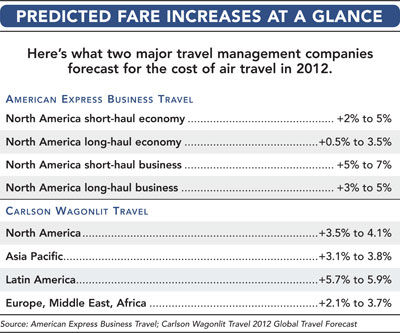
CWT expects many North America-based airlines to scale back capacity growth plans for the coming year, leading to fuller planes and growing fares.
CWT
projects domestic economy fares to go up by 3.6 to 5.2 percent in the
U.S. next year, with business- and first-class fares actually dropping
slightly for domestic travel, from -0.1 percent down to -5 percent.
Increases are expected for international travel, from 6.1 to 7.3 percent
in economy and 3.6 to 4.8 percent in business and first class.
For
its part, American Express expects the largest North American fare
increases to occur in business and first class, to take advantage of
business travelers seeking opportunities, particularly in emerging
markets. Amex projects North America short-haul business fares will jump
by 5 to 7 percent, and long-haul fares to climb by 3 to 5 percent.
Growth
will continue internationally. Strong demand likely will continue in
the Asia Pacific region, according to American Express, as "companies
within the region and across the world send travelers there to
capitalize on its economic expansion," notes Christa Degnan Manning,
director of Experts Insights research at Amex, in the forecast.
Long-haul fares in particular are expected to increase significantly: 5
to 9 percent in economy and 6 to 10 percent in business class. Amex
projects short-haul fares in the Asia Pacific region to go up by 1 to 5
percent in economy and 2 to 6 percent in business class.
Latin
America, led by economic successes in Argentina, Brazil, Chile, Colombia
and Mexico, also should see increased business-travel demand, notes
CWT's Global Forecast, both from within the region and from foreign
investors. CWT expects overall airfares on Latin America-based airlines
to climb by nearly 6 percent; Colombian fares will undergo price hikes
of about 8 to 11.4 percent.
Booking ahead will save $$. Egencia Travel Solutions calculates advance-purchase
savings in its 2012 Global Corporate Travel Forecast, and the potential
dollars saved can be significant. For example, booking tickets 22 days
in advance or more next year could translate to savings of as much as 28
percent to Toronto, 27 percent to Houston and 24 percent to Dallas.
Within Europe, advance booking can reduce business-class fares by as
much as 47 percent to Frankfurt, Germany, or 44 percent to Paris. –
MichaeL J. Shapiro
Incentives: Budgets, Agendas Hold Steady
 A
slow and steady upward trend continues to describe the outlook for the
incentive sector of the meetings industry. Many of the incentive
professionals M&C spoke with point to a stabilization in the market,
as companies reintroduce or bolster their programs to build their
businesses.
A
slow and steady upward trend continues to describe the outlook for the
incentive sector of the meetings industry. Many of the incentive
professionals M&C spoke with point to a stabilization in the market,
as companies reintroduce or bolster their programs to build their
businesses.
At Maritz Travel, newly appointed CEO Dave
Peckinpaugh said that despite some "surprises," such as the tsunami in
Japan, that affected some of the company's business, "We are seeing
double-digit growth this year and expect the same gains in 2012. Even
the economy's sluggishness and the uncertainty of the European markets
are not having an affect on our clients' programs."
But, as
Peckinpaugh and other experts point out, the bar for recovery has been
adjusted. "The 'new normal' is the right way to characterize the
recovery of the incentive market," says Chris Gabaldon, chief sales and
marketing officer for the Ritz-Carlton Hotel Co. "No one expects the
froth that existed in the market in 2007 to return." He adds that it is
much more realistic for the industry instead to look back to 2005 and
2006, when companies were focused on business growth, investing in
employees, retaining talent, development and motivation.
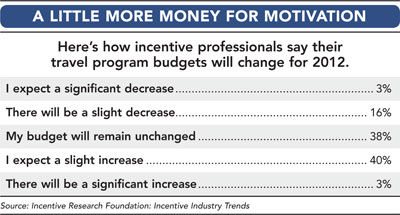
 Among
formal forecasts for 2012, the most recent poll conducted by the
Incentive Research Foundation reveals that 38 percent of respondents
expect no change to incentive program budgets; more than half
anticipated no change in the type of destinations they will use, and 26
percent expected to switch from international to domestic destinations.
Among
formal forecasts for 2012, the most recent poll conducted by the
Incentive Research Foundation reveals that 38 percent of respondents
expect no change to incentive program budgets; more than half
anticipated no change in the type of destinations they will use, and 26
percent expected to switch from international to domestic destinations.
Additional
findings show that 28 percent of those polled expect to reduce the
total number of days/nights of their programs, while one quarter
predicted no change in program duration, and 29 percent of respondents
have considered switching from group travel programs to individual
travel rewards.
Among various developments on the forefront for 2012 and beyond, experts point to the following.
Look
for a convergence of incentive and meeting planner roles. According to
some early findings from a joint study by the Site International
Foundation and the MPI Foundation, 37 percent of the 199 meeting and
incentive planners contacted by the organizations say they are now
planning other events (either meetings or incentives) in addition to
their primary roles. Of that group, two-thirds predict there will be
more role convergence in the coming year.
When asked if the next
year would see a change in the inclusion of business meetings and
similarly "serious" components in incentive programs, 62 percent of
those surveyed said they expect that trend to increase.
DMCs will
play an expanded role. The Site Index: Focus on Destination Management
Companies, released in early 2011, revealed that many DMCs are now
acting as one-stop shops by booking air transportation and hotels,
organizing meeting logistics and providing on-site staff, in addition to
their local destination services. As a result, many DMCs find
themselves in direct competition with third-party meeting and incentive
planners, a group that traditionally hired or recommended them to
clients in the past.
This trend will continue to grow,
according to the various incentive firms and DMCs M&C spoke with
during Site's annual conference, which was held this past October in Las
Vegas. – Lisa A. Grimaldi
Trade Shows: Small, But Welcome, Gains Trade
show officials are moderately optimistic as they look forward to 2012,
after seeing encouraging figures from the second quarter of this year.
According to the Center for Exhibition Industry Research Index, the
industry experienced an overall increase of 1 percent year-over-year,
with net square feet of exhibit space sold up 2.8 percent, number of
exhibitors up .5 percent and number of attendees up 1 percent.
Trade
show officials are moderately optimistic as they look forward to 2012,
after seeing encouraging figures from the second quarter of this year.
According to the Center for Exhibition Industry Research Index, the
industry experienced an overall increase of 1 percent year-over-year,
with net square feet of exhibit space sold up 2.8 percent, number of
exhibitors up .5 percent and number of attendees up 1 percent.
The
only indicator showing a miniscule decline was revenue, which decreased
.2 percent -- still a relatively welcome number compared with the 8.3
percent drop in 2010.
"It's no surprise that revenue is lagging,
because it always does after a recession," says Steven Hacker,
president of the International Association of Exhibitions and Events.
"The important thing is that the trending line is moving in the right
direction and by next year, I think we'll reach positive metrics in all
four categories we measure."

Growth will continue. According to
predictions, the trade show industry will see a boost of around 3
percent in 2012, says Doug Ducate, president and CEO of CEIR. "We're
anticipating that things will stabilize and we'll have a good year," he
notes. Still, both Hacker and Ducate are reluctant to celebrate any
victories. "Planners should approach next year very conservatively,"
Ducate says. "They should continue to set realistic goals and keep the
targets in mind that will help them measure their own progress.
"The
future of the exhibition industry still appears to be quite bright,"
Ducate adds, "and research indicates that young professionals are still
interested in maintaining the face-to-face experience. But we approach
next year with cautious optimism." – Michael C. Lowe
Conference Centers: Key Markets Rebound
 When
it comes to the conference center segment of the meetings industry,
"2012 looks like a pretty strong rebound for the second year in a row,"
says Dave Arnold, CEO East of PKF Consulting USA. Overall revenue per
available room will be up 8 percent for 2011 for conference centers and
group-related hotels, he notes, and he expects RevPAR to jump another
7.2 percent for 2012.
When
it comes to the conference center segment of the meetings industry,
"2012 looks like a pretty strong rebound for the second year in a row,"
says Dave Arnold, CEO East of PKF Consulting USA. Overall revenue per
available room will be up 8 percent for 2011 for conference centers and
group-related hotels, he notes, and he expects RevPAR to jump another
7.2 percent for 2012.
Bargains will be found inland. Facilities
near urban areas, especially on both coasts, are doing well, says
Arnold, so the conference center bargains tend to be in mid-America
destinations.
Helping the East Coast in particular is a rise in
pharmaceutical and financial-services meetings, which Arnold attributes
partially to a catch-up going on with leadership training, management
development and other traditional center activities. Also helping
conference venues is the lack of new inventory: Nobody is building new
centers at present, other than the occasional university facility.
The
Complete Meeting Package will remain strong. While there has been talk
about breaking down the CMP, where the room rate also reflects the cost
of meeting space, F&B and more, into a piece-by-piece deal, that
urge has subsided, says Arnold. He reports that 70 to 80 percent of
current center business follows the CMP model.
Lead times will
stay tight. Planners will continue to book events within about a month
at centers. However, says Arnold, more approvals are being required for
certain corporate meetings, which might lengthen the time needed to seal
a deal. – Sarah J.F. Braley