C2-MTL Fast Facts
1,200 attendees from 40 countries
125 volunteers50 conference partners
40 speakers and panelists
3 conference webcasts in real time
0 sponsorship signage
On May 22-25 of this year, the first C2-MTL conference took place in Montreal. M&C contributing editor Cheryl-Anne Sturken attended this most unusual event; here's her report from the front lines.
From my first step into the entryway -- a strobe-lighted, black-fabric-draped hallway thrumming to the pulse of techno music and dubbed the Immersion Tunnel -- it's clear C2-MTL will be no ordinary business conference. At a glance, it looks like South By Southwest meets Burning Man. A rock band is onstage in one corner, amid incredible art installations, interactive art pods, food trucks, and dozens of pink- and black-clad, iPad-toting volunteers scurrying around. The eclectic attendee base -- about 1,200 strong -- is just as odd: a mix of black-suited corporate heavy hitters happily rubbing elbows with tattooed hipsters half their age, some with dogs in tow.
I have entered an alternate universe, three years in the making. C2-MTL: Commerce + Creativity is the brainchild of the Montreal-based advertising agency Sid Lee, whose clients include Adidas, Red Bull and MGM Grand. The idea for the conference sprung from a simple question voiced by Sid Lee client Daniel Lamarre, CEO of Cirque du Soleil, during a casual meeting with Jean-Francois Bouchard, co-founder, president and senior partner of the agency. "He asked, 'Isn't there an opportunity to create an event that can be both corporate and creative?' Our answer was an emphatic yes. So we decided to embark on this collective adventure," says Bouchard, who became the event's curator.
Abandoning tradition At your typical conference, creativity and innovation are little more than buzzwords. Not here. Those two concepts are the foundation imbedded into the very fabric of this event, meant to spark cutting-edge thinking about ways to conduct business. C2-MTL has no trade show, no sponsorship signage, not a single PowerPoint presentation.
The location is just as unexpected. Instead of the obvious choice, Montreal's high-tech convention center, the Palais des Congrès, Bouchard and fellow organizers planted the three-day event in the center of the city's gritty Griffintown. The district is a bevy of construction activity, with once-abandoned factories enjoying a rebirth as they are transformed into restaurants, retail space, art galleries, offices and condominiums.
 Anchoring this pocket of the city is the historic New City Gas building, a stone-clad, peak-roofed structure completed in 1861. Conference organizers were so eager to have it be the centerpiece for their "Innovation Village" that they got involved with Heritage Montreal in its restoration. Benoit Berthiaume, executive producer of C2-MTL, says the choice of venue makes perfect sense: "We wanted a venue that reflected the host city's creativity and was as unique and innovative as the event itself."
 The conference has been funded with $750,000 of seed money from Tourism Montreal, which leapt at the idea of presenting the city as one of the world's hubs of creativity. The price of conference tickets ranges from $2,400 (for early registrants) to $3,000. Attendees have come from a number of young, cutting-edge companies from around the globe, along with a dizzying variety of major corporations such as State Farm Insurance, Johnson & Johnson, PricewaterhouseCoopers, Fidelity Investments, Nestlé Purina PetCare Co., the Mayo Clinic and Molson Coors.
Equally impressive is the roster of speakers, top visionaries of the artistic and academic worlds as well as the upper echelons of corporate America. Companies such as DreamWorks Animation, Fast Company, Google and IBM are represented. The lineup includes Michael Eisner, former chairman and CEO of The Walt Disney Co.; Arianna Huffington, editor in chief of AOL Huffington Post Media Group; and legendary film director Francis Ford Coppola.
"Getting VIP-tier speakers for an event that has not happened yet was a big challenge," acknowledges Bouchard. "Once you get one on board, it becomes easier. It puts people at ease. They see you as having credibility. It was never about money for any of them; it was about creating broader relationships."
Robert Safian, editor of Fast Company, who took to the stage on opening night to explain how his magazine selects nominees to its annual "100 Most Creative People in Business" list, was the first speaker to commit. He didn't know that until Bouchard mentioned it in passing at the conference.
"I asked him, 'Hey, did you know you were the first to say yes to us?' " Bouchard recalls. "He said he hadn't but it wouldn't have mattered. He said the concept sounded so interesting, he would have said yes anyway."
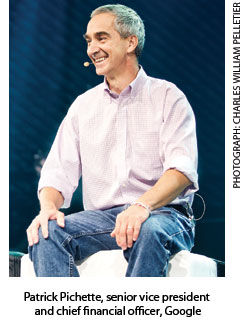 It's a sentiment echoed by many of the speakers. "I was thrilled to be invited," says Patrick Pichette, senior vice president and chief financial officer for Google. "Innovation is at the core of what we do, and it is an important message at the heart of this conference. When innovation is married to business, it's wonderful. Also, since I'm in Montreal quite often, it was easy to slip it on my calendar."
Arianna Huffington, one of the most influential figures in media with 500 reporters and editors under her company's global umbrella, notes that she did not hesitate when she heard about the conference from good friend Safian. "It was just such a fantastic opportunity. You can't emphasize creativity in business enough," she says.
Boston-based Marc Chapman, global strategy and transformation leader for IBM Global Business Services, chose C2-MTL as the place to unveil the findings of IBM's Global CEO study, which surveyed the leadership styles of 1,700 chief executives from 64 countries. "The IBM you know today is not your father's. We are constantly transforming," says Chapman. Both the timing and the conference's theme of Commerce + Creativity were perfect, he adds, because key amongst the yearlong study's findings was the revelation that top performing CEOs -- those whose companies saw increased profitability and growth -- were more open to innovation, collaboration and embracing new business models.
From the podium at C2-MTL
"We have instinct, but also intuition. Intuition is your gut. Trust it. Cultivate it. Don't let it get beaten out of you."
"I think one of the problems with American business is creative people scare the hell out of people at the top. People at the top are buttoned up. They are good at golf and are on time for meetings. Creative people instill in them a fear of having a meeting with them."
PHOTOGRAPHS: (top) Charles William Pelletier; (bottom) Ed Schipul
Making it work Jean-Francois Bouchard is a
man in perpetual motion, but when he finally takes the time to chat on
the final day of the conference, he shows an uncanny ability to harness
his energy and discuss strategy in a calm and deliberate manner. His
conviction is simple: Creativity is the catalyst to developing a strong,
successful brand. That belief fueled his thoughts on building C2-MTL.
"There are several conferences on innovation, but none is truly creative
in its approach," he notes. "We wanted to go beyond just talking about
creativity, to create a completely immersive experience."
There
is nothing ordinary about C2-MTL's Innovation Village. Scattered around
this former gas-works factory, 5,000 square feet of tented space and an
open outdoor area are dotted with wood Adirondack chairs, umbrellas and
enormous plastic futons. Here, seven artists from various Quebec
organizations are busy creating objects, works of art and visual
concepts. One is building a giant Lego-like abstract sculpture, which
changes form daily. Several others are clustered around a weaving
machine, creating a bright woolen scarf designed with the event's logo
and the messages most tweeted about the event as it unfolds. The
weaving, broadcast to attendees via a live feed, also draws a constant
stream of attendees coming by to check its progress and read the tweets.
Near the end of the conference, it is well over six feet long.
The
agenda offers content and educational sessions on everything from
online marketing to product distribution. The packed breakout session
area looks like a course in speed dating. At one table, the nominated
group leader urges participants to collaborate on their ideas and put
them on paper. It looks chaotic, but the energy is electric. Once the
allotted 20 minutes per group are up, project results are quickly
stapled to the tent wall, and attendees rush to switch tables and take
part in their next session option. There is not an empty seat, ever.
It
all seems perfectly normal to Bouchard. "I don't believe that a single
individual or company can do as well as a large group of innovative
people working collaboratively together," he says, noting that 50
companies were involved in making the conference a reality. "It's how I
work."
That concept of collaboration is reflected in the absence
of sponsorship signage, from the walls of the tents to the leather
sofas and art-deco table lamps in the networking lounges in the New City
Gas building. The way Bouchard sees it, slapping a logo on an item is
passé -- it doesn't get anyone's attention, and it doesn't convey the
brand's message. "You know what I would do if Mercedes Benz were one of
my sponsors?" he posits with delight. "I would cut one of their cars in
half and install it outside for people to sit around in like at a café,"
says Bouchard. "How cool would that be to actually be living the
Mercedes lifestyle? Even if they passed out one million brochures about
their cars, they wouldn't get as much attention."
How does one go
about wrapping up a conference whose theme hinges on creativity? By
creating a huge spectacle and inviting the public in to join the
celebration. Yes, the public. "If you want a rich fabric, you have to
have a mix of people," says Bouchard about his decision to sell tickets
to the closing night event (some 500 tickets were made available at $65
per). "Look, most companies have a final-night party at their
conference, then everyone leaves and goes to find a club somewhere to
continue the party. We decided to invite the party in and feed off the
energy."
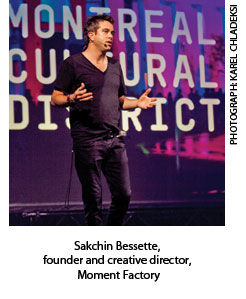 The Montreal-based production company Moment Factory,
creators of C2-MTL's Immersion Tunnel entryway, was assigned the job of
coming up with a unique and memorable send-off. It was a project that
Sakchin Bessette, founder and creative director for the company, happily
dived into. "The goal is to make the hair on people's arms go up," he
says, "to make them sense they are part of something bigger." Bessette
should know: He's been the creative impetus behind a host of other
large-scale productions, including last year's Super Bowl halftime show,
which featured Madonna.
The Montreal-based production company Moment Factory,
creators of C2-MTL's Immersion Tunnel entryway, was assigned the job of
coming up with a unique and memorable send-off. It was a project that
Sakchin Bessette, founder and creative director for the company, happily
dived into. "The goal is to make the hair on people's arms go up," he
says, "to make them sense they are part of something bigger." Bessette
should know: He's been the creative impetus behind a host of other
large-scale productions, including last year's Super Bowl halftime show,
which featured Madonna.
And an all-encompassing sensory
experience it is. As a crowd of 2,000-plus gather in the inner courtyard
of Innovation Village, the exterior walls of the New City Gas building
suddenly light up in vivid colors. A shower of soft, illuminated latex
balls fill the sky and float down. Partygoers scoop them up and throw
them at the façade, causing the walls to change color in an interactive
volley that would make the developers of Wii proud. Exactly at midnight,
American musician and deejay sensation Moby saunters on stage to
thunderous cheers and begins to deliver his sample-based electronic
music, and the party carries on late into the night.
Already,
plans are afoot for next year's C2-MTL, with the theme "Creativity Is
Everybody's Business," set for May 21-23 in Montreal. Confirmed speakers
include French designer Phillipe Starck and Sir Richard Branson,
founder of Virgin Group. Looking forward, organizers are mulling
bringing similar C2 events to the Middle East or Asia, says Bouchard,
and eyeing cities that can "leverage their dynamic, creative spark like
Montreal."