 The structure of most educational meetings is almost exactly the same: lectures and panel discussions, theater- and classroom-style seating, and almost zero audience participation. Connections happen by chance, and unless attendees are extroverted and learn by sitting and listening, they come away with very little.
However, as a growing number of forward-thinking meeting professionals are proving, conferences can be better. "Unconferences" are formats that make meetings interactive, engaging and a whole lot more fun. Although unconferences have been around for years, the formats are being implemented more frequently than ever.
"The reality is, most people are not happy with the traditional conference experience anymore," says Adrian Segar, a particle physicist, tech guru and the author of Conferences That Work: Creating Events That People Love. "When it was the only option, they grinned and bore it. Now they don't have to do that anymore."
There are many types of unconferences; what follows are two of the best.
What is EventCamp?
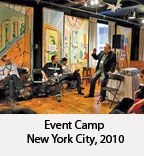
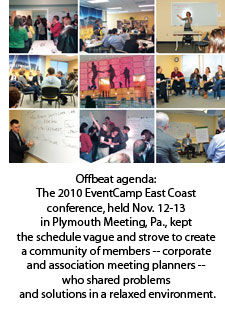
EventCamp is a conference started in late 2009 by a group of event
planners who communicate through the Twitter hashtag #eventprofs. The
concept: a low-cost, volunteer-run educational event that brings the
EventProfs community together. Conferences focus on social media and
technology and, with the exception of EventCamp East Coast, they are
streamed over the Internet, so that anyone can participate.
In
2010, the group held three EventCamps: in New York City, Minneapolis and
the Philadelphia area. Each one has experimented with conference
formats in different ways. At EventCamp Twin Cities in Minneapolis, for
example, organizer Samuel J. Smith, managing director of Interactive
Meeting Technology LLC, based in Plymouth, Minn., found ways to draw in
the 550 online attendees and thereby enhance the experience for the 75
on-site and the 30 others at remote sites. (For more on how this was
accomplished, download the free M&C webcast, "Putting on a Hybrid
Show," at mcmag.com/webcasts.aspx.)
The next EventCamp is being held Feb. 11-13 in Chicago.
Peer Conferences Picture a group of 50
meeting planners sitting in a circle, each sharing what they hope to
learn from the very event they're attending. That's what happened at
EventCamp East Coast, a two-day peer conference held last November in
Plymouth Meeting, Pa. It felt more like a retreat than a meeting.
When
attendees walked in the door, the schedule was a blank slate. Each
participant explained what she could teach, and then everyone voted on
what they wanted to learn. A schedule was hammered out, and the
resulting peer-taught sessions got rave reviews.
When Jenise
Fryatt signed up for the conference, she didn't realize she would lead
two sessions, one on social media and another on improvisational
techniques for team building. "It was such a wonderful conference, and
to think that it was created on the spot by the attendees," raves
Fryatt, co-owner and director of marketing at Icon Presentations, based
in Thousand Palms, Calif., and community manager for Engage365, an
online group of event professionals. "And I learned a lot about myself."
Peer
conferences were devised by Adrian Segar, one of the event's
organizers, as a way for meeting attendees to learn from each other,
rather than from official presenters. The full format is described in
his book, but the basic parameters are as follows:
1. The roundtable. All
the attendees sit in a circle and, one by one, answer three questions:
How did I get here? What would I like to have happen? What experience or
expertise do I have that others might find useful?
2. The peer-session sign up. At
a reception, everyone writes down, on separate sheets of paper spread
around a large table, what they want to learn or what they're willing to
teach. After that's done, everyone then rates their interest for each
of the session ideas and offers to help teach or facilitate sessions
that reflect their expertise. After the reception, a small group digs
out the most popular ideas and makes a schedule, for as little as one
day of sessions or as many as three.
3. The peer sessions.
This is the meat of the event. At EventCamp East Coast, four blocks of
hourlong peer sessions were scheduled. They went so well that a number
of the attendees voiced the wish that there had been an additional day of sessions.
4. The personal introspective.
In the first closing session, everyone again gathers in a circle and
writes the answers to these questions: What do I want to have happen
after the event? What is the current situation? What am I willing to do?
How will I know when it happens? Where and how will I get support?
Attendees
are welcome to share their answers if they like. "It's really important
to honor everyone's learning experience, and to give people at the
event the chance to process what's happened," Segar notes.
5. The "group-spective."
This takes place immediately after the personal introspective and can
take a number of different forms. At EventCamp East Coast, organizers
arranged a handful of chairs in a circle within the larger circle of
attendees, and anyone who wanted to discuss the future of the related
EventProfs online community of planners could take a seat in the
"fishbowl" and speak. (For more information, see "What Is EventCamp?," left.)
As an alternative, Segar recommends breaking
up into small affinity groups to hash out different action plans for the
group moving forward.
A few notes to consider:
• Limit the size. Peer conferences work for up to 100 attendees. Segar is designing a model for larger conferences.
• Pick a large space.
When site-inspecting for a peer conference, make sure the venue has a
large room that can seat up to 50 in a circle. The circle is one of the
least space-effective formations, so plan for that when budgeting.
• Keep it offline.
Segar recommends that peer conferences be confidential, except for what
is written on feedback forms. That way, everyone will feel comfortable
sharing and teaching in an event environment that might push their
boundaries.
• Aim for full attendance. Because of the
interactive format, attendees need to be present for the entire
conference. Get the word out in advance that the beginning is not
optional. "If you have to miss part of the event," says Segar, "miss the
end, not the beginning."
• Consider a hybrid event. Onto
this basic format, a planner can add traditional conference elements,
such as a keynote speaker or panel of experts, to help draw attendance.
Speeding Up Presentations
For many people, an hour is too long to sit through a presentation.
The following session formats facilitate a much faster pace of learning.
TED, the celebrated organization that invites world-renowned
thinkers to present "ideas worth spreading" for 18 minutes has begun
allowing independent communities to organize local TEDx events. The
website provides tips for coaching presenters.
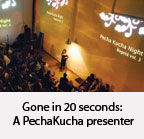
PechaKucha 20x20, a presentation format that originated among
architects in Japan, is simple: Attendees present 20 slides for exactly
20 seconds each. The slides advance automatically. The speed forces
presenters to be concise -- and to practice their speeches extensively.
Ignite is a conference format created in 2006 by O'Reilly
Media. These talks are similar to PechaKucha 20x20 -- they last five
minutes for a total of 20 slides. The format also includes an optional
warm-up contest in which attendees make science-fair-style crafts out of
ordinary objects.
Contact the above organizations to obtain permission and receive help with the planning process.
Open Space Technology Organizational consultant Harrison Owen
created this conference format in the 1980s, as a way to let meeting
attendees self-organize and create a customized event that works best
for them.
Open Space Technology is best used for problem-solving
when the answer is not known and does not need to be directed,
recommends Lisa Heft, a consultant, facilitator and educator, as well as
president of the New York City-based Open Space Institute (U.S.). Heft
has organized Open Space meetings for groups of 10 to 2,500 people.
"Open
Space is for data generation, idea exchange or understanding a fuller
picture of the system," Heft says. "It also works if there is a sense of
urgency: crisis response, a shift in funding, or something else where
the organization has to think quickly in a nonlinear fashion."
Here's
what it looks like: Everyone begins seated in a large circle, and a
facilitator explains what problem they will be working on. Any
participant who wants to talk about an aspect of that issue makes a sign
on an 8.5-x-11 sheet of paper, then stands up, introduces herself,
explains her topic and finds a place on the wall to stick it. The wall
is divided into times and places, like a giant empty schedule. Little by
little, the schedule fills up with these ideas.
When the
sessions begin, attendees go to whatever interests them, and someone
volunteers to take notes, which are submitted as conference proceedings.
Open
Space has four rules, which break down preexisting notions of an agenda
and open up possibilities for interactivity and participation.
1. Whoever shows up are the right people. Sessions
don't need a presenter or even a so-called expert. And sessions don't
need 50 attendees to be considered a success. Two people could get
together and have the most important conversation of the meeting, or one
person could sit in a corner and write down his thoughts, then submit
them as part of the conference proceedings.
2. Whatever happens is what could happen.
Attendees should not try to steer a conversation just because it's
veering off topic. People will talk about what needs to be talked about.
3. Whenever it starts is the right time.
Facilitators don't interrupt a conversation to tell everyone to begin
or end a session. If people begin the conversation early -- or show up
late -- nobody need be upset.
4. When it's over, it's over.
In other words, if three people from a session want to keep talking
about the topic, they can continue as long as they like. Or if the
subject has been exhausted 15 minutes before the break, everyone can go
to a different session or start a new conversation.
The corollary
is "The Law of Two Feet," which Heft subtitles, "The Law of Motion and
Responsibility." In other words, if someone isn't learning or
participating, it behooves that person to leave and go somewhere else.
Open
Space also encourages what are termed as "butterflies" and
"bumblebees." The former are people who don't diligently attend all the
conference sessions but who flit about and maybe don't go to any
sessions at all. Even without attending a session, those people might
engage in a conversation that changes the outcome of the meeting.
Bumblebees are people who leave one session to attend a different
session, acting as emissaries to facilitate communication between
groups.
A final guideline needs no explanation: Be prepared to be surprised.
At
the end of the meeting, everyone convenes again to talk about what they
learned and which conversations seemed the most important, and to make
room for the lasting results of the meeting to settle in.
A few tips for the best results:
• Choose your space wisely.
If you try to hold an Open Space session in an exhibit hall, use
microphones so that everyone can hear, and make sure there's a way to
post things on the walls. On the other end of the spectrum, if a room is
too small for a group, attendees should feel free to take the
conversation elsewhere, even outside.
• Explain the process beforehand.
Attendees should come in knowing the structure, as well as why the
meeting is being organized this way. Otherwise, the meeting might seem
unfocused and frustrating.
• Allow enough time. For a
truly productive session, Heft recommends five hours at the very least,
up to a few days. "I would never choose Open Space for a meeting that is
just several hours long," she says.
• Start small. If you
plan a meeting with 5,000 attendees, consider giving them a taste of
Open Space without switching the format entirely. Joan Eisenstodt, chief
strategist of Eisenstodt Associates, LLC, based in Washington, D.C.,
recommends setting aside rooms for Open Space-style topic discussions to
introduce the idea.
"I think we can do things within traditional
meetings that change their look and feel and address the participation
needs of different styles of learners," Eisenstodt says.
For further reading, Eisenstodt recommends Harrison Owen's Open Space Technology: A User's Guide.