The inefficiencies of the airport security screening process are a plague for planners and attendees alike. So when we hear word of programs that could potentially speed up airport security or immigration processes, we take note. But since the rise and fall of the government’s Registered Traveler program several years ago, it’s been difficult to keep track of just which pre-screen programs are available in which airports, and who is eligible to take advantage of each.
Essentially, two types of programs currently exist: Trusted Traveler systems, which speed up U.S. clearance for international arrivals; and the domestic expedited-security-lane programs, which include the government-run PreCheck and the privately run CLEAR. M&C combed the resources of the U.S. Transportation Security Administration and Customs and Border Protection agencies to establish just what’s in operation and where. Following is a summary of the requirements — and limitations — of each program.
Trusted Traveler
Trusted Traveler programs run under the auspices of U.S. Customs and Border Protection, and they're designed specifically to speed up the process of international arrivals in the U.S. They include the following three entities.
> Global Entry This program uses automated kiosks to speed up entry for pre-approved, low-risk travelers arriving in the United States. You might have noticed these kiosks, free from any lines, while you were standing immobile in a seemingly eternal customs cue. Global Entry members simply approach a kiosk, present a machine-readable passport or U.S. permanent resident card, verify a fingerprint scan and enter a customs declaration. The kiosk issues a receipt and directs the traveler to baggage claim.
Eligibility. U.S. citizens or lawful permanent residents, Dutch, South Korean and Mexican citizens are eligible. Participants must apply online, undergo a background check and, pending review, schedule an in-person interview at one of 26 Global Entry Enrollment Centers (most are in major U.S. airports). An interviewer asks questions, takes a photo, scans fingerprints and determines whether the applicant is accepted. Membership is valid for five years.
Cost. $100 nonrefundable application fee
Locations. As of October 2012, Global Entry kiosks were available at 30 U.S. airports, which together account for about 98 percent of international arriving passengers. Kiosks also are available in eight Canadian airports and two Irish airports, for flights that are pre-cleared for U.S. arrival. (See globalentry.gov/locations.html for the complete list.)
> Nexus This joint program with the Canada Border Services Agency offers expedited processing for travel between the U.S. and Canada. NEXUS lanes and screeners are available at ports of entry for air, land and sea travel. Approved participants receive a photo-identification RFID card, to be presented on arrival.
Eligibility. Citizens or permanent residents of the U.S. or Canada apply by filling out an online application, then interviewing at a NEXUS Enrollment Center. Applicants must be approved by both the U.S. and Canadian agencies. Membership is valid for five years.
Cost. US$50 or CN$50 nonrefundable application fee
Locations. As of October 2012, NEXUS enrollment centers and border-crossing personnel were available at 23 airports and crossing points in the U.S. and Canada (see 1.usa.gov/FW29Pp). Members also can use Global Entry kiosks in participating airports.
See mcmag.com/webexclusives for details about the SENTRI program, for land or sea arrivals from Mexico.
Expedited Screening
> PreCheck
PreCheck is an expedited security program run by the TSA that is
available at a growing number of airports in the United States. Eligible
participants can use dedicated security lanes for certain domestic
flights; any itinerary with an international destination is ineligible.
Benefits in these faster-moving lines might include leaving on shoes,
light outerwear and belts, and leaving laptops and TSA-compliant liquids
in carry-on bags.
The TSA embeds information in the
bar code on the boarding passes of eligible passengers. When those
passengers enter designated checkpoints, they might be referred to an
expedited security lane.
Eligibility. U.S.
citizens who are members of the Global Entry, NEXUS or SENTRI programs,
as well as Canadian NEXUS members, are automatically eligible for
PreCheck screening, as long as they enter their “Pass IDs” when booking
the flights. U.S. citizens who are frequent travelers on Alaska
Airlines, American Airlines, Delta Air Lines, United Airlines or US
Airways, and who have opted in to the PreCheck program through the
airline in question, might also be eligible. In most cases, the airlines
contact frequent flyers who meet the TSA’s criteria; it is sometimes
possible to submit an opt-in request through the airline’s website.
The
passenger doesn’t really have any say when it comes time to take
advantage of PreCheck lanes at the airport. The eligibility has already
been coded into the boarding pass bar code, and the TSA representative
will direct passengers when applicable — which is to say, when an
eligible passenger is on an eligible airline at an eligible airport and
is entering through an eligible security checkpoint. There is no way for
a passenger to confirm in advance whether he or she has been cleared
for expedited screening.
Cost. Free
Locations.
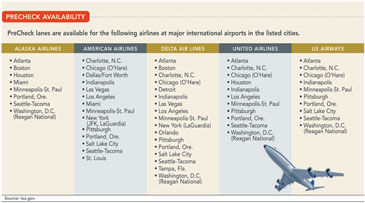
As of late September, PreCheck covered flights operated by five
different carriers at 27 domestic airports. Click link below to see full chart:
> CLEAR
CLEAR was the most popular of the Registered Traveler programs, with
nearly 200,000 members, when it unexpectedly closed down in June 2009
due to a lack of funding. The company was bought out of bankruptcy and
is operating again at a handful of airports; continued membership
benefits are being offered to members of the pre-bankruptcy CLEAR. It is
the only privately run pre-screened traveler service currently in
operation.
Travelers must register online, verify their
identities in person at an enrollment center in Dallas, Denver, New York
City, Orlando or San Francisco, obtain a CLEARcard and then use a CLEAR
kiosk at participating airports.
Eligibility.
A U.S. passport, U.S. permanent resident card or alien registration
card are required, and applicants must be at least 18 years old.
Applicants must register online, then bring specified identification to
an enrollment center.
Cost. $179 for annual membership; corporate rates are available
Locations. CLEAR kiosks currently are available at the Dallas/Fort Worth, Denver, Orlando and San Francisco international airports.