Encouraging registration and delivering information: These are the traditional jobs of conference websites. But in the 21st century, tradition changes from year to year. Once, a person would visit a site, register and never come back. Now, websites are expected to do much more than just provide information, and people expect tools and ever-changing content that keep them returning to the site.
The challenges for those designing conference sites are many: to offer the latest tools without overwhelming users, to create a sense of excitement without neglecting important information, and to give attendees every possible way to maximize their conference experiences. What follows are ways to achieve these goals.
Event ABCs
The primary function of a conference site is to convey the basics: date and location of the event, schedule, costs, exhibitor information (if there is a trade show attached), and hotel and site information. But the most important goal for the show's producer is to encourage people to register. So, advise the experts, make it easy.
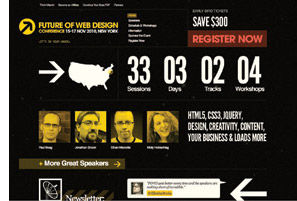 "Make that 'register' button really obvious," says Elliot Jay Stocks, a London-based designer who has helped develop a number of conference sites. "I am a fan of a nice, big call to action." That philosophy was on display at the site for the Future of Web Design (futureofwebdesign.com/new-york-2010/), an Internet conference held this past October in New York City. The first thing to catch the eye: a bold, red "Register Now" button on the upper-right corner of the page, with attractive early-bird discounts noted directly above it.
That button was not on the upper right by accident or whim. "Its almost a standard now to put the registration link on the far right," says Tony Stubblebine, CEO of CrowdVine, a company in Mill Valley, Calif., that provides social media technology to conference sites. "Users expect it to be there."
What users also expect is to quickly understand what the site is telling them and how to navigate through it. In other words, keep it simple. "It should be user-friendly with direct, concise information," says JaNelle Kyle, conference planner with the National Association of Managed Care Physicians in Glen Allen, Va. Too often, she notes, sites "can get carried away with graphics and videos. We need to keep it to the point and informative for the attendees."
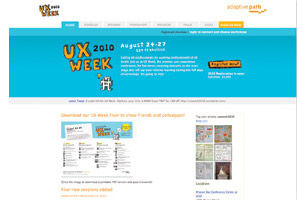 One site that Tony Stubblebine admired for its clear layout was that for UX Week (uxweek.com), a technology conference held last August in San Francisco. Tabs at the top -- including Speakers, Workshops, Schedule, Video, Venue and, of course, a highlighted Register Now button on the top right -- represented all the main points. "It wasn't cluttered with extraneous information," says Stubblebine. "Those first five tabs were the information that a potential attendee would want to get in order to make the decision about whether this conference was good."
But there's more to an effective site than just clean lines and clear information -- it should create a sense of excitement for the event. One way Elliot Jay Stocks likes to build buzz is by liberal use of photography. "Use nice big photos of people at the event, looking like they're having a good time," he says. "You want to portray the atmosphere and the fun."
 The site for CAMEX (camex.org), a show for buyers from college stores, does just that with an opening graphic montage of smiling attendees making the most of previous events. CAMEX takes the human touch even further, with big testimonials from members talking about why CAMEX is one show they won't miss. Attendees, who are members of the Oberlin, Ohio-based National Association of College Stores, come from schools of all shapes and sizes and represent a diverse body of needs. These testimonials, believes Hugh Easley, vice president, meetings and expositions for the organization, convey to the different types of prospective registrants the benefits of attending. "We speak specifically to each particular person, get very targeted and specific as to what's in it for them," he says.
Taking this idea even further was Adtech, a digital marketing conference held last spring in San Francisco. For each of the educational tracks on offer, a recognized industry expert was assigned to be that track's online ambassador, available to answer e-mailed queries from attendees. "They took it upon themselves to be sounding boards," says David Lawson, a digital marketer and designer in San Francisco who attended the conference. By being eletronically available, Lawson believes the ambassadors were a valuable tool to help attendees determine which track was right for them
Targeted information
Basic tools such as the ability for each registrant to create a
calendar of sessions they wish to attend and exhibitors they want to
meet already are de rigueur for today's sites. Other nuances promise
even more interaction between registrants.
Prior to last spring's NTEN Nonprofit Technology Conference, papers
submitted by potential speakers were available for members to comment
upon through the conference site, ultimately giving attendees a voice
in selecting which speakers would be present and what subjects they
would cover. "It means that the agenda for the conference is going to
be on target," says Andy Steggles, chief operating officer for Higher
Logic, which provides social networking platforms for associations in
Washington, D.C.
Perhaps the most dramatic feature of conference sites in the past few
years has been the addition of social networking technologies that
allow registrants to interact with each other in numerous ways. Social
networking can use well-known consumer products like Facebook or
Twitter, or have custom platforms built that integrate seamlessly with
the conference site.
In addition to Higher Logic and CrowdVine, Seattle-based Pathable
specializes in integrating social networking into conference sites, a
mission that began after CEO Jordan Schwartz and his partners had
attended numerous conferences and were frustrated with the fact that
once on-site, they never know who anybody else was. "We love going to
meet people and to network, and we'd get there and just be lost," says
Schwartz. "I can't tell you the number of times I was at a networking
reception and they'd hand me drink tickets and a name badge and say go.
I wouldn't know who to talk to. In this day and age, we felt there had
to be a better way to make use of the time that we were spending."
Through social networking, attendees, once registered, can post their
own profiles, look at those of others and start conversations with the
ones they'd like to meet. It's the critical element in keeping
attendees returning to the site, building excitement for the conference
and allowing them to make contacts, exchange thoughts and opinions of
which sessions to attend, and, most of all, create a sense of
community. "It's a great way to identify people whose thinking may
align with yours," says David Lawson. Best of all, he points out, "it
takes a lot of work off the conference planners' backs because it's all
user-generated content."
While these technological bells and whistles are playing big parts in
dramatically improving the conference experience for attendees, the
human touch should not be overlooked. No matter how much information
and interaction a conference site can offer, JaNelle Kyle believes
there always needs to be an easy way for attendees to communicate with
a live human being through the site. "Our attendees still need to feel
they can contact us for info, that there is a person who can assist
with hotels and registration," she says.
One site that executes her philosophy perfectly is futureofwebdesign.com.
Click on the information tab, and the user is immediately presented
with a raft of contact information for event producer Cat Clark, along
with a photograph -- an attractive face that assures potential
attendees and registrants that whatever questions or concerns they may
have, a real person is ready and eager to respond.