Methodology and Respondent Demographics
Travel Procurement and Meetings & Conventions invited subscribers to participate in this joint research and editorial effort. In June and September 2013, 236 qualified corporate travel and meetings buyers answered an online questionnaire.
Three-quarters of respondents confirmed that they are involved in managing corporate travel and/or meetings costs. More than half indicated they are involved in setting corporate travel and/or meetings policies; negotiating rates for transient travelers and/or meetings; and/or selecting or recommending business travel suppliers and/or meeting facilities and destinations. About 40 percent said they manage outsourced corporate travel and/or meetings management suppliers.
Represented T&E spending slanted toward small and midsize enterprises, with 37 percent indicating annual 2012 volume under $1 million. Another 19 percent had T&E up to $3 million, and 9 percent more to $5 million. Nineteen percent said their organizations spent between $5 million and $25 million on 2012 T&E spending and 13 percent indicated more than $50 million.
About one in five respondents to the survey works in procurement or meetings departments. Seventeen percent indicated they work for senior management, followed by the travel department (13 percent of respondents) and marketing or sales (12 percent).
In terms of travel management structure, 45 percent of all respondents -- including 62 percent of those representing organizations with more than $1 million in annual T&E spending -- reported a centralized travel program. Another 9 percent (of both the total and the $1 million-plus subset) indicated they now are centralizing. Most of the remainder said travel spending is managed but not centralized, with small minorities reporting unmanaged travel spending.
Third-party analytics firm Equation Research tabulated all results. -- D.J.
The discipline of supplier relationship management can run the gamut from formalized processes and data-driven performance assessments to periodic meetings and shared user feedback. Number-crunching on key performance indicators and service-level agreements can help organizations determine if they are maximizing value, while such strategic activities as joint product development and participation on advisory boards -- as well as simple, open dialogue -- often are more important elements.
Travel buyers want good service and value for their dollar. Sellers want as much of the buyers' business as they can get. But successful and collaborative enterprisewide relationships go further to include engagement from individual travelers up to the C-suite. They may involve fostering responsible corporate practices, reducing risk, sharing goals and driving innovation.
"The challenge for procurement departments in organizations has been the balancing act between the traditional role of negotiating the most beneficial form of commercial agreement, whilst also facing the challenge of maintaining a trusting partnership," according to Kirsten Schipper and Thomas Dahm, authors of a segment within a Capgemnini Consulting research report, Supplier Relationship Management Research 2012-2013. "Many 'old school' procurement professionals have been struggling with the balance of negotiating with a supplier, and being the manager of a partnership with that same supplier. ... Today's challenge is to set up structures to successfully measure and manage suppliers and build processes and procedures to intervene if KPIs are not met."
Many of the key tenets of any good supplier relationship are foundations for the most successful ones with travel suppliers. "It's transparency; having a very open and honest and clear relationship," said Gordon Wilson, president and CEO of Travelport, which provides technology to managed travel programs, travel agencies and other travel suppliers. "If there is a misunderstanding or distrust, or people aren't getting the full information, that's a problem. The other thing is related to data. Every corporate I speak to -- every single one -- complains about data: lack of data, inconsistency of data, the form it comes in, the possibility of reconciling it. That's a key area that relationships increasingly pivot on but actually is poorly served."
Of course, it's a two-way street. To pursue meaningful relationships with their suppliers, buyers need a clear strategy and well-defined goals. The best clients "task us at being better at what we do," said Balboa Travel president and CEO Denise Jackson. "They push us to be innovative."
To explore how travel and meetings procurement professionals measure, interact and collaborate with their suppliers,
Travel Procurement and
Meetings & Conventions surveyed 236 of them.
While 32 percent of respondents indicated their organizations have a formal SRM team (38 percent among respondents representing organizations that spend more than $1 million annually on T&E), seven in 10 indicated they engage in SRM with hotels, a higher response rate than for any other supplier category. That's likely due to the large number of properties -- including those local to headquarters or other office locations -- used by many organizations. Second in that regard is travel management companies (56 percent of all respondents, and more than three-quarters of the $1 million-plus crowd), which is not surprising, given how engrained TMCs are within many managed travel programs. More than half of all respondents also indicated SRM activities with airlines and car rental firms.
Unsurprisingly, companies with more than $1 million in T&E spending were more likely than those with less to engage in each formal SRM technique listed. Review meetings, service-level agreements and key performance indicators were most cited.
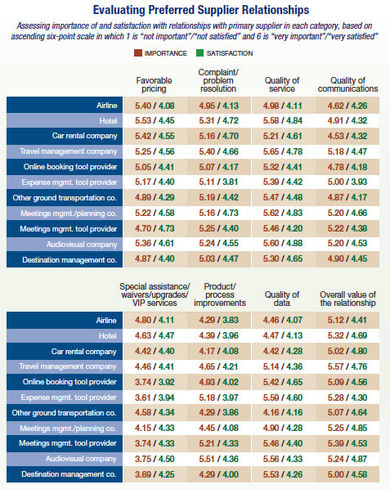
Meanwhile, with few exceptions, the aggregate level of importance placed on eight components of preferred relationships with the 11 listed supplier segments was greater than the level of satisfaction reported by survey respondents.
What's most important? Of the seven measures garnering an overall importance score above 5.5 points on a six-point scale, four were for quality of service. Also rating highly were favorable pricing from hotels and the value of relationships with travel management companies.
Who does well? Satisfaction levels for five of the eight categories were highest for audiovisual companies.
Whose performance falls short, short, comparatively speaking? Airlines received the lowest satisfaction levels in four categories. Meanwhile, across all findings are eight instances of the aggregate level of satisfaction falling below a 4 on the six-point scale. Half were for expense management tool providers and, overall, half were in the area of product and process improvement.
When supplier performance falls short, some organizations levy penalties. Among represented companies in the Travel Procurement and Meetings & Conventions survey, nearly three in 10 indicated that penalties are applied when TMCs miss agreed-upon service-level agreement targets. Among the $1 million-plus T&E crowd, more than one in three said as much.
When monitoring contractual performance by airlines, hotels and car rental companies, represented organizations are much less likely to use penalties than they are with TMCs, and for those supplier segments are more likely to use rewards for performance that meets or exceeds expectations.
A key part of SRM can be sharing with suppliers feedback from travelers and/or meeting attendees. More than eight in 10 survey respondents said they do so, including more than nine in 10 among those representing organizations that spend more than $1 million annually on T&E. Across the survey base, informal feedback and post-trip/post-meeting surveys are the most popular means.
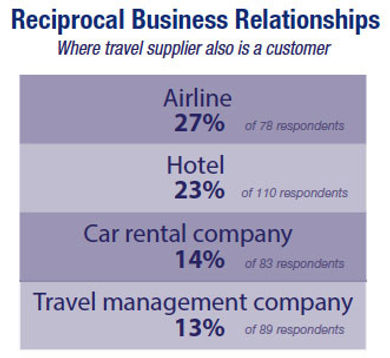
Reciprocity also can be a key component in instances when an organization's supplier also is a customer. About a quarter of respondents indicated such relationships with airlines and hotels, and fewer with car rental companies (14 percent) and travel management companies (13 percent). -- D.J.
Estée Lauder's Meetings, Transient Ties Not Cosmetic
When Cindy Shumate left Estée Lauder two years ago, leaving behind her position as executive director of global travel and meetings, she also left behind a centralized system where meeting planners and travel managers could cross-reference information to negotiate better deals for the whole company.
Technology and tracked spending were the keys to building the system. "We had a special credit card for meetings to separate that spend, which made it easier to get specific reporting," said Shumate, now the travel program manager for Princeton University in New Jersey, working to consolidate its scattered travel spending and starting to look at the school's meetings, as well. "Then we started using technology and ended up using [meetings technology provider] Cvent's full capabilities, including their [requests for proposals]. Wewere able to get meetings availability back in 24 to 48 hours- and we were beginning to be able to monitor which hotels were our best meetings partners."
As Estée Lauder's transactions became more centralized, Shumate noticed that the hoteliers were happier, as they dealing with the same contacts on her staff instead of with multiple administrative assistants.
"It becomes a smart negotiation if everyone knows what terms like attrition and cancellation mean," she said. "We were finding that it was a more efficient process. We got feedback from the hoteliers that they were relieved; they didn't have to explain how this worked every time." Also, if her staff needed a concession during a negotiation, their hotel contacts, with solid meetings and transient-travel numbers at their fingertips, could see how much business the company was bringing each year and were more open to talking about adjustments.
As the process became more mature, Shumate asked the hotels Estée Lauder used not just for the transient numbers but also group room details and reports on how much was being spent on food and beverage for meetings. "I wanted to see our worth to the hotel on the bottom line, because we had a lot of choice on how we spent our group dollar," she said. "If our preferred partner was interested in growing our transient numbers, it was worth being able to show our total value during the rate conversations."
The information Shumate compiled helped separate the wheat from the chaff on both the meetings and transient sides. Some hotels were strong options the transient business, but less so for meetings-perhaps the location was less desirable or the property didn't have enough event space-or vice versa. That information helped her in all her negotiations. -- S.B.
Managing Meeting Supplier Relationships
Doing it well can benefit event quality -- and the bottom line.
In an ideal world, corporate meeting planners and their travel manager counterparts would work together every day, sharing such supplier data as actual annual companywide room nights, so both departments would have bottom-line numbers to use in their respective negotiations. This reality only exists, however, in organizations with solid, centralized management systems for both departments, and the penetration of these programs on the meetings side still hasn't gotten very deep. Which begs the question: Why?
No C-Suite Buy-In Detracts
"There's a lot of talk in the industry as to why strategic meetings management programs or meetings management is not consolidating as quickly as it did on the travel side 15 to 20 years ago," says Shimon Avish, a strategic meetings management consultant. "One of the main reasons we see for that lagging is that meeting managers are having trouble convincing leaders of the value of the programs in terms of potential savings to the company, and in terms of risk mitigation for those associated with corporate meetings."
The lack of support from above for centralizing meetings data is hampering how well Robin Tenpenny can leverage the dollars her company, LifeWay Christian Resources, shells out to hotels each year for the travel and meetings involving its 4,000 employees. "I struggle with convincing someone to track the meetings spend," said the manager of travel and administrative services for the Nashville-based corporation. "And as much as I think it would be fascinating to know how much we spend, I'm not sure we would change our processes. I'm not sure what benefit we would get."
The company a little more than a year ago hired a third party, Arrowhead Conferences and Events, to handle management of training events and larger meetings that require citywide room blocks. But even with data now being compiled by Arrowhead, too much of the rest of LifeWay's travel and meetings spend isn't tracked, Tenpenny said, making it hard to identify suppliers that are being used over and over.
Tapping Into Preferred Hotels
Even with a strong travel program in place and preferred hotels identified, Avish says he doesn't see many organizations make much use of those preferred relationships on the meetings side. "One of the reasons for that probably is that meeting managers have been so busy building their SMM programs, adding in the preferred suppliers falls to a lower level," he says. "It takes two to three years to build the SMM program, and only then can they start to build a preferred supplier program."
Avish said existing technology isn't quite right for this step: "For meetings, there is no global distribution system where rate history and so on can be tracked, as with transient-travel data. In the meetings world, we have islands of data held by individual companies or the technology firms, so benchmarking is difficult."
Also, he said, there are no agreed-upon standards for how spend elements should be measured. "One of the best examples of that is, how do we arrive at a common definition of daily cost per person, per day? Every system tracks the inputs into that formula differently, so it's very difficult to arrive at a common metric that can be used to track across industries, like-sized events and so on."
Strategic meetings management expert Debi Scholar said planners should push into the process. "I encourage planners to meet with the transient-hotel account executives along with their own organizations' travel managers to identify what is possible in terms of gaining discounts or value-added services. Even small to midsize companies will benefit by leveraging their total spend with hotel properties."
Scholar said it is best for larger companies to leverage the total transient and group spend at the global-account level. "It is possible to obtain annual discounts and value-added services for the most frequently used transient and group properties, while still allowing sourcing professionals to negotiate when a new meeting arises," she said.
"It always makes sense to manage your spend and to have visibility," said Cindy Shumate, travel program manager at Princeton University in New Jersey and former executive director of global travel and meetings at Estée Lauder. "I have this little mantra: If you can measure it, then you can monitor it, and then you can make decisions about it. When you can say, 'Our locations in five cities are near a Hilton,' not only can you negotiate on a property level, but you can bring it up to the brand level."
Letting The Guests Speak
Planners should survey their attendees regularly and always use that data to improve services with their hoteliers, said Scholar. Otherwise it's wasted effort.
Avish agreed. "This is very valuable insight that we're not getting anywhere else," he said. "Unfortunately, these results are very fragmented, with surveys being conducted by the client, the meetings management company and the hotel itself. But meeting managers should be gathering the information, evaluating it and sharing it with suppliers to shape negotiations. I've actually seen feedback data used in chain negotiations, where a meeting manager had the information at their fingertips and provided it back to the supplier, who became a little more forthcoming in concessions." In that instance, survey data showed that attendees complained vociferously over high charges for using Wi-Fi, and the meeting manager was able to show through the survey results just how many people were dissatisfied. The rate was adjusted during chainwide negotiations for the next year.
Kathleen Zwart, who in September 2012 added travel management tasks to her meetings duties at Blue Cross Blue Shield of Florida, focuses on hotel negotiations for both transient travel and meetings. In a few instances last fall, feedback from sales-agent training programs turned up some challenges, and changes have been promised by the properties involved before the organization will return. "I will provide both negative and positive feedback to a hotel, she said, "but our company has no formal way to give the information back to the hotels." -- S.B.