It's no secret that a good diet and exercise are key to a healthy lifestyle. But experts say they're also important elements of productive meetings. "Wellness has a positive impact on the mind," notes Sean Anderson, vice president of operations for Sodexo, a provider of food and conference-center management services. "Busy planners find it helps increase their attendees' engagement and productivity, ultimately leading to better results."
A growing number of conference centers are noting that connection and finding new ways to help groups put wellness on the meeting agenda.
The Meetings Connection
"The way in which effective meetings are defined and measured now has changed dramatically," notes Anderson. "If you can't put a finger on specific outcomes and productivity, there's a question as to whether that meeting will happen at all."
Health and wellness play a key role in encouraging that productivity, notes Karen Ansel, MS, RD, a spokesperson for the Academy of Nutrition and Dietetics and co-author of The Calendar Diet: A Month by Month Guide to Losing Weight While Living Your Life (Lightning Source Inc.). "Nutrition is critical for overall wellness," she says. "Studies show that the foods we eat directly impact our brain health, determining how clearly we think, how much energy we have and even how happy we are." (See related M&C article, "Brain Food Comes to Meetings.")
"For example," Ansel continues, "focusing on foods that are digested slowly, such as protein, fiber and moderate amounts of complex carbohydrates, can help keep blood sugar levels on an even keel, giving you more energy and helping you focus more efficiently. Staying hydrated and eating more protein can fight fatigue."
Wellness also is about team building, says Moses Debord, general manager of the High Country Conference Center in Flagstaff, Ariz. "Getting your group to relax together helps to build that team environment as much as it does attendees' individual well-being."
Adds Ansel, "If you're cranky or lethargic because you skipped breakfast or are coming down from a sugar high from that donut you ate, you're not going to be a very effective team member."Designed for wellness
At some conference facilities, wellness begins with the very design of
the building. In Aspen, Colo., the Doerr-Hosier Center, part of the
Aspen Institute (a leadership think tank), was built in the iconic
Bauhaus style, known for its focus on soothing clean lines and Zenlike
simplicity. In addition, the LEED Gold-certified center features
floor-to-ceiling windows with majestic mountain views.
But perhaps most refreshing, notes Doug Crawford, director of sales for
the on-site 98-suite Aspen Meadows Resort, is that the restaurant and
conference buildings are separated by outdoor space -- meaning that
attendees must go outside for breaks.
"You have to walk all the way across the property," says Crawford about
the complex, which has a combined total of 22,000 square feet of meeting
space. "It's only a couple hundred yards, but it was designed that way.
And it's great because when people walk together outside, they network
and bond. In an elevator, you don't talk; you barely make eye contact."
Mary Ann Johnson, Ph.D., national spokesperson for the Bethesda,
Md.-based American Society for Nutrition (nutrition.org), agrees that
physical surroundings can have significant impact on one's health and
wellness, adding that good lighting -- including natural light -- is
key, as is moderate exercise. "Be sure to schedule in a 30-minute
exercise break, and call it such to remind us to take a walk, even if
only on the hotel grounds," she advises.
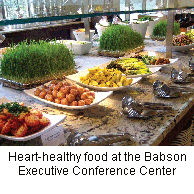 Danny Wisel, corporate executive chef for FLIK Hotels and Conference
Centers, adds that these breaks can include simple in-room activities
like stretches, arm circles or jumping jacks -- a favorite at FLIK's
Babson Executive Conference Center in Wellesley, Mass.
Danny Wisel, corporate executive chef for FLIK Hotels and Conference
Centers, adds that these breaks can include simple in-room activities
like stretches, arm circles or jumping jacks -- a favorite at FLIK's
Babson Executive Conference Center in Wellesley, Mass.
Scents make sense
At the Millennium Centre in Johnson City, Tenn., which offers 25,000
square feet of conference space, the menu has been revamped to reflect a
holistic approach to health and well-being -- with an accent on the
sense of smell. "Aromatherapy can be an important part of adding
wellness to a meeting," says Ken Misterly, the property's general
manager. "Engaging all the senses wakes up the brain -- it engages the
cognitive reasoning side, and people can better retain messages from the
meeting. So, for example, we might add applewood smoking to grilled
chicken to add the aroma.
"Sometimes it's hard to relay that value to a meeting planner," Misterly
concedes, "but after the second, third and fourth meeting, they really
see it."
High-tech calorie check
Sodexo recently debuted a new conference wellness program called
Mindful, which Sean Anderson says will be in all of its 17 conference
centers by this spring. Mindful incorporates smart menu choices and
gives attendees access to nutritional information, thanks to a
partnership with mobile app MyFitnessPal. The placard for each dish is given a barcode, which
attendees can scan using the MyFitnessPal app, which downloads nutrition
information and connects to MyFitnessPal.com to allow users to track
calories.
If desired, MyFitnessPal also will sync with online information from
attendees' personal FitBits -- another name for wireless pedometers that
track movement, fitness, diet and sleep patterns -- to provide a
360-degree approach to wellness.