(Pictured) Swan song: ASAE's 40-year-old Springtime event is being replaced next year.
The meetings industry, like so many other sectors, is in a time of rapid change. Our own professional associations are leading the charge, killing tired events, testing new technologies and amping up engagement techniques. The result is a live laboratory designed to keep attendees on the cutting edge.
Many credit the influx of Millennials in the workplace with pushing the meetings envelope.
"Where I think Millennials have expedited the journey is that they are more comfortable with the technology and the pace that has evolved," says Mark Cooper, CEO of the International Association of Conference Centres. "Soon, I think we'll be in a completely different environment. It's going to be a fun five years."
Here's how some industry organizations are upping their games.
ASAE: New show
At the opening of the American Society of Association Executives' annual Springtime Expo in April, ASAE president and CEO John Graham IV, CAE, announced that the 40-year-old event was being retired, and a new conference, the Xperience Design Project, or XDP, will be introduced next May at the Gaylord National Resort & Convention Center at National Harbor, Md.
"We could have ridden it out for a couple more years," Graham says of Springtime, which had struggled with declining attendance and booth sales in the years following the 2008 economic downturn. "We weren't losing money, but we didn't want to be associated with a dying event, because it hurts all of our events."
ASAE wants XDP, developed with design partner 360 Live Media, to be 100 percent interactive. On the first day, sessions in The Lab will offer six key topic areas around meeting trends: location; technology; experience strategy, design and production; performance metrics and ROI; marketing, and curriculum. On the second day, findings from day one will be presented in a TED Talk-style recap, and attendees will participate in the Business Exchange, one-on-one conversations with industry partners. Following the show, a white paper will recap topics, ideas and solutions for the association community.
The one-on-one exchange is not to be confused with hosted-buyer events like those popularized by the IMEX shows, where meeting planners are invited to meet with suppliers. "Most associations are not quality hosted buyers because they don't have enough business," says Graham. "They're not like corporate buyers, who are procurement buyers; associations buy on relationships. We are going to give industry partners and buyers an opportunity to be together in a more intimate way, solving problems and, not coincidentally, building more relationships."
ASAE is testing the inaugural XDP show at the Gaylord National to tap into the Washington, D.C., association market; the event could then be taken to other association-rich markets, such as Chicago.
MPI: New learning
In February, Meeting Professionals International used a Danish concept called Meetovation to shake up the design of its 400-person European Meetings & Events Conference in Copenhagen, Denmark. Nontraditional seating options and setups marked the general sessions and breakouts, and speakers focused on spreading their messages by telling their own stories.
"From a customer and learning experience, we had our highest ratings ever," says MPI president and CEO Paul Van Deventer. The concepts worked well enough that the association employed them again at the much larger World Education Congress, which attracted some 2,000 attendees to Harrah's Atlantic City's new Waterfront Conference Center in June. The general sessions featured comedian Dena Blizzard as emcee; Mike Shea, executive director of South by Southwest, told his planning stories, and other singular speakers wowed the crowd.
Van Deventer feels, however, that general sessions are becoming less of the focus of MPI's main events. "It's the interactive elements that people are looking for, where colleagues can share together," he says. "We're trying to break down into smaller elements and do a lot more tracks and segmented learning. We're trying to give more focused learning experiences."
MPI, which currently has about 17,000 members, also has been bringing its classroom to other industry events. For instance, the association provides education for IMEX America's Smart Monday and is offering a course at Northstar Meetings Group's Destination Florida hosted-buyer event next month. "Our goal is to reach the broadest community possible within the industry and be as inclusive as possible," says Van Deventer. "The more we can raise the overall professionalism of the industry, the stronger our position to advocate becomes."
Fundamental Changes
Two industry groups have made big announcements this year.
Beginning in 2018, SITE (the Society for Incentive Travel Excellence) will hold its annual Global Conference in January, an event that traditionally was held in the fall. The decision means the group won't hold the conference in 2017. The 2016 gathering still will take place Nov. 5-7 in Panama City, Panama.
"The timing in the fourth quarter is really congested," says Kevin Hinton, SITE's chief excellence officer. "We decided to hold this conference right before the incentive season starts in late January, starting in 2018 in Rome."
The organization also has introduced a new event, the Incentive Summit, to be held in the United States every year.
Meanwhile, in May, the International Special Events Society changed its name to the International Live Events Association. The 5,000-member organization administers the Certified Special Events Professional designation; its main conference is ILEA Live, taking place this month in Austin, Texas.
DMAI: New theme
Destination Marketing Association International saw many changes in the first part of this year as it welcomed its new president and CEO, Don Welsh, and realigned its staff. The organization also revamped its annual convention, held Aug. 1-3 in Minneapolis, with the theme, "It's a Brand New Day."
With the event just weeks away at press time, Welsh -- former CEO of Choose Chicago, who joined DMAI in April -- offered a preview: "We gathered a lot of member feedback in determining the direction of the event. The most prominent feedback we received is that the association hasn't adapted the annual event to engage our members the way they want to be engaged."
Using survey results from last year's meeting, held in Austin, Texas, and borrowing ideas from cutting-edge events such as South by Southwest and SalesForce.com's Dreamforce, DMAI set out to bring more energy and engagement opportunities to its offerings.
According to Welsh, plans for this year's meeting featured dynamic general sessions, extra space for networking and an overall energetic atmosphere. The association also upped the number and variety of sessions and formats. "We heard loud and clear that members want more education tracks specific to their disciplines," Welsh notes.
In the end, Welsh hopes DMAI members will come away with a renewed sense of enthusiasm for the association and the industry at large.
IACC: New styles
The International Association of Conference Centres was founded 1981 as a consortium of purpose-built meetings facilities, most of which were residential centers with guest rooms supporting the meeting rooms. The nature of the 385 member facilities (in 22 countries in the Americas, Europe and Australia) has been changing in the 21st Century, and the organization is working to welcome those changes.
Longtime attendees to the IACC-Americas Connect Annual Conference saw tradition thrown out the window at the 2016 meeting, held in New York City in April. Attendees could stay at any hotel they liked, rather than gathering at a single center and paying a set price for the typical IACC complete meetings package, calculated to cover all the aspects of the event from guest rooms to F&B and A/V. The sessions took place at two Convene day centers in Manhattan, a few blocks apart, and the closing event was held a cab drive away at Chelsea Piers.
"Providing people the opportunity to book housing that was affordable ties into our desire to bring new contacts to the association," says IACC's CEO, Mark Cooper. "We count on the same people coming every year, but we needed to bring in new faces." The strategy worked: The 30 percent growth at the conference, which hosted about 250 people this year, was mostly from first-time attendees.
The association also used multiple venues for the IACC-Europe Knowledge Festival in Italy last year. The host venues were Châteauform La Cascina Erbatici, a reimagined farmhouse south of Milan, and Châteauform La Villa Gallarati Scotti, an 80-room villa north of Milan.
"The objective is to get people to connect for one day, one evening or three days, whatever it might be," Cooper explains. For the New York event, to encourage interaction that might otherwise have taken place in the restaurants and corridors of a residential conference center, three bars near the Convene facilities had VIP lounges set aside for the group. As for education, the Americas meeting featured more campfire sessions and shorter classes, keynotes and awards presentations.
"Time is precious, so we have to find a way to make our events more accessible," notes Cooper. "Duration was one of those ways, as well as opening up to day registrations, which was not done previously."
PCMA: New layouts
The Professional Convention Management Association is in an enviable position: About 60 percent of its more than 6,500 members attend its main conference, Convening Leaders. The association's president and CEO, Deborah Sexton, cites a willingness to reinvent and take risks as the reasons the conference is so successful.
"Years ago, we realized that there's a tremendous amount of competition for our members' time," Sexton says. "It became very clear that this event had to continue to evolve to remain the place to be the second week in January."
One ongoing experimentation involves open-space learning -- using nontraditional meeting areas and innovative seating arrangements -- first tested at the 2011 event in Las Vegas. The space configurations change every year, as does the content focus and the technology. "This can be a demonstration environment, smaller sessions, smaller conversations about trends and issues," notes Sexton. In Vancouver, British Columbia, this past January, some sessions that drew about 125 people were crowd-sourced.
With risks, not everything has been a success. Last year in Chicago, three small stages were set up too close together; that fact and a hard floor surface made for a very noisy time. "We could have used the exact same space and demonstrated headset technology on the middle stage, where the speaker's comments only go to the headsets of those in the audience," says Sexton. "It's a great technology if you have limited space to control the sound."
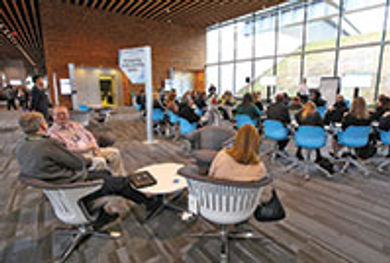 Foyer time:
PCMA's open-space
sessions in Vancouver
Foyer time:
PCMA's open-space
sessions in VancouverThis year, open-space learning took place in the Vancouver Convention Center's concourse area on two floors. "We gave attendees advance notice; otherwise they'd probably still be wandering around," says Sexton. Using drones, the organization made a video of the show's layout, which was shown during the opening general session
Another change: Instead of keeping the general session space constantly set up for 4,000 -- and therefore empty most of the time -- partition walls were used to create two 900-seat rooms for thought-leaders sessions, and a third space was reserved for general-session rehearsals.
"I liked the smaller rooms and group sizes," says Beth Cooper-Zobott, director of conference services for Equity Residential and a first-time Convening Leaders attendee. "I like the way they used prefunction space for small breakouts, demos and discussions."
Another innovation that has become a PCMA standard is setting up satellite registration desks at all the host hotels. A small registration area is available at the convention center for people who aren't staying in the official hotels or are attending just for a day.
The ultimate objective, says Sexton, is "to create something that your members can't afford not to be at."