Celebrity chef Jamie Oliver is on a mission to change the way we eat -- at home, at school, in restaurants and during meetings. Our meals and snacks should be wholesome and nutritious, beautifully presented and delicious. And when the agenda calls for concentration and learning, we should eat foods that boost brainpower.
It's a concept that's quickly gaining traction here and abroad. The so-called "brain food" movement is based on a growing body of scientific evidence that mental factors like mood, motivation and intellectual performance are powerfully influenced by diet. This has clear implications for meetings, suggesting that F&B can play a role in forwarding a group's goals and agenda.
Many hotel companies not only are buying in, but revamping their banquet menus to make it easier for meeting planners to make smart choices. Scandic Hotels, which has 160 properties throughout Northern Europe, enlisted Oliver, host of ABC-TV's Jamie Oliver's Food Revolution, to tweak its group offerings last year. "Soups with fresh, seasonal vegetables; salads with different dressings and fruit -- each menu is designed to be created by the guests to their individual taste," Oliver explains. "That encourages interactivity and communication, being together. Thus, a meeting can become even more productive."
Certain foods produce chemicals in the body that can be building blocks for neurotransmitters, explains Andrea Sullivan, president of BrainStrength Systems, who speaks on topics relating to the complexity of our gray matter. "Neurotransmitters are keys to how we're thinking, how we're feeling."
In other words, feeding the brain well throughout the day can lead to better learning. We've all been in midday sessions when our focus is shot and we struggle to absorb information. Planners can help eliminate that crash by careful menu selection to improve attendee concentration, ultimately enhancing the effectiveness and ROI of the meeting. And that means rethinking breakfast, lunch and breaks.
Drowsy vs. alert A number of our biological processes are at work throughout the day that can be enhanced or blocked by tweaks to what we eat, depending on the goal of the gathering.
For instance, according to Sullivan, studies of diabetics have shown that everyone benefits from steady blood-sugar levels, and eating complex carbohydrates (whole grains and many fresh fruits and vegetables, combined with protein) helps maintain those levels. When learning is paramount, so is the necessity of keeping glucose levels on an even keel. Sullivan cites a study by the University of Nottingham in the U.K., in which children who ate complex carbs (in the form of oatmeal) performed better on tests throughout the morning than their counterparts who were served a white-flour breakfast or no food at all.
Some ways to choose foods that support meeting goals:
• Balance blood sugar. Eating sugary foods and those made with white flour, like Danish and doughnuts, pumps blood-glucose levels up fast and high, followed by a huge drop below normal. "That's when you feel really drained and can't think straight," says Sullivan.
"People often don't get it that mental work requires energy, it uses up blood glucose," Sullivan explains. "Even though we're doing nothing 'physically,' our blood sugars drop and we feel listless. The key is to eat foods that enter the blood stream in a slower, stable way, and to eat a little bit about every three hours to maintain level blood sugar all day long."
• Rethink meats. Some foods, such as red meats and turkey, produce tryptophan in the brain. This is a building block for serotonin, which gives us a sense of calm and well-being -- great for after dinner and for team building, when attendees need to cooperate in a generous way, but a poor choice when the group still needs to learn and retain information.
Tryptophan also is a factor when you eat more carbohydrates than protein, says Sullivan. "But if you have more lean protein than carbohydrates, that will provide tyrosines, amino acids that serve as building blocks for dopamine and epinephrine, which are neurotransmitters that stimulate the brain and bring clarity of thought." (See page 36 for breakfast and lunch ideas to elevate energy.)
• Go easy on fats. Processing fatty foods taxes the digestion and makes us tired, so it helps to keep desserts light and small. A small portion of dark chocolate mousse, for example, is tasty and offers chocolate's ability to improve cognition and mood, among other benefits.
Jamie Oliver Plays with Food
When star chef Jamie Oliver
was tapped to update menus for Scandic Hotels, he first revamped the
children's food, introducing a creative concept that let the kids
construct their own meals from wholesome ingredients. Soon, the idea was
extended to meeting menus.
Oliver, whose banquet expertise
includes preparing organic Scottish salmon and slow-roasted shoulder of
lamb for President Obama and his global colleagues at the G20 gathering
in 2009, recently shared some of his food philosophies with M&C.
What were the most glaring problems with Scandic's former banquet menus?
There weren't any, really. But they wanted to offer something a bit
special for certain customers. It was really a question of taking what
was there and adding to it. [To view some of Oliver's conference
concepts, go to
bit.ly/kPxplj.]
How did you then approach the conference offerings?
For meetings, it was all about food that wasn't too heavy and loaded
with sugar. We've all been in meetings where it's hard to stay awake,
and it's even harder after a carb-filled lunch. So we focused on
delicious soups and slow-release energy foods [complex carbs and lean
meats].
How do you deal when creating a dinner for 1,000?
You have to think in terms of what can be prepared earlier and then
served quickly so the actual plating-up is in effect just like a
production line. Everything has to be ready at the right time, of
course, but it's easier if you choose a menu that allows for advance
preparation.
Chains embrace change The idea that brain-friendly foods produce better meeting results has not been lost on major hotel companies.
• Hyatt Hotels & Resorts.
"We use fewer sugars and white flours, and more whole grains, fiber and
protein to keep you going," says Steve Enselein, vice president of
catering and convention services for Hyatt Hotels North America. "At
lunch, smaller portions are in order, using chicken and fish. Also, a
lot more people are willing to have a vegetarian option one day during
the program."
For banquet menus, "We've moved away from 80-page
lists of everything we serve," Enselein notes. "We're offering seasonal
menus of locally sourced products and encouraging our chefs to find
products at the peak of freshness."
 • Loews Hotels & Resorts.
Planners who choose Loews start from a basic menu and use "chances to
enhance" items. "Our breakfast options allow you to add an omelet or
antioxidant yogurt station, organic cereals or a smoothie station, where
chefs talk to attendees about which foods will help keep them focused,"
says Geneya Sauro, director of F&B for the Loews Ventana Canyon in
Tucson, Ariz.
• Loews Hotels & Resorts.
Planners who choose Loews start from a basic menu and use "chances to
enhance" items. "Our breakfast options allow you to add an omelet or
antioxidant yogurt station, organic cereals or a smoothie station, where
chefs talk to attendees about which foods will help keep them focused,"
says Geneya Sauro, director of F&B for the Loews Ventana Canyon in
Tucson, Ariz.
Another way to boost creativity and stave off
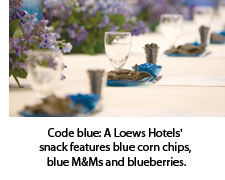
hunger: Loews' Color Breaks. At every attendees' spot in the meeting
room are three small colored dishes holding same-color foods. For a
morning break, blue bowls might be filled with blueberries and
mini-blueberry muffins; the yellow break offers diced pineapple and
lemon corn-bread muffins; the green break features Granny Smith apples,
peanut butter and green M&Ms.
In addition, "Every hotel has
partnered with a local organic, sustainable farm, so the products are as
healthy as they can be," says Sauro.
• Marriott International.
"We have some breaks that are about energy, with more complex
carbohydrates, whole grains, fruits, vegetables and antioxidants," notes
executive chef Brad Nelson. "Groups are moving away from the 3 p.m.
chocolate-chip cookies, the break that puts everybody to sleep by 3:30."
In
main dishes, items like whole-grain pasta and barley risotto are
replacing dishes with sticky-sweet glazes. "We try to keep it so meals
are not high in fat and certainly not saturated fats," says Nelson, who
blogs at chefblog.marriott.com. "It's not a trend," he adds. "People are
changing how they eat and how often they eat. We have some groups who
want to get away from three meals
a day to almost a series of breaks."
• Omni Hotels & Resorts.
Three years ago, Omni introduced the food element of its Sensational
Meetings program. Developed with the Culinary Institute of America, the
offerings are broken into themes -- energetic meetings, challenging
meetings and recognition meetings -- and allow the planner to customize
their attendees' experience.
For energetic meetings (e.g.,
brainstorming, planning and training sessions), stimulating flavors such
as ginger, horseradish and rosemary are offered, along with specialty
drinks like orange-zested cranberry shooters and vitamin waters. For
challenging meetings, often about transition or negotiation, Omni chose a
relaxing palate of foods such as sushi, herb-roasted chicken, aromatic
teas and cinnamon-spiced apple shooters. Honoring accomplishments with
recognition meetings means celebratory foods: basil and pine-nut
tortellini salad, tricolor orzo and ancho sugar-cured beef tenderloin,
accompanied by champagnes and other sparkling beverages.
• Radisson Blu Hotels.
This brand's properties in Denmark and Norway offer a specific Brain
Food program for meetings, which will be expanded to Sweden this summer
and Finland in the fall. Principles followed include lots of whole-grain
products, fruits and vegetables; pure ingredients with minimal
industrial processing; less meat; never more than 10 percent fat
content, and the use of natural sweeteners.
The change has been
well received, says Ole Sorang, director of regional marketing, Nordic
countries, for Rezidor Hotels, which includes Radisson Blu properties.
"After all," he notes, "if a group is spending $100,000 on a meeting and
you serve the wrong food, you have 500 people coming back on Monday
morning who don't know what they were supposed to learn."
• Scandic Hotels.
Jamie Oliver's contributions to group menus include Jamie's Energy Bar,
a homemade cereal, nut and fruit bar. For the soup and deli buffet, a
variety of soups are set out with a number of toppings so attendees can
mix and match their lunches. Breaks feature fruit salads, again with a
number of toppings to spice up the bowl.
• Westin Hotels & Resorts.
Working with a team of doctors, nutritionists and scientists, Westin
has concocted a break program that leans heavily on fruit, vegetables,
grains and proteins, including avocados, walnuts, honey, blueberries and
wild salmon. Morning-break items might include orange-mango-cranberry
smoothies; smoked salmon, avocado and chives on whole-grain bread;
apple wedges with a bee-pollen yogurt dip, and almonds. A restorative
afternoon break could feature a "tutti-frutti" with dark chocolate
chips, popcorn, walnuts, almonds, dried cranberries, raisins and
apricots, or minted orange and green apple salad topped with a dollop of
cinnamon yogurt.
On the dinner plate The
rules ease at night. "Dinner can be more traditional because it's the
end of the day, people can relax, and we don't have after-dinner
meetings," says Andrea Sullivan of BrainStrength Systems. "You can serve
red meat, lamb. I would still keep it healthy and present the desserts
in small portions so people can take a taste of this and a taste of
that."
Sullivan's advice to planners looking to get in on the
revolution: "Don't go crazy; just make small changes. Start with new
options and minimize the bad foods. Shift the balance a bit."
