Compressed for Time
As lead times for corporate events continue to contract, so does the request-for-proposal process, often eliminating the formal back-and-forth altogether.
"About 70 percent of what I'm working on is so last-minute, no more than 30-to-60 days out, typically," says Kelly Williams, CMP, senior event planner for Walgreens in Deerfield, Ill. Placing meetings these days for the drugstore chain involves an introductory e-mail and a follow-up phone call.
The good news is Williams has plenty of meetings to plan. "Meetings travel stopped in 2008, and from 2008 to 2009 there was really no meetings travel at all," she says. "It picked up when some positions were filled, and the meetings we're doing have picked up. But the audience is smaller."
Williams is required to approach at least three hotels for each event, and she's created a spreadsheet to pop her responses into. Luckily, she's hearing back from the hotels in time. "Twenty-four hours is the maximum lately for a response. Since the turnaround is so quick, the hotels need a decision, too," she says.
For about 50 sporting events each year, the national arm of the Leukemia & Lymphoma Society's Team In Training sends hordes of runners, triathletes and cyclists to fulfill their fundraising promises. For instance, about 6,000 women (and a few men) head to San Francisco each fall to run in the Nike Women's Marathon, for whom the LLS planners arrange about 3,500 rooms. In 2009, those athletes stayed in 11 hotels. But the year before, when San Francisco was hosting a citywide convention at the same time, Randi Willmann, an event and meeting manager for the society, helped block rooms for LLS runners at an astronomical 43 hotels. Booking those properties took a lot of juggling, especially during the request-for-proposal phase.
"There are four of us managing the event," says Willmann, who is based at the society's home office in White Plains, N.Y. "Each of us had between eight and 15 hotels to manage. We handled the RFP process through the chains' national sales offices, but for independent hotels, there was a lot of research on Expedia and Google."
In the RFPs Willmann prepares, she's not afraid to ask for numerous concessions, a hallmark of the process in the current economy. Planners also are sending out more detailed RFPs to make sure they get exactly what they want. For some, it's a hotel with plenty of rooms available on the desired dates, an attractive rate and all the free function space the group needs. Others might prioritize subtle service elements, location or security. Winnowing down the choices starts with a well-built RFP and quick turnaround from the hotels.
Prep work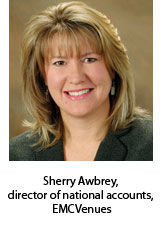 Before beginning the RFP process, planners should take a mental walk through the day-to-day needs of the meeting. That's the advice Nancy Crook and Sherry Awbrey, both directors of national accounts for EMCVenues, a site-selection and meetings education firm, imparted to attendees of the "Effective RFP Writing" sessions the company offered during its MEET events, held around the country last year.
"You want to understand all the specs," says Crook, based in New York City. She suggests planners get a firm handle on all meeting room and guest room requirements, food and beverage minimums, and any special needs before starting the RFP process.
This includes figuring out all the information you want back from the hotel -- in addition to dates, space and rates -- in order to make a final decision. "You want to be comparing apples to apples," says Crook. "You'll know that the average buffet price at each hotel is x, for instance, because you asked that question."
Fill in the blanks Now you're ready to fill out the form. Whether you use your own RFP, the hotel's or one from an online site-selection service such as the M&C Facilities Search, include the following basics.
• Details about your organization
• Information about the event and its purpose
• Who the attendees will be and whether they are required to attend
• Dates you are considering and whether they are flexible
• Number of guest rooms needed per night
• Meeting space needs
• F&B needs, including whether the meals will be plated or buffet and if there will be any special dietary instructions
• A/V requirements
• "Green" specifications
• Any special details you require
"Two key points I have seen that very much help us put together an educated proposal are the demographics and a quick overview of the organization," says Michael Dominguez, vice president of global sales for Loews Hotels. "You never know what correlation will come through when we're putting together the proposal. For instance, for a scientific program in Arizona, we found out that the organization had been involved in a NASA space program. At the time, the University of Arizona had been awarded a component of a NASA mission and was able to bring in a full-sized model of what the school was helping send to Mars. When you're trying to lock in a destination, you won't know such information unless you've helped us help you."
Depending on the event, you also might need to add specifics such as exhibit space requirements and special room setups, and requests for information about details such as occupancy tax, typical transportation costs, parking fees, renovation timelines and so on.
"One of my clients only wants to know the room rate, the exhibitor fees and F&B minimums," says Crook. "And I have others who want to know if there are ergonomic chairs, what the ceiling height is and the average F&B prices for each meal. It all depends on how complicated the meeting is and what information my client wants back in the proposals."
Awbrey, Crook's colleague, reminds planners to ask all the suppliers the same questions, so all responses are consistent. Also, if you are putting together RFPs for a series of programs, such as training sessions held around the country, create one form and just change the dates and destination from one event to the next.
A Note on Zero Attrition
Since some properties -- like Omni Hotels -- are offering zero attrition for meetings booked and held this year, this monumental concession is creeping into requests for proposals. The clause typically specifies that no penalty will be applied for a group that falls short of filling its room block, no matter how far off the mark.
"I have been getting zero attrition," says Louise Felsher, CMP, CMM, an independent planner in the San Francisco Bay Area and a contributing editor to M&C. The deal sometimes comes with a catch, though, in the guise of higher F&B minimums.
If zero attrition is part of the offer, read the other details carefully and make sure the resulting contract states that the only rooms you are going to be responsible for are those your group has paid for and occupied. "It's got to be specific," says M&C's legal expert, Jonathan T. Howe, Esq., founding partner of Howe & Hutton in Chicago.
Howe is not surprised planners are being asked to agree to higher F&B minimums as a trade-off. "Margins are much better in room revenue," he notes, "but in terms of dollars that I can collect if I'm a hotelier, I'll take it any way I can. I still have my debt coverage to meet, operating costs, all those fixed costs." For planners, he adds, "Make sure it's very clear what the scope of the offer is, what makes you eligible and what wording is in the contract. That wording is going to be key."
The hotel's perspective  In 2009, the
614-room Omni Fort Worth Hotel tracked more than 5,200 event leads,
about 20 percent of which were phone inquiries and the rest arrived as
electronic RFPs. If the Omni was the planner's property of choice, she
would have needed to send in a detailed RFP that answered all the sales
staff's questions in order to stand out. Such complete inquiries get
everyone's attention during the Omni's morning meeting, where Larry
Auth, area director of sales and marketing, goes over every new lead
with his team.
In 2009, the
614-room Omni Fort Worth Hotel tracked more than 5,200 event leads,
about 20 percent of which were phone inquiries and the rest arrived as
electronic RFPs. If the Omni was the planner's property of choice, she
would have needed to send in a detailed RFP that answered all the sales
staff's questions in order to stand out. Such complete inquiries get
everyone's attention during the Omni's morning meeting, where Larry
Auth, area director of sales and marketing, goes over every new lead
with his team.
"You go back 10 or so years, when I had the same
size staff, and we were receiving a quarter of the leads," Auth recalls.
Unfortunately, he reports that most of the RFPs now coming to the hotel
present only about 50 to 60 percent of the information he needs to know
in order to determine out if the business is right for his property.
"It's hard for a salesperson," he says. "It looks bad that you have to
call the planner and ask questions, when you know they didn't want you
to call in the first place. To be put on their grid and move up in the
grid, we need to know what's more important to them, and it's hard to
know that without the data."
One detail Auth looks for that he
doesn't see often enough is whether the planner has any flexibility in
dates, an age-old complaint from the hotel world.
"We had a lot
of suppliers mention this in our sessions," says Awbrey. "Many times
there is no flexibility in dates, but if there is, that gives you some
leverage, and that can get you better rates."
Tell all? There was a time when
experienced planners preached about holding some meeting details and
needs -- particularly budget levels -- close to the vest. In fact, M&C
ran a story in 2001 called "Don't Tell All in the RFP."
Today,
that sentiment has changed somewhat. Many experts agree that more
details are better than fewer. "We include the rate we're trying to
achieve and why we're trying to keep it low," says Willmann of LLS,
"because when we save money, we're not just saving for the organization,
but for the participants who have to raise a certain amount of money to
attend."
Crook notes that some planners like to see what rate
the properties propose and negotiate from there. "But I find it works
better to be up front," she says. "If the hotel can work with you,
generally they will. If your budget is firmly $200 a night and you can't
go above that, why not share that? You allow the property to say,
‘We're not going to waste our time.' "
Coupling the planner's
rate needs with realistic F&B requirements also helps the hotel
sales staff determine if they can give a little on the rooms. "It's a
total revenue package we look at," says Dominguez of Loews Hotels. "If
you're spending heavily on F&B, then we have more flexibility in the
room rate."
Also, if every detail is stated from the get-go, the
negotiating process might take less time. In this world of
ever-shortening lead times, saving a couple of hours of back-and-forth
could mean a lot. "This way you start out with a good partnership," says
Dominguez. "The more you get out on the table, the better the
negotiations and the better the process will be for everyone."
Echoes
Crook: "Really, the more information you put in the RFP, the more
qualified proposals you'll get back, and the less backtracking you're
going to have to do down the line. If you know you're going to have to
bring 20 people in three days before the event, let the property know.
Otherwise you might find that the hotel is sold out those three days,
and where are you going to put your staff?"
Key Concessions
In asking a hotel for comps and freebies, what's reasonable
and what's out of line? The answer will be based, in part, on the size
and scope of your event. Also, ask for what's most meaningful to your
group, rather than issuing a laundry list of requests, suggest Nancy
Crook and Sherry Awbrey of EMCVenues. With those caveats, following are
perks properties often are willing to give.
• One comp room per
40 booked
• Complimentary meeting space
• Higher attrition
allowance
• Complimentary one-hour reception
• Special rate on
staff rooms
• Upgraded rooms at the group rate
• VIP amenities
•
Free parking
• Discounted Internet costs
Remember, you can
help the hotel agree to concessions by making some promises of your own,
like keeping all F&B events on property to up your group's spending
there.
Give and take In response to the
current
economy, a buyer's market if ever there was one, hotels have been
offering incredible extras to entice meetings into their spaces. The
concessions on planners' wish lists, such as complimentary rooms and
generous attrition rates, should be spelled out in the RFP.
The
standard for comp rooms used to be one room per 50 sold. "One for 40 is
more common now," says Crook. "And sometimes one for 35 and one for 25. I
just saw one come across my desk that was one for 10."
And the
attrition rate, a hard line at 10 percent in a seller's market (meaning
an organization had to meet 90 percent of its room block or face penalty
fees), now might be 20 percent, 30 percent or more. In other words,
your attendance can be off by quite a bit and still meet your
contractual obligations.
Most of the hotel chains have come up
with across-the-board offers that planners know to put into their RFPs.
For instance, Marriott International's Meetings Matter promotion states
that for each qualifying meeting of at least 50 cumulative room nights
booked after Jan. 1, 2010, and completed by Dec. 31, 2010, the host will
get a 35 percent attrition rate, one complimentary room for every 35
paid rooms and more. "My more experienced clients now know to ask for
these concessions," says Crook. "They're expecting the promotions."
Hyatt
Corp. has decided not to make a blanket offer across all properties,
allowing individual hotels to tailor proposals to their markets. "We
have been preaching to the sales team to put their best foot forward at
the start," says David Gauthier, director of sales for the Hyatt Regency
Denver at the Colorado Convention Center. "Because if you don't,
somebody else out there is and in this economy, you're not going to get a
second and third look. There is so much availability out there."
Still,
in the RFP, planners need to be realistic about what they can get for
the business they're bringing to the property. "Based on the size of
your meeting, you have to be very careful," says Awbrey. "If you have 20
people for two nights, you can ask for one or two concessions, but if
you have 100 people for two nights, you can ask for more."
And
planners should be willing to give back, too: "You could keep all your
F&B on-site," Awbrey suggests. "Anything you can keep on the
property makes your value greater."
Planners bringing large
numbers to town can ask for a lot. "We look for complimentary meeting
space for a staff and coaches meeting," says Willmann of the Leukemia
and Lymphoma Society. "We try to get one comp room per 40. We look for
discounts on A/V. We try to get some upgrades for our top fundraisers --
at the Nike Women's Marathon, our top fundraiser had brought in more
than $50,000. We look for free 800 and local calls in the guest rooms
and complimentary parking passes or a percentage off on parking. We look
for staff rates."
Willmann lists all the concessions in section
three of her RFP response sheet, allowing the hotel salespeople to
circle "yes" or "no." It's rare to have every "yes" circled, she says,
but typical to get 80 percent of the concessions. "We've been working
with some of these hotels for a very long time. They expect that's what
we're going to ask for."
In response The last piece of the RFP process is receiving the
hotels' responses.
Awbrey and Crook stress that planners should specify in their RFPs how
they want that information returned, such as in a spreadsheet of their
own design or an e-mailed packet created by the property. The benefit of
creating a response spreadsheet for the salesperson to fill out is that
all the responses can be reviewed side-by-side for an efficient
comparison.
The last piece of the RFP process is receiving the
hotels' responses.
Awbrey and Crook stress that planners should specify in their RFPs how
they want that information returned, such as in a spreadsheet of their
own design or an e-mailed packet created by the property. The benefit of
creating a response spreadsheet for the salesperson to fill out is that
all the responses can be reviewed side-by-side for an efficient
comparison.
It's also important to provide a response deadline.
"Some
planners find it hard to express their terms," says Crook. "It's
important to set the expectations. If you need to make a decision by a
certain date, tell the property what you need."
Salespeople try
to respond to planners within 24 hours, even if it's to note they're
working on the proposal. Ideally, an initial reply will be more
immediate.
"The days of taking 24 hours are long gone if you hope
to have any chance at the business," says Gauthier of the Denver Hyatt.
Auth at the Omni says his team has a turnaround deadline of two
hours to get back to the customer, even if it's just to ask a couple of
questions. "People hit send on their e-mail and expect an answer within
minutes," he says. "I hear from clients all the time about hotels that
don't respond at all. For a client who might only have a few days to
make a decision, a hotel that takes three to four days to respond has
lost that sale."