
Putting the "I" in MPI
Promoting cross-cultural knowledge is a must for Dallas-based Meeting Professionals International, which has more than 24,000 members in 84 countries. In this regard, the association offers the MPI CultureActive Tool, an online assessment and learning program, to help members better understand how to do business on a global basis across different cultures.
After answering a series of questions, members are shown where they fall on a triangle of cultural attributes. According to Didier Scaillet, left, MPI's Luxembourg-based vice president of global development, linear-active people, who tend to be hierarchical and rely on schedules (typically American, British, German and Swiss) fall on one point; another point comprises multiactive, often Latin, cultures (such as those of Argentina, Brazil and Spain) geared to relationships; the third point holds reactive cultures, which thrive on harmony and family (e.g., those of China and Japan). About 1,000 members have taken the assessment so far, reports Scaillet.
In addition, the tool offers profiles of 60 countries, featuring their histories, information on their economies and their core values.
MPI also has launched one-day workshops, called Meetings Without Borders, for planners who arrange international events. Seminars will be held in Washington, D.C., on Nov. 19; Chicago on Nov. 21, and San Francisco on Nov. 24. The cost is $49 for members, $99 for nonmembers. For details, visit
mpiweb.org. -- SARAH J.F. BRALEY
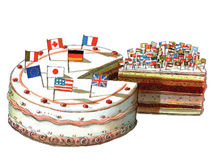 The world is a global marketplace, and even in a struggling world economy, meeting attendees from nations near and far will come to the United States. Clearly, catering to participants with varied languages, cultural traditions and ideas about conducting business can be a challenge. Following are some tips on how to make international delegates feel welcome.
Paving the way
Visas. "The biggest issue for international attendees is dealing with the visa process," says Tara Dunion, senior director of communications for the Arlington, Va.-based Consumer Electronics Association. Dunion plans her group's largest event in the United States, International CES, which this past January in Las Vegas drew 130,000 delegates, of which about 25,000 arrived from 140 countries, including Australia, Fiji and Monaco. "We try to provide as much assistance as we can on our website to promote the process," she notes. "Our message is to apply early."
Indeed, planners should see to it that international registrants have access to applicable visa regulations several months prior to the meeting dates to ensure adequate processing time.
Generally, international attendees fall under one of two categories: those who require a nonimmigrant visa for business travel, and those exempt from needing a visa, per the Department of Homeland Security's Visa Waiver Program, which grants citizens of 27 countries stays of up to 90 days. (Another seven countries were poised to join the program this month.) For applications, fee details and links to country-specific visa requirements, visit www.unitedstatesvisas.gov.
The interview. To obtain a visa, most countries require an in-person interview at the U.S. Embassy in their country of origin; typically, the U.S. Department of State recommends scheduling an appointment at least six to eight weeks prior to departure. During the interview, the purpose of the meeting is discussed and the attendee must present an invitation letter from the host organization.
Invitation letters. These serve as proof of the intended business trip. Required details include dates, location and purpose of the meeting; the attendee's name, date of birth and passport number; and the planner's contact information. The invitation also should spell out the financial responsibility of the attendee to prevent possible future claims against the host organization. For example, "We try to include some language clarifying that foreign attendees are on their own with their travel expenses," says planner Julie Ratzloff of Minneapolis-based L&L Management Services Inc. (Ratzloff plans the Organization for Human Brain Mapping's annual conference, which typically draws 1,800 to 2,200 international delegates.)
Travel details. Today, it's standard procedure to provide foreign attendees with preconference information via the company/meeting website or e-mail. Helpful details include suggested fly-in cities, airports, airline discounts, shuttles, typical weather conditions, housing block or hotel recommendations, restaurant suggestions and more.
It also helps to appoint a U.S.-based contact for the attendee, says Rebecca Aguilar, senior manager of customer and industry events for the Chicago-based Boeing Co. "For many cultures, conducting business is about relationship building," she asserts. "Our international customers should have contacts, which may include both the planner and a colleague at the company."
Nancy Mason, Pittsburgh-based corporate event planner for Lanxess Corp., a global chemical energy company, prepares booklets to give to foreign attendees. "These include photos, names and outside interests of participants," she says. "It helps those with limited language skills and allows them to connect and find commonalities."
M&C Web Exclusive: Visa Waiver Program Update
While citizens of the 27 countries included in the Department of Homeland Security's Visa Waiver Program can gain a fast track on entry to the United States, new requirements are being implemented. Beginning Jan. 12, 2009, a new online screening process, dubbed the Electronic System for Travel Authorization, will become a mandatory step for VWP applicants.
Prospective attendees will have to log on to the ESTA website (
esta.cbp.dhs.gov) and answer questions pertaining to basic biographical information. The questions are similar to those found on the I-94W form -- the pre-Customs questionnaire typically handed out by flight attendants just before landing. Eventually, the ESTA will replace the I-94W. Once completed (about 72 hours prior to departure is the minimum recommended lead time), the new online form will remain valid for two years (or until one's passport expires) for multiple trips to the United States.
In addition to the 27 countries approved for the VWP, eight more nations are on track for inclusion in the program within the next year or two, including the Baltic states, the Czech Republic and South Korea. For more information, go to
travel.state.gov/visa/temp/without/without_1990.html. -- K.H.
The welcome wagon
Convention and visitor bureaus. Enlisting
help from the local CVB can greatly facilitate the arrival process.
Jorge Franz, vice president of tourism for the Greater Houston
Convention and Visitors Bureau, says his bureau can provide services
for international attendees at the airport. "We can work with Customs
to create special lines for large groups of 1,000 or more," he notes.
"And our personnel, who speak more than 20 languages, can provide
on-site assistance, like walking attendees through the airport with
their bags and getting them out quickly."
The GHCVB
also alerts relevant consulates in Houston when a group of their
citizens is present. Case in point: The annual Offshore Technology
Conference, held in the city each spring, brings in some 75,000
attendees, 13,000 of whom arrive from 110 countries. "If issues come up
like losing passports, it's great for them to have a home base," says
Franz. "We let attendees know that we have access to 89 consulates in
the area, and we will act as a conduit between the them and the
attendee, if needed."
Hotels. Meeting hotels
can be an excellent resource for planners at the point of arrival,
beyond providing standard amenities like car services and local tourist
information. Many properties provide adapters for appliances geared to
overseas voltage, currency-exchange services and even in-room TV
channels from an attendee's home country.
Michael
Lotwich, executive director of the Millennium Broadway New York
Conference Center, suggests that planners negotiate for group rates to
apply for several days before and after the meeting "for those who'd
like to take an extra day or two to explore the area."
At
the 1,946-room New York Marriott Marquis Times Square, translation
services are provided by staff members who speak more than 65 languages
combined. "Recently we had a big insurance company from Spain hold
their meeting here," says a hotel spokesperson. "There were several
hundred guests, and they all came in on different airlines. We made
sure we had every Spanish-speaking employee available and working."
Registration. The
International CES show provides a separate registration area for
foreign attendees, says Tara Dunion. "We also set up several special
international commerce centers that offer light refreshments, private
rooms and Internet access. Attendees can use the computers, relax or
network," she notes.
Catering to other cultures
Customs.
"The number-one rule is to do your homework," says Boeing's Rebecca
Aguilar. "It's important to know the traditions and customs of your
attendees, and that includes acknowledging prayer times; choosing
appropriate color schemes, gifts and flowers; and noting major holidays.
For example, if we had a group of French attendees, and the meeting
fell on Bastille Day, we'd want to acknowledge that in a meeting. And
while Americans would consider a black-and-white affair to be the
height of elegance, those colors signify mourning in Asian cultures."
Food. Be sure to request information about dietary restrictions or preferences on registration forms.
While
hotels routinely work with planners to provide appropriate food choices
for international attendees, some go the extra mile. The Manchester
Grand Hyatt in San Diego, for example, provides foreign-language
translations for menus, and New York's Marriott Marquis offers menu
cards with detailed explanations of ingredients.
Buffets
are a safe way to present and serve food to a multinational crowd. In
addition to offering specialties from attendees' native lands, says
corporate planner Nancy Mason, "we make sure to include some classic
American items," including barbecue and apple pie.
Sometimes a
simple tea ceremony can make foreign delegates, especially those from
Asia and the Middle East, feel welcome -- if done right. "My worst
nightmare is having to serve tea in a Styrofoam cup with powdered
cream," says Aguilar. "It should be served in a pot, and little touches
like investing in a tea service really make a difference."
The
timing of meals also requires special consideration for attendees from
overseas, who often are accustomed to different dining patterns than
those of Americans. Mason, for one, gives more time for dinners when
the group is heavily European. "They like to eat for three hours or
more, as opposed to two hours. You might have a cocktail hour first,
and possibly a private party following the event. It's much more
relaxed -- they want to start later and go longer."
Free time. In
today's global economy, it's all about the exchange rate. "With
Europeans, the question we get most is, ‘Where is the nicest shopping
mall?'" says Michael Canalizo, director of events for the New York
City-based American Kennel Club. Nancy Mason schedules free time at the
beginning or end of an event specifically with independent shopping
excursions in mind. "With the dollar so low, they're eager to shop at
stores like Best Buy," she notes. There's no need to create personal
itineraries, Mason adds, as long as delegates are provided with the
time -- and local maps and transportation schedules -- to explore on
their own.