Lead Retrieval & Contact Exchange
For 30 years, trade show lead retrieval primarily has been run by large registration companies using booth-bound devices to read bar codes or mag stripes on name badges. But new approaches are increasingly mobile and designed for a two-way exchange of information.
Bartizan Connects, a Yonkers, N.Y.-based lead-retrieval company, recently introduced iLeads, a mobile app for Apple's iOS devices. Using the app eliminates the need for scanning equipment or badge bar codes: Exhibitors can enter a badge number using the app on an iPhone, iPod touch or iPad, populating a web-based contact database managed by the exhibitor.
Alternatively, a number of companies have released USB key devices (Mingle360's MingleStick, Poken and the Getyoo Clickey) that can automatically exchange contact information, which is then uploaded to a dedicated website. Carrying the small gadgets eliminates the compatibility issues raised by platform-dependent smartphone apps, such as Bump.
Other new products take advantage of the Near Field Communications protocol, such as the BCARD from Bethesda, Md.-based ITN International. The NFC protocol is used in Japan and some parts of Europe to pay for public transit or parking meters; in the case of the BCARD, a dedicated reader can record attendee info when the BCARD badge is held within one inch of the reader.
The term "meetings technology" is broader than ever. Industry consultant Corbin Ball catalogs no fewer than 1,400 such products, across more than 40 categories, on his website (corbinball.com). To drill down to the essentials, we've selected and demystified today's hottest meetings technologies. These are the methods tech-savvy planners already are using to make their meetings more efficient and effective. Those who aren't should consider following their lead.
Mobile Apps Mobile technology is one of the hottest areas of development in any industry. Mobile applications will continue to change the way we meet and travel, and their influence will continue to grow. Global smartphone wholesale revenues were expected to hit $97.3 billion in 2010, according to New York City-based ABI Research -- a year-over-year jump of nearly 57 percent. ABI expects revenues to climb to more than $175 billion by 2015. As a fast-growing majority of planners and attendees have smartphones in hand, the opportunities for mobile meetings management and mobile event engagement will skyrocket.
On a basic level, mobile apps for events fall into two types: a web-based program that might be accessed through an Internet-enabled phone, iPod or tablet, or downloadable software that runs natively on a specific device. Of the latter, developers primarily are focusing on three operating systems: iOS, the Apple mobile operating system that powers the iPhone, iPod touch and iPad; Google's Android, an open operating system that runs on a fast-growing number of devices; and BlackBerry, those smartphones made by Research in Motion that long have been favored in the corporate world. But tech use is difficult to predict, and preferred mobile platforms could easily shift; Windows 7 apps, for instance, could grow in popularity over the coming year.
Developers debate the merits of native vs. mobile web apps, and some offer both. Web-based apps run on most Internet-enabled mobile devices, while device-specific downloadable apps can function even without a constant Internet connection -- important points to consider with respect to the size, location and venue of any given event.
How they are being used. App development is occurring at breakneck speed, and potentially thousands could be of use to planners. MeetingApps.com is making efforts to list them all; as of press time, the site had catalogued nearly 1,000 different meeting apps, across 26 different categories, for the iOS alone. Also listed are a steadily growing number of meeting apps for the BlackBerry, and the site has plans to catalog Android apps as well.
Two categories of mobile apps are particularly relevant to meetings:
• Meetings management apps. These often are free and provide planners the ability to tap into web-based meeting platforms from their mobile devices while on-site or in transit. In many cases, the apps provide mobile access to a platform for which users already pay. In theory, a dedicated app might not be necessary for that, as long as planners have access to the Internet; but an app that provides a phone-friendly interface and optimizes the display for mobile-device viewing can make the difference between incredibly useful and utterly useless access while away from one's desk.
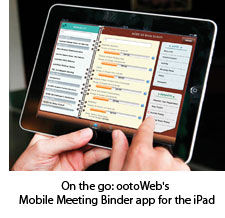 Newer platforms now are being built with the assumption that planners will be logging in from mobile devices. For example, ootoWeb, an attendee management and online registration platform, was released last summer. The "ooto" stands for "out of the office," and the platform was designed for mobile access: Sites are all optimized for mobile viewing, whether they offer log-in opportunities for planners to check attendee and housing information, or they are actual registration sites.
Attendees can register and pay from mobile devices just as easily as from their desktops. Apps for the iPhone and iPad are available free to ootoWeb subscribers (who currently pay $49 per month, per user, for the basic platform). The iPad app is designed to provide planners with immediate access to all of the data they might normally carry in paper form -- a Mobile Meeting Binder that potentially eliminates the need to carry traditional binders and folders.
• Meeting apps for attendees. Think of these as "electronic event programs plus." These event-specific apps may be downloaded by attendees, nearly always for free, and can include all of the speaker, scheduling, seminar, keynote and attendee information, along with exhibit floor maps, that might be found in a printed program. Additional features could include everything from social-media platform links to attendee messaging or local restaurant listings. (See Checklist for tips on preparing the necessary data for a show app.)
Cost to the event manager depends on the features and the amount of customization required. Apps range from free (e.g., some are offered to groups by host hotels) to more than $30,000 (for major events that require a lot of multimedia functionality and customization). Prices are coming down, though, especially as developers get more event-app experience and can offer template-based, standardized options that don't require additional development. "That should really be driving the cost down," notes Minneapolis-based event technology consultant Samuel J. Smith. "It depends on what you want to do, but I don't think people should even be considering paying $30,000 and up unless the app is going to be doing video and getting you drinks."
App use is gaining traction among attendees, particularly when event producers market it well. Toronto-based 5Touch Solutions, which makes the EventMobi app, has seen 70 percent of attendees download the app at some tech shows, according to president and founder Bob Vaez, and an average 40 to 60 percent download rate overall. Those numbers have grown quickly, says Vaez; as they continue to grow, so too will opportunities to generate revenue from the apps through sponsorships and advertising. Continued...
Social Media for Events Social media
facilitates interaction, networking and a dialog among participants --
goals not unlike those of many meetings. "Events are really the original
social media," says Corbin Ball, "and associations are the original
social-networking platforms. These things tie in very naturally."
Driven
by the mobile technology boom, social-media platforms now represent a
common way to quickly interact with large numbers of people, meaning
these are natural places for beginning a dialogue before a meeting or
continuing to communicate afterward. The explosion in popularity of the
major platforms makes them excellent media through which marketers can
reach their target audience. (For more, see Back to Basics, "Boost Attendance With Digital Ads.") Facebook boasts more than 500
million users, Twitter has 175 million and LinkedIn claims more than 85
million registered users.
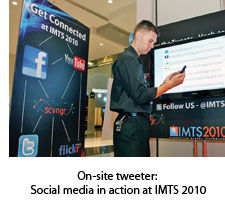 How they are being used. It's
becoming increasingly difficult to find people who haven't at least
tested the waters of social-media interaction, and many events, such as
the International Manufacturing Technology Show (IMTS) held last
September in Chicago, have experimented with Twitter-based communication
and Facebook pages. "The technology is very user-friendly," points out
St. Louis-based professional trade show presenter Emilie Barta. "I think
where people fail is in their strategy. Before you get on social
media," she adds, "you have to have a strategy." The aim is to have a
year-round conversation, not to push out information about one event.
How they are being used. It's
becoming increasingly difficult to find people who haven't at least
tested the waters of social-media interaction, and many events, such as
the International Manufacturing Technology Show (IMTS) held last
September in Chicago, have experimented with Twitter-based communication
and Facebook pages. "The technology is very user-friendly," points out
St. Louis-based professional trade show presenter Emilie Barta. "I think
where people fail is in their strategy. Before you get on social
media," she adds, "you have to have a strategy." The aim is to have a
year-round conversation, not to push out information about one event.
Social
media goes beyond these well-known platforms, and a number of
developers offer event-specific platforms. In these cases the sites are
more event-centric, but discussion still begins long before the
attendees arrive. Sites should go up well in advance of the event and
usually remain live for a year, at which point the content may be rolled
over for the next event. Pathable, CrowdVine and Zerista are among the
growing number of companies offering conference-
specific social media solutions.
Virtual/Hybrid Events
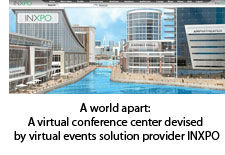
The age of the hybrid event, in which some kind of virtual component is
added to a physical event to engage off-site attendees, is upon us,
according to tech expert Michael Doyle.
 "We've reached the point
where just about any physical event could easily become a hybrid event,"
says Doyle, executive director of the Virtual Edge Institute, an
organization that promotes education about virtual technology, and event
director for the annual Virtual Edge Summit. "To bring in some kind of
remote audience, there are more solutions out there, at more price
points, than ever before. The simple addition of audio or video
streaming for some aspects of a physical event is really going to become
the norm by the end of this year. We're nearly at the point where
people will expect there is some way to tune in virtually if they can't
be at the physical event."
"We've reached the point
where just about any physical event could easily become a hybrid event,"
says Doyle, executive director of the Virtual Edge Institute, an
organization that promotes education about virtual technology, and event
director for the annual Virtual Edge Summit. "To bring in some kind of
remote audience, there are more solutions out there, at more price
points, than ever before. The simple addition of audio or video
streaming for some aspects of a physical event is really going to become
the norm by the end of this year. We're nearly at the point where
people will expect there is some way to tune in virtually if they can't
be at the physical event."
While the buzz about virtual and
hybrid events has been growing for several years, 2011 is the year in
which the technology will become mainstream, Doyle believes. He points
to the co-location this month of the Virtual Edge Summit with the annual
Professional Convention Managers Association meeting in Las Vegas,
indicating PCMA's acknowledgement that there is a real interest -- and
need -- for this education among its members. Doyle also notes that the
giant exhibition company Freeman recently launched a new business unit
devoted to virtual event solutions. "When you have companies that have
been around for 80 years in the trade show industry making this a core
offering, that to me is a signal that things have changed and there is a
market acceptance now that this is really a viable solution, and a
necessary solution," Doyle says.
How it's being used. A
wide variety of solutions are available, from basic (and free) streaming
options through full virtual show platforms and professional video
production houses. "I ask groups what they need, and what level of
engagement they're aiming for from remote attendees," Doyle explains.
For the basic desire to extend an event's reach, and to share
information with those who can't be in the room, he is all for low-cost
experimentation. "One thing we have seen is that people who can't attend
an event live generally are forgiving about the virtual production," he
notes. Doyle's belief is that as long as attendees know what to expect
and aren't misled about the production, they are grateful for the
opportunity to listen and watch.
What's next? For a glimpse at key meetings technologies to watch for in the future, see "What's Next in Meetings Tech."